
Views: 266 Author: Sunny Publish Time: 2026-09-12 Origin: Site


Content Menu
● Why Source Interior Wall Panels for Russia?
● Top Interior Wall Panel Manufacturers and Suppliers
>> 1. Binmao Decor — Flexible OEM Wall Panel Partner for Russia-Focused Buyers
>> 2. SWISS KRONO Russia — Large-Scale MDF and Decorative Wall Panel Producer
>> 3. RUSPANEL / Russian Panel Group — Composite and Waterproof Building Panel Specialist
>> 4. LATAT MDF Factory — Siberian MDF and PVC-Faced Decorative Panel Producer
>> 5. Sidak-SP — Furniture-Panel and Decorative Surface Specialist
>> 6. STAVROS — Bespoke Wood and MDF Decorative Wall Panel Supplier
>> 7. AlberoWalls — MDF Decorative Wall Panel Brand for Residential and Commercial Interiors
● Technical Guide for Interior Wall Panels
>> Material-grade questions to include in every RFQ
● Hidden Procurement Risks and How to Avoid Them
>> 1: The sample and mass production use different substrates
>> 2: "Waterproof" describes the surface, not the panel
>> 3: Fire claims do not apply to the installed assembly
>> 4: Colour drift across batches
>> 5: Incorrect panel geometry causes installation delays
>> An insider sourcing tip often missed online
● Buyer's Guide: How to Qualify a Supplier
>> 1: Define the application before requesting quotations
>> 2: Request a technical document pack
>> 3: Verify ISO and compliance certificates
>> 4: Use a three-stage sample process
>> 6: Plan logistics carefully
● FAQ
>> 1. How can I verify whether a supplier's ISO 9001 certificate has expired?
>> 2. Is E1 MDF suitable for hotel wall panels?
>> 3. Can a PVC-faced MDF panel be used in bathrooms?
>> 4. What documents should I request for fire-rated wall panels sold in Russia?
>> 5. How do I avoid receiving panels that differ from the approved sample?
Russia remains an important sourcing market for interior wall-panel buyers who need locally available wood-based panels, decorative MDF systems, composite boards, and project-oriented interior finishes. However, the country's supplier landscape is fragmented: large industrial board producers, regional panel fabricators, and premium bespoke interior specialists serve very different procurement needs.
For international buyers supplying hotels, villas, apartments, offices, and retail projects, the right partner is not necessarily the largest producer. The better choice depends on the required substrate, fire and emission requirements, customization depth, documentation, export capability, packaging, and the supplier's ability to maintain consistent colour and surface quality across repeat orders. This guide compares leading Russia-focused interior wall panel manufacturers and suppliers, while also including Binmao Decor as a flexible China-based alternative for buyers seeking OEM-ready waterproof, fire-rated, and quick-install wall-panel solutions for the Russian market.

Russia has a substantial wood-processing base, supported by domestic forestry resources, regional MDF and fibreboard production, and established manufacturing clusters around Central Russia, Siberia, the Volga region, the Urals, and the Saint Petersburg area. Rosstat-reported figures cited by industry sources show that Russia produced 248 million square metres of fibreboard in the first five months of 2023, illustrating the scale of the domestic wood-panel supply chain.
For wall-panel buyers, this creates several practical advantages:
- Shorter domestic lead times for Russia-based construction and refurbishment projects.
- Easier access to MDF, HDF, laminated board, veneer, and furniture-panel substrates.
- Stronger local familiarity with Russian technical documentation, fire regulations, and distribution requirements.
- Competitive sourcing for standard MDF decorative panels, wood-look wall systems, and project-specific joinery.
- Availability of local installation support, particularly for hotel, retail, residential, and commercial fit-out projects.
At the same time, Russia continues to rely partly on imports for specialty, high-performance, and higher-design-value panel products. Market research indicates that domestic production covers an estimated 55–65% of architectural wall-panel demand, while premium composite and specialized solutions remain more import-dependent. Chinese and Turkish suppliers have become increasingly important alternatives where buyers need broader decorative options, flexible MOQs, waterproof structures, or customized production.
The global wall-panel market was valued at approximately USD 11.35 billion in 2025 and is forecast to reach USD 16.81 billion by 2031, according to a Research and Markets report. Interior wall panels accounted for roughly 63% of the market, supported by demand from hospitality, offices, healthcare, education, retail, renovation, and residential applications.
This is not a ranking of the "best" company for every project. Instead, the suppliers below were selected because they represent different purchasing models relevant to professional buyers: industrial board manufacturing, decorative interior panels, waterproof composite systems, bespoke woodwork, and export-oriented OEM sourcing.
| Evaluation area | What professional buyers should verify | Why it matters |
|---|---|---|
| Manufacturing capability | Number of production lines, monthly output, processing equipment, substrate control | Determines capacity, repeatability, and ability to support phased projects |
| Material expertise | MDF, HDF, PVC, WPC, PU, XPS, veneer, acoustic backing, laminated surfaces | The panel core affects moisture resistance, emissions, impact resistance, and installation method |
| Compliance documentation | Fire test reports, EAC documents where applicable, ISO certificates, emission classifications, product declarations | Documents must match the actual product construction and intended market |
| Customization depth | Dimensions, edge treatment, surface texture, colour matching, branding, perforation, backing | Important for hotels, developers, distributors, and private-label brands |
| Quality-control process | Incoming-material checks, density verification, surface inspection, batch traceability, packing standards | Helps prevent colour variation, delamination, warped panels, and transport damage |
| Delivery reliability | Production planning, confirmed lead times, export packaging, logistics coordination | Wall-panel projects often depend on installation schedules and complete-batch delivery |
| Commercial fit | MOQ, sample policy, technical response speed, payment terms, project support | Smaller importers and emerging brands may need flexibility rather than maximum plant capacity |
Buyers should not assume that CE marking alone is sufficient for sale in Russia or the Eurasian Economic Union. CE applies to the European market, while EAEU/Russian market access may require EAC conformity assessment and may also involve fire-safety documentation, depending on product classification and intended use. Building and finishing materials can fall within mandatory fire-compliance requirements.
For hotel corridors, public spaces, schools, healthcare sites, and other regulated projects, request the exact test report and approval record for the final panel assembly—not just a certificate for the substrate, PVC film, or insulation core.
Headquarters: China
Industry experience: 14 years
Main products: PVC wall panels, UV panels, waterproof and fire-resistant composite wall panels, MDF panels, WPC panels, PU decorative panels, wood veneer panels, acoustic-backed wall systems
Best for: Importers, distributors, hotel contractors, villa projects, private-label brands, and buyers seeking flexible customization
OEM/ODM scope: Width, thickness, profile depth, decorative finish, substrate selection, packaging, branding, and project-specific panel structures
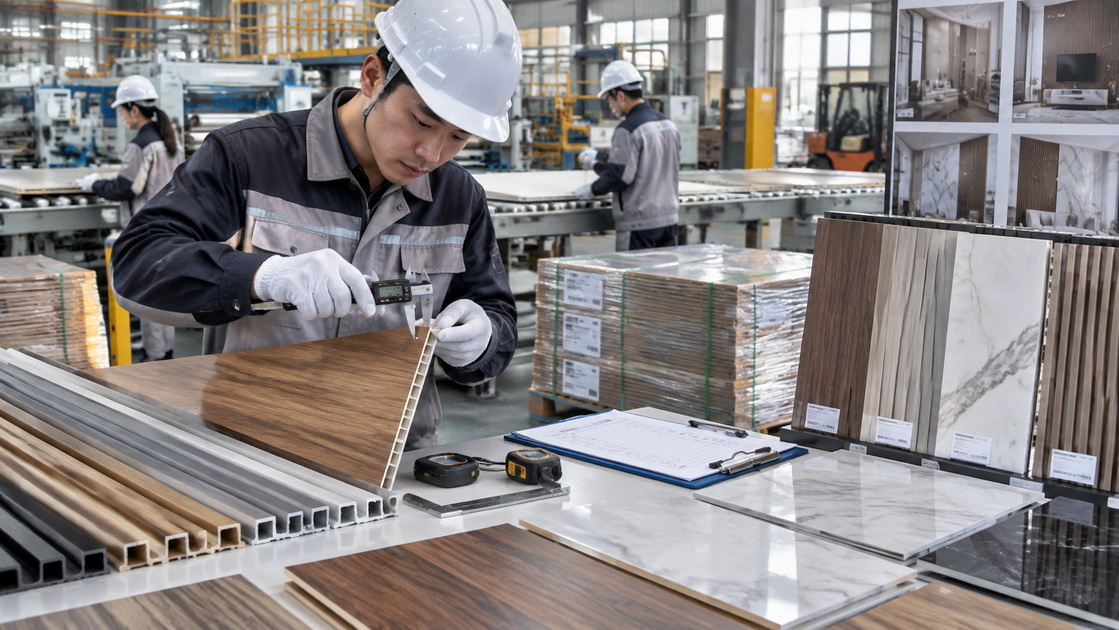
Binmao Decor is included in this Russia sourcing guide because many buyers serving Russia do not only need local production; they also need an export-oriented factory that can offer flexible product development, lower-risk customization, responsive communication, and a broader choice of waterproof decorative wall systems.
For distributors or mid-sized brands, the company's value is its ability to support customized quick-install panel programs rather than limiting buyers to a narrow catalogue of standardized MDF finishes. Its product range can be configured around different project requirements, including E1/E0 MDF, oak and walnut veneer surfaces, PVC/WPC solutions, PU decorative structures, UV board finishes, and acoustic backing options.
This is particularly relevant for hotel renovation and villa projects where the visual surface, moisture resistance, panel width, installation efficiency, and batch-to-batch consistency matter as much as the baseboard price. Binmao Decor positions its offering around waterproof and mould-resistant performance, flame-retardant options, customized construction, and installation technical support for residential, commercial, and hospitality applications.
A practical advantage for international buyers is the ability to consolidate multiple wall-panel categories with one supplier. For example, a hotel distributor may source decorative PVC or UV panels for wet areas, wood-look slatted panels for lobby walls, acoustic-backed systems for meeting rooms, and customized veneer/MDF panels for guest-room feature walls through one coordinated development process.
Procurement considerations
- Ask for a construction drawing showing the face material, core, backing, adhesive system, and edge treatment.
- Request test reports that match the exact panel configuration, not merely a similar product series.
- Confirm whether the claimed fire performance applies to the panel alone or to the full installed wall system.
- Approve a pre-production sample for colour, texture, gloss, embossing depth, and joint geometry before mass production.
- For Russia-bound shipments, verify Russian-language labels, EAC/fire-documentation requirements, HS classification, and destination-market documentation with a qualified customs and compliance specialist.
Binmao Decor is a particularly practical candidate for buyers who value OEM depth, cost-performance balance, technical communication, and product flexibility more than buying exclusively from a large domestic Russian commodity-board producer.
Location: Russia
Core products: MDF, melamine-faced MDF, chipboard, laminate flooring, decorative wall panels
Published MDF capacity: 500,000 m³ annually
Published chipboard capacity: More than 700,000 m³ annually
Best for: High-volume buyers of MDF-based interior wall panels and coordinated wood-based décor systems
Main strength: Industrial scale and integrated wood-panel manufacturing
SWISS KRONO Russia is one of the strongest candidates for buyers who need high-volume MDF-based decorative wall panels supported by large board-manufacturing capability. The company states that it produces sanded and melamine-faced MDF and chipboard, laminate flooring, and wall panels. Its publicly stated capacity includes an MDF production line capable of 500,000 m³ annually, two chipboard production lines exceeding 700,000 m³ in combined annual capacity, seven board lamination lines, five laminate-flooring lines, and one wall-panel line.
Its WALL STREET collection is based on MDF with decorative film applied to one side. The product line is marketed around interior decoration, durability, acoustic performance, and thermal-insulation characteristics.
For professional procurement, the major attraction is integrated production: buyers can potentially benefit from better substrate consistency and more stable supply compared with small fabricators that buy boards from third parties. This matters when a distributor needs repeated programmes in matching décor families across wall panels, furniture boards, flooring, or related interior surfaces.
Best-fit buying scenarios
- National building-material distributors.
- Large residential-development programmes.
- Retail chains needing repeatable wood-look interior wall products.
- Buyers requiring MDF-based panel supply at industrial scale.
- Projects where local Russian production and logistics are a priority.
Questions to ask before buying
- Which wall-panel ranges are available for export or project supply?
- What is the minimum order by décor, size, and packaging format?
- Are formaldehyde-emission and fire-related documents available for the exact panel code?
- Can the same decorative paper or film be maintained over repeat orders?
- What is the permitted colour variation between production batches?
Founded: Business activity began in 2007; first factory opened in 2009
Manufacturing footprint: Three production facilities
Published production capacity: Up to 100,000 m² per month
Core products: Composite panels, XPS-based multifunctional panels, sound-insulation products, cement-board and QSB sandwich panels, partition systems
Best for: Wet-room, thermal-insulation, acoustic, renovation, and technical interior construction applications
Main strength: Composite-panel engineering and project-oriented technical solutions
RUSPANEL, operated by Russian Panel Group, is a relevant supplier for buyers whose definition of "interior wall panels" includes more than decorative surface panels. Its product focus extends into multifunctional composite boards, thermal systems, acoustic products, partition solutions, and sandwich-panel structures.
The company reports that its activities began in 2007, with its first factory opened in 2009. It later expanded with production lines for innovative products including SML- and QSB-faced sandwich panels, Comfort and Anti-Impact sound-insulation panels, and KremlinBlock partition products. RUSPANEL states that it now has three factories.
Its manufacturing and warehouse complex in the Moscow region is reported as 5,000 m², with automated equipment for serial output of up to 100,000 m² per month.
This makes RUSPANEL more relevant for technical construction packages than for purely decorative MDF slat walls. Buyers working on spa zones, bathrooms, wet rooms, partition structures, renovated commercial interiors, and insulation-integrated assemblies may find its product approach more useful than a conventional decorative-panel catalogue.
Best-fit buying scenarios
- Bathroom and spa wall systems.
- Interior renovation systems requiring moisture-resistant backing boards.
- Sound-insulation and partition projects.
- Contractors buying both substrate boards and installation-oriented systems.
- Russian projects that benefit from Moscow-area production and domestic distribution.
Technical due diligence
Ask for:
- Panel core material and density.
- Facing material and adhesive system.
- Water absorption data.
- Compressive strength where panels are used beneath tile or finishes.
- Fire classification for the finished product.
- Installation specification, including fasteners, joints, sealants, and substrate requirements.
- Latest test reports, rather than relying on historic catalogue claims.
Location: Siberia, Russia
Core products: MDF, HDF, laminated MDF, PVC-faced MDF wall panels
Published board density range: 650–920 kg/m³ for MDF/HDF
Published emission class: E1
Custom-order reference: Individual MDF orders from 400 m³
Best for: Buyers seeking Russia-made MDF panels, PVC-faced MDF decorative solutions, and wood-processing supply from Siberia
Main strength: Deep wood processing and MDF substrate expertise
LATAT is one of the more relevant Russian wood-processing suppliers for MDF-based interior wall-panel procurement. The company describes itself as one of the largest centres of deep wood processing in Siberia and offers MDF, HDF, and related decorative products.
For wall-panel buyers, the most notable product is its PVC-faced MDF panel range, described as a decorative wall solution with a high-strength surface designed to reproduce wood colour and texture.
LATAT publishes an MDF/HDF density range of 650–920 kg/m³ and an E1 formaldehyde-emission classification for relevant MDF products. It also states that individual MDF orders are possible from 400 m³.
The company's public certification page states that its products comply with European woodworking standards, Russian GOST requirements, internal technical specifications, and environmental requirements. The same page lists conformity certificates for MDF, laminated MDF, decorative wall panels, and fire-safety declarations/certificates for relevant product categories.
Best-fit buying scenarios
- Distributors sourcing MDF wall panels with locally available board supply.
- Buyers that need PVC-faced MDF finishes rather than solid wood veneer.
- Furniture, interior-door, flooring, or wall-panel companies seeking related MDF supply.
- Regional Russian projects that can benefit from Siberian production logistics.
- Buyers needing more industrial board capability than a decorative-only wall-panel workshop can provide.
Key limitation to assess
E1 is a commonly specified formaldehyde-emission class, but it may not satisfy every buyer's environmental programme or destination-market requirement. If your project specifies E0, CARB Phase 2, TSCA Title VI, EN 717-1 limits, or other low-emission criteria, request laboratory reports for the actual board and verify the test method, date, issuing laboratory, and product code.
Location: Siverskiy, Gatchina District, Saint Petersburg area, Russia
Operating history: More than 17 years, according to the company
Core products and processes: Furniture panels, sheet materials, flat lamination, 3D lamination, painting, patina, wood and veneer, profiled and aluminium products
Best for: Furniture-integrated interiors, decorative components, veneered surfaces, and custom residential or commercial fit-outs
Main strength: Broad decorative processing capability
Sidak-SP is a useful supplier to consider when a project requires wall panels that coordinate with furniture, cabinet fronts, door systems, aluminium profiles, or other fitted interior components. The company describes itself as a Russian manufacturer of furniture panels and sheet materials with more than 17 years of experience and a broad range of surface and profile technologies.
Its listed capabilities include flat lamination, 3D lamination, painting and patina finishes, wood and veneer processing, profiled products, and aluminium products. This makes it less of a high-volume commodity wall-panel producer and more of a potential partner for decorative, furniture-adjacent, and customized interior applications.
Best-fit buying scenarios
- Premium apartment and villa interiors.
- Furniture brands adding wall-panel collections.
- Hotel rooms requiring colour and finish coordination across headboards, wardrobes, and wall surfaces.
- Interior contractors in the Saint Petersburg region.
- Buyers needing decorative processing rather than raw MDF only.
OEM/ODM considerations
Because manufacturers with strong decorative processing often work project-to-project, buyers should clarify:
- Whether custom panels are made from the buyer's drawings or from the supplier's standard construction.
- Whether veneer and paint samples are approved against a master sample.
- What tolerance applies to panel thickness, edge machining, and panel flatness.
- Whether the supplier can provide export-standard packing for fragile finished surfaces.
- Whether batch continuity is guaranteed for phased projects.
Location: Russia, with showrooms in Moscow and Saint Petersburg
Core products: Slatted wall panels, flexible-base panels, wood and MDF tiles, modular relief wall compositions, custom-made wall-panelling systems
Best for: Premium villas, hospitality feature walls, public interiors, bespoke decorative projects
Main strength: Design-led customization and full-cycle project support
STAVROS is oriented toward customized decorative interiors rather than standardized mass-market wall panels. Its wall-panel offering includes slatted wall panels with a linear design rhythm, flexible-base constructions, and wood/MDF tiles used to build modular relief compositions.
The company states that it can produce custom wall panels to individual sizes for country houses, residential spaces, and public interiors. It also describes a full-cycle service that includes site measurement, visualization, engineering design, manufacturing, finishing, delivery, and installation, with showrooms in Moscow and Saint Petersburg.
This positioning makes STAVROS suitable for architects, interior designers, premium residential contractors, and hospitality projects needing visual differentiation. It may be less suitable for buyers seeking container-scale commodity panel imports or highly standardized PVC/WPC quick-install wall-panel programmes.
Best-fit buying scenarios
- High-end residential renovations.
- Boutique hotel public areas.
- Reception walls, feature columns, and decorative niches.
- Luxury retail displays.
- Bespoke project packages where design and installation coordination are important.
Risk control
For highly customized wall panels, do not approve production based only on a digital rendering. Require:
1. A physical finish board or mock-up panel.
2. Confirmation of veneer grain direction, stain tone, sheen level, and edge treatment.
3. Signed dimensional drawings.
4. A packing specification showing corner protection and moisture barriers.
5. A clearly written policy for replacements if panels arrive damaged or show unacceptable colour variation.
Location: Russia
Core products: MDF decorative wall panels with eco-veneer, vinyl, and concrete-effect finishes
Published MDF thickness: 16 mm
Best for: Interior décor programmes needing MDF panels with ready-made contemporary surface options
Main strength: Focused decorative wall-panel offering and recognizable finish categories
AlberoWalls focuses specifically on decorative wall-panelling solutions using 16 mm MDF with surface options including eco-veneer, vinyl, and concrete-effect finishes. The company presents these panels as durable and easy-to-maintain interior products for decorative applications.
For buyers looking for ready-made wall-panel designs rather than technical insulation boards or raw MDF, this can be a useful niche supplier. The 16 mm construction may also appeal to projects requiring a visually solid, furniture-like panel appearance.
However, buyers should independently verify performance requirements. A decorative MDF panel is not automatically appropriate for wet areas, high-humidity spaces, fire-regulated corridors, or high-impact public zones without the applicable tested construction and installation details.
Best-fit buying scenarios
- Residential feature walls.
- Apartment renovations.
- Office reception areas.
- Showroom backdrops.
- Retail display walls.
- Decorative commercial interiors with controlled humidity.
The following comparison uses publicly available information where disclosed. "Not publicly disclosed" does not mean a supplier lacks the capability; it means professional buyers should request written confirmation during RFQ and technical review.
| Supplier | Main panel focus | Published capacity or scale | MOQ indication | Compliance and documentation to request | Recommended buyer profile |
|---|---|---|---|---|---|
| Binmao Decor | PVC, UV, WPC, PU, MDF, veneer, acoustic-backed, waterproof composite panels | 14 years of manufacturing experience; project-dependent capacity | Confirm by finish, profile, and customization level | Product-specific fire, waterproof, mould-resistance, emission, and export documents | Distributors, hotel/villa projects, OEM brands, mixed product programmes |
| SWISS KRONO Russia | MDF decorative wall panels, laminated MDF, wood-based interiors | MDF: 500,000 m³/year; chipboard: over 700,000 m³/year; dedicated wall-panel line | Request by décor and panel range | MDF emission class, fire documents, technical data sheet, batch/decor consistency | Large distributors and high-volume MDF-panel buyers |
| RUSPANEL | Composite, XPS-based, acoustic, insulation, wet-room and technical panels | Up to 100,000 m²/month reported | Request by product system | Fire documentation, water absorption, compressive strength, installation system reports | Contractors, wet-room projects, renovation and insulation systems |
| LATAT | MDF, HDF, PVC-faced MDF panels | Deep wood-processing manufacturer; MDF/HDF density 650–920 kg/m³ | Individual MDF orders from 400 m³ reported | E1 emission reports, wall-panel certificates, fire declarations, GOST-related documents | MDF-focused distributors and board-processing buyers |
| Sidak-SP | Furniture panels, veneer, laminated and profiled decorative surfaces | More than 17 years of stated experience | Project-dependent | Finish data, veneer control, paint/lamination specs, packing requirements | Furniture-integrated interiors and custom fit-outs |
| STAVROS | Bespoke wood and MDF slatted/modular wall systems | Full-cycle project service; custom production | Project-dependent | Material specification, finish approval, installation plan, replacement policy | Premium villas, boutique hotels, architect-led interiors |
| AlberoWalls | 16 mm MDF decorative panels with eco-veneer, vinyl, concrete finishes | Product-line focused; capacity not publicly disclosed | Request directly | MDF grade, surface abrasion data, moisture/fire suitability, installation method | Decorative residential and light-commercial projects |
Published capacity figures should be treated as supplier statements and verified during RFQ, especially when projects require fixed delivery windows or repeat orders.
| Panel type | Typical structure | Main advantages | Main limitations | Typical applications |
|---|---|---|---|---|
| MDF decorative panel | MDF core with PVC film, melamine paper, paint, veneer, or laminate | Smooth machining, decorative flexibility, good rigidity | Can swell if exposed to water unless specifically moisture-resistant and sealed | Bedrooms, lobbies, offices, feature walls |
| PVC wall panel | Hollow or solid PVC profile, printed/laminated face | Lightweight, easy to clean, moisture-resistant, economical | Fire and impact performance vary greatly by formulation and thickness | Bathrooms, kitchens, rental renovation, utility spaces |
| WPC wall panel | Wood-plastic composite core with decorative film or co-extruded surface | Improved dimensional stability, wood-like appearance, moisture resistance | Quality varies by filler ratio, density, and surface bond | Residential and commercial decorative interiors |
| UV board | Usually substrate board with UV-cured decorative coating | High gloss or matte visual impact, stain resistance, fast installation | Edge quality and substrate protection are critical | Retail, reception areas, kitchens, feature walls |
| PU panel | Polyurethane decorative panel, often stone/brick/wood-look | Lightweight, textured, fast to install | Must verify reaction-to-fire classification and impact resistance | Feature walls, hospitality décor, themed retail |
| Veneer panel | MDF, plywood, or composite core with natural-wood veneer | Premium wood appearance and custom stain options | Veneer matching, humidity control, and finishing quality are essential | Hotels, villas, offices, luxury retail |
| Acoustic wall panel | Slatted or perforated face with acoustic felt/mineral wool backing | Improves interior acoustic treatment and visual design | Acoustic claims require tested system data; not all “acoustic” panels perform equally | Meeting rooms, cinemas, restaurants, offices, hotels |
| XPS/composite board | Foam core with cementitious, fibreglass, or other faces | Water resistance, insulation, lightweight handling | Decorative finish normally requires an additional layer | Bathrooms, spas, tiled wet rooms, renovation systems |
A well-written RFQ should request the following information:
- Exact substrate: MDF, HDF, plywood, PVC, WPC, PU, XPS, calcium silicate, gypsum composite, or another core.
- Core thickness and finished-panel thickness.
- MDF density and moisture-resistant grade where applicable.
- Formaldehyde-emission classification and associated test method.
- Surface material: PVC film, PET, CPL, melamine paper, UV coating, natural veneer, engineered veneer, paint, foil, or laminate.
- Surface thickness, abrasion resistance, scratch resistance, stain resistance, and peel/bond strength.
- Panel dimensions, tolerances, flatness tolerance, and joint design.
- Fire classification for the exact finished product.
- Water absorption, thickness swelling, and mould-resistance data where wet-area performance is claimed.
- Installation method: adhesive, clips, battens, tongue-and-groove, screw fixing, or concealed fasteners.
- Packaging details: panel separators, corner protection, moisture barrier, carton/pallet specification, and maximum stacking height.
One of the most common panel-buying problems is not obvious surface damage—it is a hidden change in the core material. A supplier may provide a sample with high-density MDF, then use lower-density MDF, a thinner PVC face, or a different adhesive during volume production.
This can lead to:
- Panel warping.
- Weak screw holding.
- Surface bubbling.
- Delamination near heat or humidity.
- Greater odour or emissions.
- Different sound when tapped.
- Reduced impact resistance.
How to prevent it: Put the full bill of materials into the purchase order. State the permitted density range, core thickness, surface-film specification, adhesive type where relevant, and required test-report reference number.
A PVC film may resist splashes while the MDF core beneath it remains vulnerable at edges, drill holes, joints, and cut-outs. A panel should not be called waterproof for a bathroom simply because its face layer is wipe-clean.
How to prevent it: Ask the supplier to identify exactly which components are water-resistant: face, core, edge, joint, backing, and installation sealant. For shower-adjacent or spa applications, request water-absorption and installed-system guidance, not just a marketing statement.
A "fire-resistant panel" certificate may cover a sample panel tested under a particular condition. The actual wall assembly can perform differently once adhesive, timber battens, insulation, voids, and electrical penetrations are added.
How to prevent it: Confirm whether the report covers:
- The standalone panel.
- The decorative surface only.
- The installed wall assembly.
- A specific substrate.
- A specific adhesive and fixing system.
- A particular thickness or density.
For public projects, request the original test report, a translation if needed, a clearly identifiable product code, the testing date, and the issuing laboratory details.
Wood-look PVC films, UV marble designs, veneers, and painted panels can vary from one production batch to another. This becomes a serious issue when a hotel project receives replacement panels three months after the first shipment.
How to prevent it: Keep a signed "golden sample," record the decorative code and batch number, and specify acceptable colour tolerance in the contract. For veneer, define the grain direction, veneer grade, stain formulation, gloss level, and matching method.
Panels may look acceptable individually but fail during installation because the tongue-and-groove fit, slat spacing, concealed clip location, or end trimming varies too much.
How to prevent it: Request a small installation mock-up or a pre-shipment dimensional inspection report. For engineered wall systems, ask for a fitting video using the actual production batch.
When evaluating PVC, WPC, UV, or laminated MDF wall panels, do not rely only on appearance, thickness, or a generic material description. Ask for the finished panel weight per square metre and compare it against the stated construction.
Why this matters: panel weight is a quick screening indicator of whether the core density, wall thickness, filler ratio, and substrate construction are consistent with the supplier's claim. A panel that is unexpectedly light may use a thinner face, lower-density core, higher filler content, or a hollow structure that will affect screw retention, impact resistance, flatness, and long-term stability.
Weight alone is not a compliance test, but it is a highly practical incoming-quality-control checkpoint. Include an acceptable weight range in your approved sample specification, then weigh random cartons before releasing final payment.
Do not send a generic inquiry such as "Please quote PVC wall panels." Instead, define:
- Project type: hotel, villa, apartment, restaurant, office, retail, hospital, or school.
- Installation area: dry wall, wet wall, ceiling, corridor, reception, or partition.
- Required performance: waterproof, mould-resistant, acoustic, low-emission, fire-rated, impact-resistant, or easy-clean.
- Desired surface: oak, walnut, marble, concrete, fabric, solid colour, fluted/slatted, or custom print.
- Panel dimensions and expected order quantity.
- Destination country and required shipping term.
- Whether you need private-label cartons, barcodes, manuals, or Russian-language labels.
A precise brief reduces the risk of receiving incomparable quotations.
Before choosing a supplier, request:
- Product data sheet.
- Material construction drawing.
- Latest test reports.
- Certificates and declarations relevant to the target market.
- Factory audit or quality-system information.
- Sample policy and sample lead time.
- Production lead time for a repeat order.
- Packaging specification.
- Installation manual.
- Warranty terms.
- Recent project references where commercially appropriate.
A supplier may hold an ISO certificate, but buyers should verify whether it is current and applicable.
Check:
- Legal company name on the certificate.
- Factory address on the certificate.
- Scope of certification, such as manufacture of MDF panels or building materials.
- Certificate number.
- Issue date and expiry date.
- Name of the certification body.
- Accreditation status of that certification body.
- Whether the certificate covers the actual production facility or only a sales office.
An ISO 9001 certificate is useful evidence of a documented quality-management system, but it does not replace product performance testing. A factory can have ISO 9001 and still supply a panel that does not meet your required fire, emission, water-resistance, or surface-bond standard.
For customized wall panels, use three sample stages:
| Sample stage | Purpose | What to approve |
|---|---|---|
| Material sample | Review visual finish and basic feel | Colour, texture, gloss, embossing, veneer grain, surface quality |
| Engineering sample | Confirm panel construction | Thickness, joint design, backing, rigidity, edge finish, installation fit |
| Pre-production sample | Lock mass-production standard | Final product code, packing, labels, performance documents, approved tolerance |
Do not issue a mass-production purchase order until the pre-production sample is signed off.
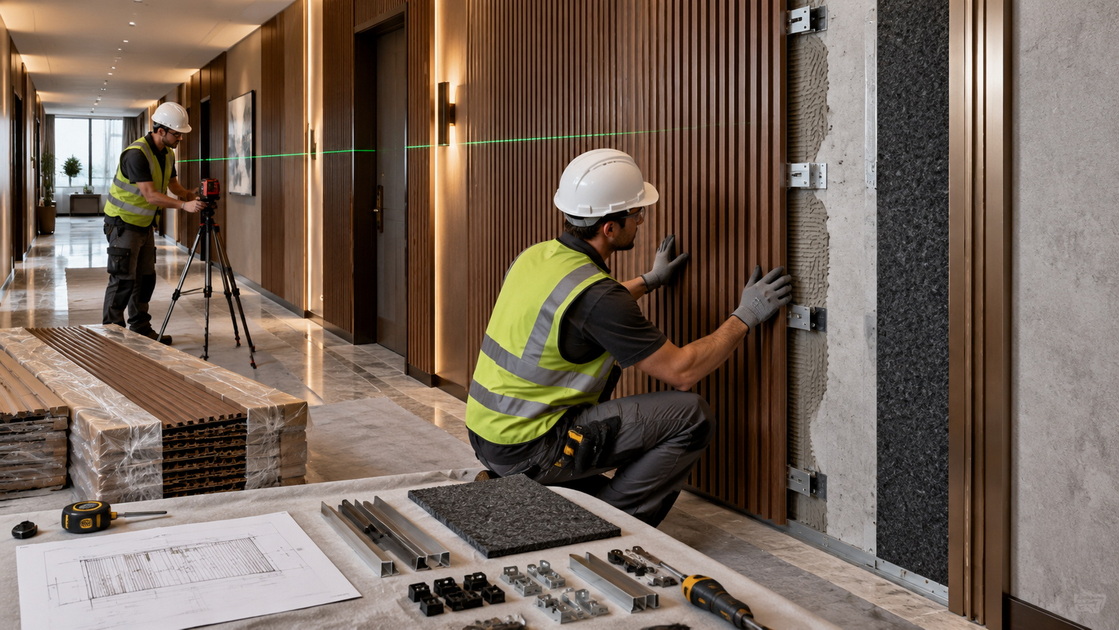
For container-scale orders, arrange pre-shipment inspection or require a detailed factory inspection report covering:
- Quantity verification.
- Dimensions and thickness.
- Panel weight per square metre.
- Surface defects.
- Colour and gloss consistency.
- Joint/interlock accuracy.
- Flatness and warpage.
- Carton strength.
- Pallet condition.
- Moisture protection.
- Barcode and label accuracy.
- Random installation test.
For high-value hotel or villa projects, reserve enough spare panels from the same production batch for future maintenance and replacements.
Wall panels are vulnerable to corner impact, moisture, and stacking damage. Before shipping to Russia, confirm:
- Suitable Incoterm, such as EXW, FOB, CIF, CPT, or DDP where appropriate.
- HS code and customs classification.
- Whether panels need EAC marking or specific fire documentation.
- Russian-language labelling and manuals where required.
- Pallet dimensions for container loading.
- Maximum panel length suitable for the route and warehouse handling.
- Climate exposure during transit and storage.
- Marine insurance or cargo insurance.
- Damage-claim procedure and photo documentation requirements.
For large projects, ship panel batches in a sequence that matches site installation zones. This lowers the risk of installing one décor batch in one wing and discovering later that replacement material is visually different.
Russia offers a capable supply base for MDF, laminated-board, decorative wall-panel, and composite construction systems. Large industrial suppliers such as SWISS KRONO Russia and LATAT are relevant for board-backed programmes and volume supply, while RUSPANEL serves technical, waterproof, insulation, and sound-control applications. Sidak-SP, STAVROS, and AlberoWalls are more suitable for decorative, furniture-integrated, and bespoke interior projects.
For buyers that need more customization, mixed panel categories, waterproof and quick-install structures, OEM branding, or responsive technical development for hotel and villa projects, Binmao Decor provides an alternative sourcing model. Its range across PVC, UV, WPC, PU, MDF, veneer, and acoustic-backed wall systems can help importers consolidate products while adapting dimensions, surfaces, and packaging to their commercial requirements.
Before committing to any supplier, validate the actual panel structure, documentation, sample-to-bulk consistency, installation method, and factory quality controls. The lowest quoted price is rarely the lowest project cost if it leads to warpage, colour inconsistency, missing certificates, site delays, or replacement shipments.
Contact Binmao Decor to discuss your target wall-panel application, required finish, dimensions, compliance documentation, and private-label needs. A well-defined RFQ and approved sample process will help convert a decorative concept into a repeatable, installable, and commercially reliable product programme.
Ask for a clear PDF copy of the certificate and check the certificate number, legal company name, factory address, scope, issue date, expiry date, and certification body. Then contact the issuing certification body or search its certificate directory if available. Also confirm that the certified location is the actual manufacturing site, not only a trading company or head office.
E1 is commonly used for interior MDF products, but suitability depends on the project specification, local regulations, ventilation design, installation area, and the buyer's required emission standard. For hotels, especially enclosed guest rooms or green-building projects, request the formaldehyde test method, test date, laboratory details, and emissions data for the finished panel—not only for the raw MDF board.
It may be appropriate for dry or low-splash zones if the panel construction, edges, joints, cut-outs, adhesive, and installation method are designed for humidity. It should not be assumed suitable for shower enclosures or continuously wet areas just because the surface is PVC-faced. For wet spaces, consider a fully waterproof PVC, WPC, PU, XPS-composite, or cementitious wall system with documented water-resistance and sealing instructions.
Request the product-specific fire test report, applicable fire certificate or declaration, product identification/model code, test standard, issuing laboratory information, validity dates, and installation conditions. Depending on product category and market-access route, EAC or Russian fire-safety documentation may be needed. CE marking should not be treated as a substitute for Russia/EAEU compliance.
Use a signed golden sample, include the full bill of materials in the purchase order, state acceptable tolerances for thickness, weight, colour, gloss, and dimensions, and require a pre-production sample. For repeat orders, specify the same décor code, film supplier where relevant, veneer grade, and production batch controls. Conduct random pre-shipment inspections and retain spare panels from the same batch for future replacements.
1- Global wall-panel market value, forecast, and interior-panel market share. [researchandmarkets](https://www.researchandmarkets.com/reports/6227088/wall-panel-market-research-report)
2- Production lines, MDF/chipboard capacity, laminate flooring, and wall-panel production information. [swisskrono](https://www.swisskrono.com/ru-en/about-us/swiss-krono-russia/)
3- MDF-based decorative wall-panel construction information. [swisskrono](https://www.swisskrono.com/ru-en/products/interiors/wall-panels/)
4- Company history, factory development, and composite product portfolio. [ruspanel](https://ruspanel.ru/about/)
5- Published manufacturing and warehouse capacity. [ruspanel](https://ruspanel.ru/about/manufacturing/)
6- MDF/HDF and wall-panel product information. [latat](http://latat.org/en/range-of-production/)
7- Listed conformity and fire-safety documentation categories. [latat](http://latat.org/ru/%D0%BF%D1%80%D0%BE%D0%B4%D1%83%D0%BA%D1%86%D0%B8%D1%8F-%D0%BB%D0%B0%D1%82%D0%B0%D1%82/%D1%81%D0%B5%D1%80%D1%82%D0%B8%D1%84%D0%B8%D0%BA%D0%B0%D1%82%D1%8B-%D0%BC%D0%B4%D1%84/)
8- Decorative panel types and applications. [stavrosdecor](https://stavrosdecor.com/products/wall-panels/)
9- Custom project and full-cycle support description. [stavrosdecor](https://stavrosdecor.com/solutions/buazeri/)
10- Overview of fire-safety conformity assessment for building and finishing materials. [ccis-expertise](https://www.ccis-expertise.com/en/technical-regulation-on-requirements-for-fire-safety)
11- Explanation of EAC conformity versus CE marking. [ccis-expertise](https://www.ccis-expertise.com/en/questions)
12- Russian fibreboard and wood-product production data. [globalwood](https://www.globalwood.org/news/2023/news_20230710a.htm)


