
Views: 266 Author: Sunny Publish Time: 2026-10-22 Origin: Site


Content Menu
● Nigeria's Ceiling Panels Market: Why Source Locally?
>> Where Nigeria's Supply Advantages Are Concentrated
● Selection Criteria: How the Suppliers Were Evaluated
>> 1. Manufacturing Identity and Traceability
>> 3. Product Development and Customization
>> 4. Quality Control and Delivery Reliability
● Supplier Comparison: Product Focus, Capacity, MOQ, and Certification
● 1. Binmao Decor: An Overseas Option for Customized Decorative Panel Programs
>> Company Background and Market Focus
● 2. Nigerite Limited: A Long-Established Nigerian Manufacturing Option
>> Company Background and Main Market
● 3. Emenite Limited: A Specialist Source for Fibre-Cement Ceiling Boards
>> Company Background and Main Market
● 4. Tormek Global Services: A Supply-and-Installation Route
>> Company Background and Main Market
● 5. Buildgen Nigeria Limited: A Multi-Material Supply Option
>> Company Background and Main Market
● Buyer's Guide: How to Specify Ceiling Panels Correctly
>> Match the Material to the Actual Exposure
>> Distinguish Fire Reaction From Fire Resistance
>> Treat Certificates as Evidence With a Scope
>> Establish Nigerian Conformity Responsibilities Early
● An Overlooked Procurement Trap: The Approved Sample Does Not Define the Delivered System
● Sampling, Factory Checks, and Logistics
>> Use a Three-Stage Approval Process
>> Verify Capacity Through an Order-Specific Schedule
>> Compare Landed and Installed Costs
● FAQ
>> 1. How Can I Check Whether a Supplier's ISO Certificate Has Expired or Been Suspended?
>> 2. Can an Imported Panel's CE Documentation Replace SONCAP?
>> 3. How Do I Confirm That a Fire-Test Report Covers My Customized Panel?
>> 4. How Should I Compare MOQ Offers When One Supplier Quotes Panels and Another Quotes Square Metres?
>> 5. Who Should Be Responsible When Panels Pass Inspection but the Installed Ceiling Sags or Fails?
Nigeria offers several sourcing routes for ceiling panels: established domestic fibre-cement manufacturers, local ceiling-system distributors, and overseas factories supplying customized decorative materials. For procurement managers, the right partner depends on the application—not simply the lowest price per square metre.
A hotel corridor, humid bathroom, retail showroom, and acoustic meeting room require different materials, installation systems, and supporting documents. A reliable supplier should explain those differences before recommending a product.
This guide evaluates five companies worth considering when sourcing ceiling panels for Nigerian projects: Binmao Decor, Nigerite, Emenite, Tormek Global Services, and Buildgen Nigeria. It distinguishes manufacturers from distributors and identifies where specifications, certifications, and commercial terms still require verification.
Nigeria combines domestic building-board manufacturing with an import and distribution market for decorative ceiling materials. Its established producers include companies manufacturing fibre-cement ceiling sheets, while distributors offer gypsum products, ceiling tiles, and PVC panels.
The construction market provides a substantial demand base. Agusto & Co.'s 2025 Construction Industry Report describes construction as contributing approximately ₦6.5 trillion, or 4% of GDP, in 2024, and projected growth of around 7% for 2025. These are the report's historical estimate and forecast—not a measured ceiling-panel market size.
That distinction matters. General construction growth does not establish the sales volume, capacity utilization, or financial health of an individual ceiling supplier.
The verified company locations point to two useful sourcing centres:
- Lagos and Ikeja: Nigerite's manufacturing base provides an established source of locally produced roofing, ceiling, and building-board solutions.
- Enugu and the Southeast: Emenite's Emene operation provides another long-established fibre-cement manufacturing base.
These are practical sourcing anchors rather than evidence of a single, formally defined ceiling-panel industrial cluster.
Local sourcing can simplify replenishment, site coordination, and replacement orders. Overseas sourcing deserves consideration when a project requires distinctive finishes, private-label packaging, or dimensional customization unavailable from local stock. Buyers should compare both routes using a complete installed-cost quotation.
The shortlist uses public company information, official conformity guidance, and product documentation. No factory visits, laboratory retesting, or independent capacity audits were conducted for this article.
A supplier should clearly identify whether it:
- Manufactures the proposed panels.
- Imports and distributes another company's products.
- Provides installation services.
- Subcontracts production or finishing.
Request the legal company name, production address, invoicing entity, and manufacturer's identity for every proposed product.
Evaluate the complete ceiling specification:
- Core material and formulation.
- Panel thickness, dimensions, and tolerances.
- Weight per square metre.
- Permitted framing or suspension arrangement.
- Moisture exposure limits.
- Fire-performance classification.
- Acoustic performance, where required.
Suspended-ceiling standards such as EN 13964 address systems and components, including relevant performance and assessment requirements. A decorative surface alone does not establish the performance of an assembled ceiling.
For custom orders, request evidence of drawing approval, tooling capability, finish development, pilot production, and change control. A catalogue with many colours is not equivalent to engineering capability.
Ask for incoming-material inspection records, in-process checks, final inspection procedures, batch identification, and recent dispatch performance.
A quoted production rate is less useful than a confirmed production slot supported by material availability and an agreed inspection date.
Nigeria's Standards Organisation distinguishes between MANCAP for locally manufactured products and SONCAP for regulated imports. Buyers should establish the applicable route before issuing a purchase order.
Comparable, independently verified production-capacity and minimum-order figures were not available in the reviewed sources. The table therefore identifies disclosure gaps instead of substituting estimates.

| Company | Supplier role and main focus | Establishment information | Production capacity | MOQ | Certification and documentation position |
|---|---|---|---|---|---|
| Binmao Decor | China-based integrated decorative-panel manufacturer; custom material and finish options | Client states 14 years; website timeline begins in 2012 but contains inconsistent experience wording | Numeric output not published on reviewed page | Request by material, finish, and packaging configuration | Request current, product-specific reports; no certificate numbers verified |
| Nigerite Limited | Nigerian fibre-cement manufacturer offering ceiling and broader building solutions | Incorporated in 1959 | Comparable current output not verified | Request factory or distributor terms | Verify current certification and reports for the selected product |
| Emenite Limited | Nigerian fibre-cement manufacturer with dedicated ceiling-board products | Incorporated in 1961 | Comparable current output not verified | Request direct or distributor quotation | Request current certificates and product-specific performance evidence |
| Tormek Global Services | Nigerian supplier, distributor, and installer of gypsum and ceiling products | Incorporated in 2007 | Factory capacity is not an appropriate distributor comparison | Request by brand, SKU, and delivery location | Verify the original manufacturer’s documents and product origin |
| Buildgen Nigeria Limited | Nigerian building-material supplier offering PVC and gypsum ceiling panels | Profile lists 2014; parent-group history is separate | Ceiling-panel manufacturing capacity not established | Request stock and indent-order terms separately | Verify panel manufacturer, applicable certificates, and import traceability |
Company-role and establishment information comes from the reviewed company pages and profiles. None of these entries should be interpreted as confirmation of an active certificate or guaranteed production allocation.
Binmao Decor is a Foshan-based Chinese manufacturer of integrated decorative wall panels. Its published range targets hotels, villas, commercial interiors, and residential spaces, with wood-grain, stone, and fabric-effect finishes. The company also describes overseas supply and customized product services.
The commissioning brief states 14 years of experience. Its website includes a company-history timeline beginning in 2012, but also contains "over 20 years" wording and references to another business name. Buyers should reconcile these details against the legal manufacturer's registration before using a founding date in contracts or corporate presentations.
The published material range includes:
- MDF described as E1/E0 grade.
- Oak, walnut, and other wood veneers.
- PVC/WPC.
- PU.
- Acoustic backing structures.
The company also offers customized widths, depths, and finishes, together with painted, stained, lacquered, and textured treatments and technical installation support.
This combination makes Binmao worth evaluating for smaller brands and project buyers seeking coordinated decorative collections rather than a single standard board.
Its published capabilities support discussions about dimensional customization, surface development, and coordinated panel designs. Private-label packaging, tooling ownership, order flexibility, and design-development responsibilities should be negotiated explicitly.
For buyers prioritizing cost control, compare a defined custom specification against equivalent local alternatives. No verified price comparison establishes that Binmao is universally cheaper.

The reviewed company page primarily describes wall-panel applications. Before specifying a Binmao product as a ceiling panel, obtain written confirmation covering overhead use, panel weight, fastening details, support spacing, and relevant performance reports.
Likewise, the company's advertised waterproof, mould-resistant, and flame-retardant characteristics should be checked against the exact material construction. These claims should not automatically be extended to every MDF, veneer, PVC/WPC, or acoustic-backed configuration.
Nigerite was incorporated in Nigeria in 1959 as a joint venture involving Etex and Odu'a Investment Company. Its manufacturing base is in Ikeja, Lagos. Odu'a's company profile identifies roofing, ceiling, walling, cladding, flooring, and integrated building solutions within its offering.
Its principal relevance to this shortlist is domestic manufacturing combined with a broader construction-system proposition.
Nigerite is worth evaluating when a buyer needs locally manufactured fibre-cement ceiling products alongside related building components.
Odu'a's profile also describes installation and maintenance support. Buyers should establish which services are currently available in the project location and whether they are provided directly or through approved contractors.
The reviewed information does not establish an open private-label ceiling-panel program. Treat Nigerite primarily as a branded manufacturer unless it confirms otherwise.
Ask about:
- Standard sheet dimensions and thicknesses.
- Available surface designs.
- Volume-order arrangements.
- Project-specific cutting or preparation.
- Installer training and technical support.
Request the current technical sheet for the exact ceiling product. Do not accept roofing-sheet documentation as a substitute for ceiling-board performance evidence.
Emenite was incorporated in 1961 and identifies itself as an Etex company. Based in Emene, Enugu, it manufactures and markets fibre-cement roofing and ceiling products for construction applications.
Its dedicated ceiling-board range makes it particularly relevant to buyers seeking a defined fibre-cement solution rather than a mixed decorative-material catalogue.
Emenite's published brands include KalsiCeil, KalsiKraft, and Kalsi building boards. Its product information describes KalsiCeil as a cement, cellulose, and silica formulation available in 1,220 × 1,220 mm sheets with a stated 3 mm thickness. The product page identifies internal and external ceiling applications.
These published dimensions provide a starting point for quantity calculations, transport planning, and framing discussions.
Public information supports branded-product supply, not a confirmed private-label program. Buyers should ask about project quantities, approved finishing methods, cutting arrangements, and technical assistance.
Do not assume that a manufacturer's ability to supply large volumes includes ownership transfer of designs or custom branding.
Confirm the permitted ceiling arrangement for the selected board: support spacing, fasteners, edge treatment, jointing method, and exposure conditions.
An exterior-use statement does not eliminate the need to follow the manufacturer's installation specification.
Tormek Global Services states that it was incorporated in 2007. Its Ceiling and Wall Systems business describes the supply, distribution, and professional installation of gypsum plaster products, ceiling tiles, plasterboards, and related materials in Nigeria.
It is therefore better evaluated as a procurement and installation partner than as a verified ceiling-panel factory.
A supplier that also installs can help connect product selection with site execution. This model is worth considering when a buyer wants material supply and installation coordination under a defined scope.
The commercial comparison should separate:
- Materials.
- Suspension and framing components.
- Installation labour.
- Finishing.
- Access equipment.
- Defect correction.
No original manufacturing or private-label production capability was verified. Any proposed custom panel should identify the actual factory, production location, and party responsible for technical warranties.
Project-specific layout and installation services are distinct from product manufacturing customization.
Ask Tormek to identify the manufacturer and product code for every ceiling-board or tile line quoted. Require supporting documents to match that identity rather than relying only on the distributor's brochure.
Sun Group's building-materials division identifies Buildgen Nigeria Limited as offering PVC and gypsum ceiling panels alongside glass, doors, hardboard, and other construction materials.
Buildgen's public company profile lists 2014 as its founding year and separately describes the parent group's earlier West African history. These dates should not be treated as interchangeable.
Buildgen merits consideration when a contractor wants to consolidate multiple finishing-material purchases.
Its published product range supports enquiries for both PVC and gypsum ceiling panels, although current availability, brand representation, and technical specifications require direct confirmation.
The reviewed sources do not establish a ceiling-panel production facility or an in-house product-development program.
Ask whether custom colours, printed surfaces, dimensions, or packaging are supplied through an overseas manufacturing partner. If so, identify that partner and establish responsibility for quality claims.
Separate locally stocked products from special-order imports. They may have different lead times, payment requirements, replacement arrangements, and documentation responsibilities.
Avoid writing "waterproof ceiling panel" as the complete specification.
Instead, define whether the ceiling will face occasional humidity, condensation, direct splashing, cleaning chemicals, or semi-exterior exposure. Request written confirmation that the proposed panel and installation system suit those conditions.
For MDF and veneer products, require the emissions test method and actual result behind an E1 or E0 description. A grade label alone is not enough to compare different suppliers.
For PVC/WPC products, specify dimensions, weight, surface construction, and acceptance tolerances. For acoustic panels, request the tested assembly details rather than a standalone absorption claim.
A material's reaction-to-fire classification and a ceiling assembly's fire-resistance performance answer different questions.
EN 13964 distinguishes relevant characteristics for suspended-ceiling components and kits. Buyers should verify whether evidence applies to the panel alone or the complete installed system.
Reject vague descriptions such as "fireproof" unless they are replaced with an identifiable test standard, classification, report, and permitted application.
A management-system certificate does not establish the fire, moisture, or acoustic performance of a particular panel.
Similarly, where CE marking is relevant, obtain the applicable product-standard information and Declaration of Performance rather than accepting a logo on a catalogue. Suspended-ceiling guidance from the Finishes and Interiors Sector explains the connection between relevant conformity marking and performance declarations.
A RoHS-labelled document should not replace the building-product evidence required by the project specification.
For local manufacturing, request the applicable MANCAP details and verify that the product covered matches the purchase.
For imported regulated products, establish SONCAP requirements before shipment. SON describes this as a pre-shipment conformity process involving product verification and supporting certification documents.
The purchase order should identify who arranges testing, inspections, certificates, and correction of documentation discrepancies.
A visually approved sample can leave major technical variables unspecified.
Two panels may share the same colour and face texture but differ in thickness, weight, backing, edge geometry, or fastening requirements. Equally, a performance report may describe a mounting arrangement different from the one proposed on site.
The practical safeguard is to approve a sample package, not just a colour chip:
1. Retain a signed full-section sample.
2. Record dimensions, weight, backing, finish code, and edge profile.
3. Attach the approved installation drawing.
4. Identify the exact test reports and their sample descriptions.
5. Prohibit material or structural substitutions without written approval.
6. Compare randomly selected production panels against the approved package.
This approach turns an aesthetic approval into a measurable purchase specification.
For overhead applications, give special attention to the connection between the panel and its supporting structure. A decorative wall-panel sample should never be treated as proof of ceiling suitability.
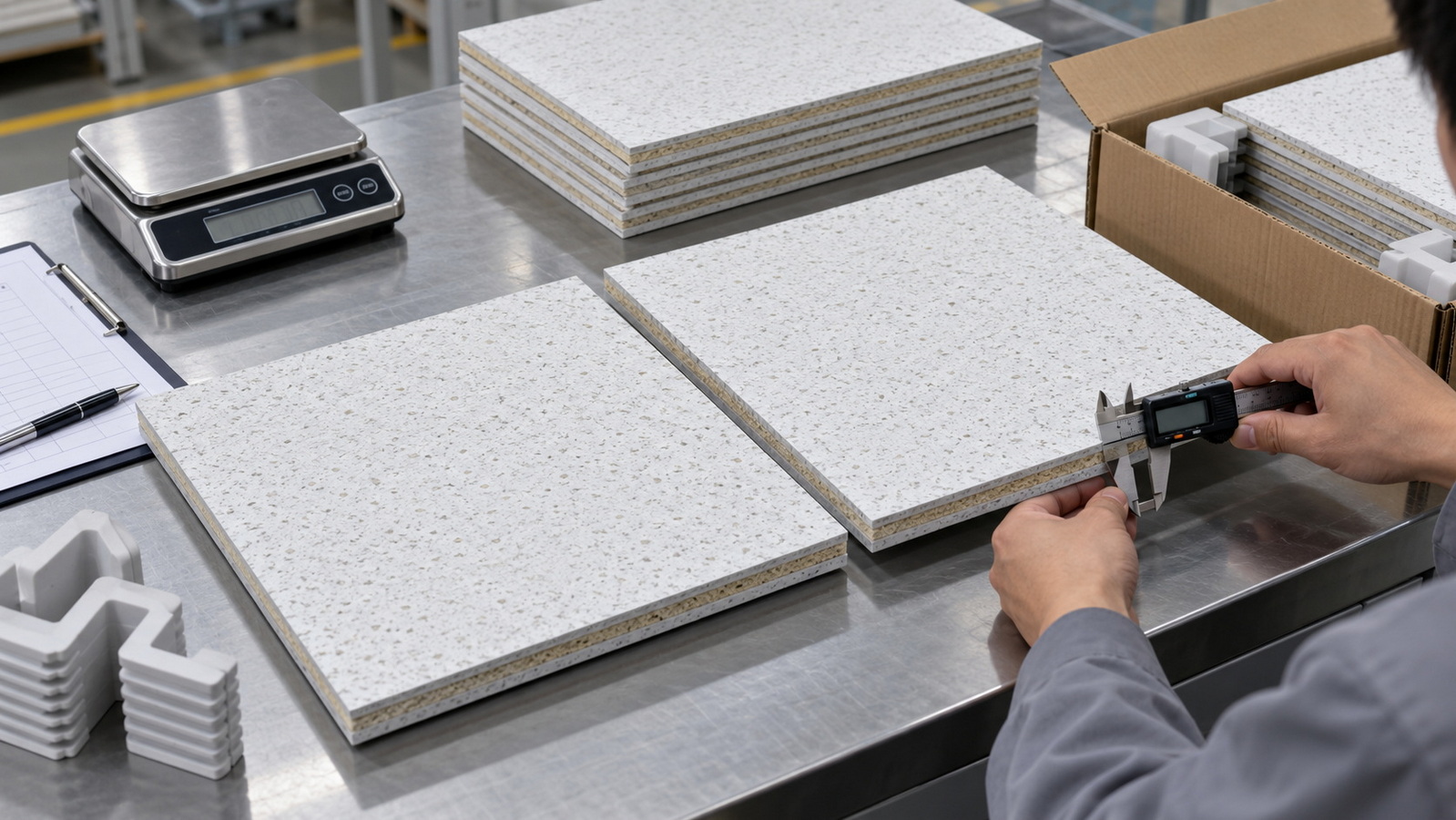
A practical sequence is:
- Material samples: approve appearance, texture, and construction.
- Full-size mock-up: check joints, framing, lighting interaction, access, and installation.
- Production inspection: compare finished goods with the approved specification before release.
Include packaging inspection and carton identification in the final stage.
Request a schedule showing:
- Raw-material availability.
- Production allocation.
- Custom-finish preparation.
- Inspection date.
- Packing and dispatch milestones.
For a distributor, request confirmed stock quantities and replenishment arrangements instead of factory output claims.
Evaluate more than panel price:
- Export and inland packaging.
- Freight and insurance.
- Import conformity costs.
- Customs and handling charges.
- Site delivery.
- Cutting waste.
- Framing and accessories.
- Installation.
- Replacement stock.
Ask for the container-loading plan or local delivery arrangement before confirming quantities. Require protection for vulnerable edges and agreement on how transport damage will be documented and resolved.
Nigerite and Emenite offer established Nigerian fibre-cement manufacturing routes. Tormek provides a supply-and-installation proposition, while Buildgen offers access to a broader building-material portfolio. Binmao Decor adds a China-based customization option for buyers exploring coordinated decorative finishes and flexible product development.
For a custom decorative-panel enquiry, send Binmao Decor the project drawings, ceiling application, target material, finish references, required quantities, and performance criteria. Request a written ceiling-suitability assessment, matched sample package, product-specific reports, and itemized quotation before proceeding.
The strongest long-term supplier is the one that can reproduce the approved specification, document its performance, and support installation—not simply submit the lowest initial offer.
Search the exact certificate number and legal company name through a certificate-verification platform such as IAF CertSearch. Check the status, standard, certified site, scope, issuing certification body, and accreditation information.
If a record cannot be located, contact the issuing certification body directly. Do not decide authenticity from a scanned certificate or expiry date alone.
Do not assume equivalence. CE-related documentation and Nigerian import conformity serve different regulatory purposes.
SON states that regulated imports require the relevant SONCAP process and documentation. Confirm the proposed product's treatment with SON or an authorized conformity-assessment provider before shipment.
Compare the report's specimen description with the purchase specification: core, thickness, finish, backing, adhesive, mounting arrangement, and supporting components.
Ask the laboratory or technical assessor whether the proposed customization remains within the report's applicable scope. A report covering a different construction should not be accepted merely because the product names look similar. The distinction between component and system assessment is particularly important for ceilings.
Convert both quotations to usable installed area using the approved dimensions and layout.
Then separate MOQ by colour, finish, profile, packaging design, and overall order. Ask whether accessories carry their own minimum quantities. A low headline MOQ can become commercially unattractive if each finish requires a separate production run.
Define responsibility before ordering. The contract should separate product conformity, storage conditions, installation workmanship, support design, and unauthorized substitutions.
Retain the approved drawings, installation instructions, inspection records, batch numbers, and site photographs. Since ceiling performance can involve panels, substructures, and complete kits, a panel-only acceptance check cannot settle every system-level issue.
1- Binmao Decor — company background, material options, customization, and installation support. [binmaomaterials]
2- Odu'a Investment Company — Nigerite's establishment, manufacturing activities, and building solutions. [oduainvestment.com]
3- Emenite Limited — company history, product families, and manufacturing scope. [emenitelimited]
4- Emenite Limited — KalsiCeil composition, dimensions, and applications. [emenitelimited]
5- Ceiling and Wall Systems — Tormek Global Services' history and service scope. [ceilingandwallsystems]
6- Sun Group — Buildgen's building-material and ceiling-panel offering. [sungroupe]
7- Buildgen Nigeria Limited — company-profile establishment information. [linkedin]
8- Agusto & Co. — 2025 Construction Industry Report; historical construction contribution and forecast. [agustoresearch]
9- Standards Organisation of Nigeria — SONCAP requirements for regulated imports. [son.gov]
10- Standards Organisation of Nigeria — MANCAP requirements for locally manufactured products. [son.gov]
11- IAF CertSearch — certificate-status and scope verification. [iafcertsearch]
12- EN 13964:2014 — suspended-ceiling requirements and test-method scope. [standards.iteh]
13- Finishes and Interiors Sector — suspended-ceiling standards guidance. [thefis]


