
Views: 277 Author: Sunny Publish Time: 2026-09-11 Origin: Site


Content Menu
● What Are PU Stone and Wood Wall Panels?
● The Most Common Types of PU Stone Panels
>> 1. PU Travertine Stone Panels
>> 2. PU Stacked Stone and Ledge Stone Panels
>> 3. PU Slate and Natural Rock Panels
>> 4. PU Brick and Industrial Concrete Panels
● The Most Common Wood Wall Panel Types
>> 1. Fluted and Slatted Wood Wall Panels
>> 4. PVC and WPC Waterproof Wall Panels
>> 5. Acoustic Wood Wall Panels
● PU Stone vs. Wood Panels: Which Should You Choose?
● How to Verify Waterproof and Fire-Retardant Claims
>> Verify Waterproof Performance
>> Understand Fire-Test Language Correctly
● Expert Buying Checklist for Hotels, Villas, and Commercial Projects
>> Design and Material Questions
● Why Fast-Install Wall Panel Systems Matter
● Binmao Decor: Custom PU Stone and Integrated Wall Panel Manufacturing
● Request Samples and Technical Support
>> 1. Are PU stone wall panels really waterproof?
>> 2. Are PU stone panels lighter than real stone?
>> 3. Can PU stone wall panels be used in hotels?
>> 4. What is the difference between PU stone panels and WPC wall panels?
>> 5. Are MDF wood wall panels suitable for humid spaces?
>> 6. What does ASTM E84 Class A mean for a wall panel?
>> 7. Can you customize PU stone wall panel sizes and finishes?
PU stone wall panels and decorative wood wall panels are now among the most practical fast-install interior cladding options for hotels, villas, retail environments, offices, and renovation projects. They give designers the visual character of natural stone, timber, concrete, or fluted wood while reducing on-site weight, wet trades, installation time, and maintenance requirements.
At Binmao Decor, we have spent 14 years manufacturing integrated wall-panel solutions for global interior projects. In real hotel, villa, and commercial-space specifications, buyers rarely choose a panel based on appearance alone. They need to compare fire performance, moisture resistance, substrate emissions, installation method, acoustic needs, finish consistency, customization capability, and documentation before approving a material.
This expert guide explains the most commonly used PU stone and wood panel types, where each works best, what buyers should verify before purchase, and how to select a high-performance wall system for your project.

PU stone panels are lightweight decorative wall cladding products made primarily with polyurethane-based materials. They are molded and surface-finished to reproduce the appearance of natural materials, such as stacked stone, travertine, slate, sandstone, brick, concrete, or carved architectural blocks.
Wood wall panels are broader in construction. Depending on the project, they may use MDF, plywood, WPC, PVC, solid wood veneer, engineered veneer, acoustic felt backing, or composite substrates with decorative finishes. Common visual options include oak, walnut, teak, ash, smoked wood, slatted timber, fluted panels, and embossed wood grain surfaces.
The strongest specification is not necessarily "PU" or "wood" alone. It is a complete wall-panel system that matches the project's environment, regulatory needs, aesthetic direction, and installation conditions.
For example:
- A hotel corridor may require a flame-retardant decorative surface, impact durability, simple cleaning, and stable repeatability across many rooms.
- A villa feature wall may prioritize deep textures, customized dimensions, premium oak or walnut effects, and concealed lighting integration.
- A restaurant may need moisture-resistant wall cladding, acoustic support, fast installation, and finishes that withstand frequent cleaning.
- A commercial renovation may need lightweight panels that can be installed over a stable existing wall to reduce demolition work and project downtime.
Binmao Decor supplies customizable integrated wall-panel systems in PU, PVC, WPC, MDF, wood veneer, UV board, acoustic-backed, waterproof, and fire-retardant constructions. Depending on the application, widths, depths, finishes, profiles, and backing structures can be developed around the customer's drawings and performance requirements.
PU stone is not one single product style. It is a design category with multiple surface effects, profiles, and project uses. The following types are the most frequently specified for contemporary interiors.
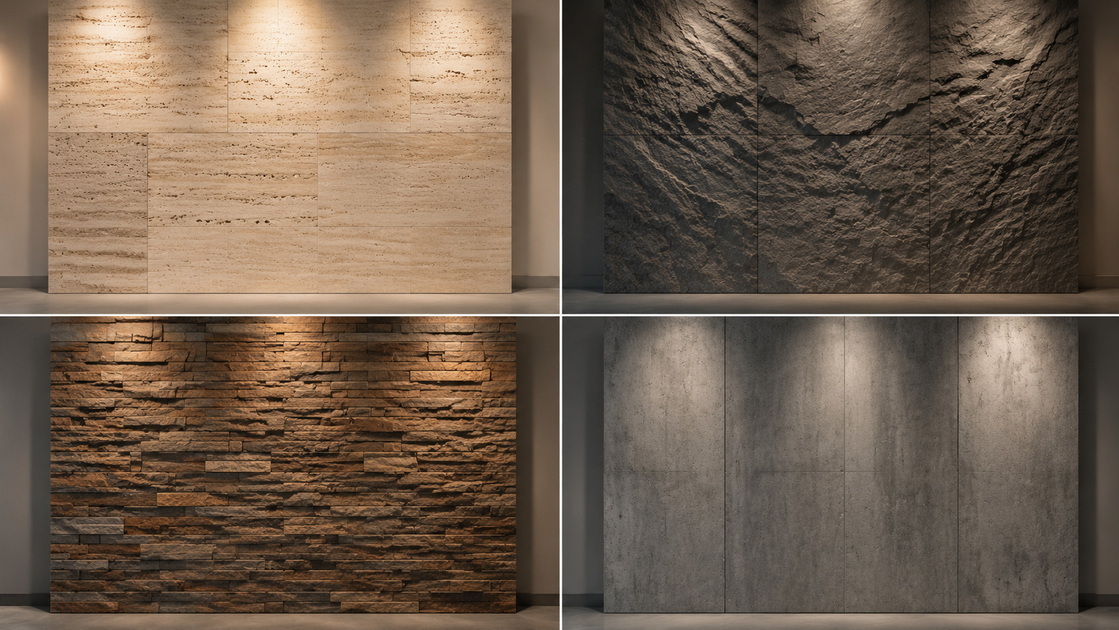
PU travertine panels imitate the linear pores, soft color variation, and calm luxury associated with natural travertine. They have become especially popular in minimalist hotels, reception areas, villas, retail showrooms, and modern apartments.
Typical colors include:
- Cream beige
- Ivory white
- Light grey
- Warm sand
- Taupe
- Coffee brown
- Dark charcoal
Why buyers choose it: Travertine-look PU panels can create a large-format stone appearance without the weight, cutting difficulty, or installation complexity of real stone slabs.
These panels work well for:
- Hotel lobby feature walls
- Villa living rooms
- Reception desks and backdrops
- Boutique retail interiors
- Lift lobby walls
- High-end apartment entrances
For a premium result, buyers should request samples with consistent color tone, realistic pore patterns, clean corner details, and a surface texture that does not look overly repetitive.
Stacked stone PU panels replicate irregular split-face stone, dry-stacked masonry, and layered rock surfaces. They are widely used where a project needs stronger visual texture and a more architectural appearance.
Common applications include:
- Restaurant walls
- Bar fronts
- Fireplace surrounds
- Villa exterior transition spaces
- Retail display areas
- Landscape-adjacent interiors
- Theme hotels and resorts
The main benefit is that the visual depth can look substantial while the panel remains much lighter than natural stone. This helps reduce handling difficulty, transport weight, and structural loading concerns.
However, deeper stone textures should be specified carefully for high-traffic zones. Very rough surfaces may accumulate dust or become harder to clean. For hospitality projects, ask the supplier about surface cleanability, impact resistance, and whether the finish is appropriate for the intended maintenance routine.
PU slate panels create a darker, more dramatic stone appearance. They commonly use grey, black, rust, brown, or mixed mineral tones and work particularly well in projects with industrial, contemporary, luxury, or biophilic design concepts.
They are often specified for:
- Boutique hotel feature walls
- Wine bars
- Spa rooms
- Villa staircases
- Exterior-covered entrance areas
- Commercial reception zones
- Fireplace and media walls
A slate-style panel can provide a natural-material mood without the complicated cutting and jointing associated with real slate. Still, designers should check lighting conditions. Directional lighting can dramatically enhance surface relief, while flat lighting may make dark panels appear visually heavy.
PU brick and concrete wall panels are commonly used for cafés, creative offices, restaurants, co-working spaces, and retail environments. They offer an urban visual identity without the dust, curing time, or masonry labor associated with traditional brickwork or cast concrete finishes.
Popular styles include:
- Exposed red brick
- Whitewashed brick
- Grey concrete
- Microcement effect
- Aged industrial cement
- Rust-effect concrete
- Black brick
- Loft-style weathered wall finishes
Best use case: Fast renovation projects where the owner wants a strong design transformation with limited disruption.
For hotels, branded retail chains, and large villa projects, standard panels may not be enough. Custom PU stone panels can be developed with specific dimensions, edge profiles, colors, textures, and decorative patterns.
Customization options may include:
- Panel width and length
- Surface depth
- Stone texture
- Color matching
- Logo or brand patterns
- Corner pieces
- Lighting channels
- Hidden access panels
- Custom joint design
- Protective surface treatment
This is particularly valuable when designers need consistent detailing across multiple rooms, floors, branches, or international project locations.
Wood-effect and wood-veneer wall panels remain one of the most versatile interior design materials. They can make a space feel warmer, quieter, more premium, and more human-centered than a plain painted wall.
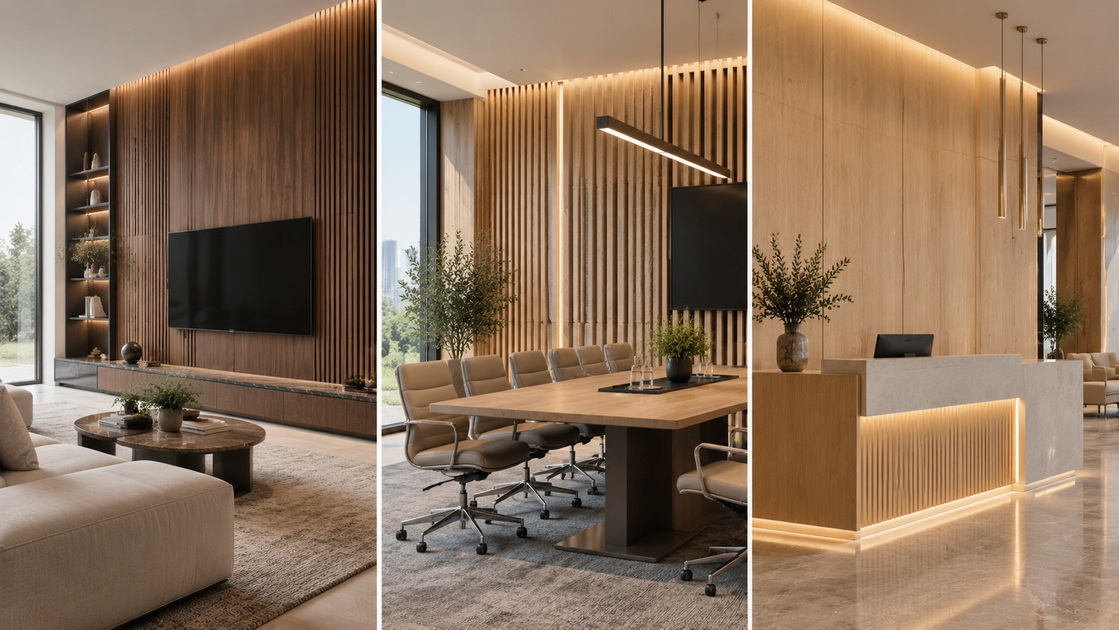
Fluted wall panels feature repeated vertical or horizontal grooves. Slatted wall panels generally use narrow strips or battens with visible spacing between them. Both styles are widely used in modern hotels, villas, offices, restaurants, and residential interiors.
Common finishes include:
- Natural oak
- Smoked oak
- Walnut
- Teak
- Ash
- Black wood grain
- Grey oak
- White oak
- Matte painted finishes
Fluted panels create rhythm and verticality. They can make a low ceiling appear higher when installed vertically, while horizontal slats can visually widen a narrow room.
They are especially effective for:
- TV background walls
- Bed headboard walls
- Hotel room entrances
- Reception areas
- Meeting rooms
- Restaurant partitions
- Villa corridors
Wood veneer panels use a thin natural wood surface on an engineered core. They are usually selected when a project wants the visual authenticity of real timber grain with more controlled panel dimensions and better material efficiency than solid wood.
Popular veneer species include:
- Oak
- Walnut
- Teak
- Ash
- Maple
- Cherry
- Ebony-look veneer
A wood veneer wall panel may be constructed with MDF, plywood, or another engineered backing. For indoor projects, it is important to confirm the substrate grade, emission documentation, finish system, moisture conditions, and installation method.
For the U.S. market, composite wood products such as MDF are subject to formaldehyde-emission requirements under EPA TSCA Title VI. Buyers should request relevant compliance documentation rather than relying only on general claims such as "eco-friendly" or "low formaldehyde."
MDF UV panels are decorative boards with a UV-cured surface. The surface is commonly smooth, glossy, matte, marble-effect, metallic, solid-color, or digitally printed.
They are often chosen for:
- Hotel furniture panels
- Cabinet-facing systems
- Commercial wall décor
- Retail display fixtures
- Apartment interiors
- Fast interior refurbishment projects
Their advantages include stable decorative appearance, broad color selection, easy cleaning, and the ability to coordinate wall finishes with furniture or cabinetry.
For a better specification, confirm whether the board is E1 or E0 grade, the coating type, edge sealing method, scratch resistance, and whether the product is intended for dry or humid interior conditions.
PVC and WPC wall panels are common choices for moisture-prone areas because they can offer strong water resistance, easy maintenance, and fast installation.
They are often used in:
- Bathrooms
- Kitchens
- Laundry rooms
- Hotel washrooms
- Basement renovations
- Corridor walls
- Commercial restrooms
- Utility areas
WPC panels generally combine wood-based fibers with thermoplastic materials, while PVC panels are plastic-based decorative boards. Performance varies substantially by formulation, thickness, structure, surface film, backing, and installation quality.
Important: "Waterproof" does not automatically mean every joint, adhesive, screw hole, edge, and substrate is waterproof. The full wall system must be designed to manage moisture correctly.
Acoustic wood wall panels typically combine decorative slats, wood veneer or wood-grain surfaces, and sound-absorbing backing such as PET felt, mineral wool, or other acoustic materials. They improve visual warmth while helping manage reflected sound.
They are widely used in:
- Hotel meeting rooms
- Restaurants
- Open-plan offices
- Home cinemas
- Recording spaces
- Conference rooms
- Education facilities
- Reception and waiting zones
The word "acoustic" should be supported by test data. A panel's acoustic performance depends on the panel design, open-area ratio, backing material, cavity depth, insulation, and installation method. Ask for laboratory reports and clarify whether the stated rating applies to the exact panel configuration you plan to install.
The right material depends on the visual target and project conditions. PU stone panels are generally selected for sculptural texture and stone-inspired aesthetics. Wood wall panels are preferred for warmth, rhythm, acoustic design, and furniture-like detailing.
| Selection Factor | PU Stone Wall Panels | Wood Wall Panels |
|---|---|---|
| Primary appearance | Stone, slate, travertine, brick, concrete | Oak, walnut, teak, ash, fluted or slatted timber |
| Typical project style | Contemporary, industrial, natural-luxury, resort | Warm modern, hospitality, residential, biophilic, corporate |
| Weight | Usually lighter than natural stone | Varies by MDF, veneer, WPC, PVC, or acoustic construction |
| Moisture suitability | Depends on finish, joints, and application | PVC/WPC typically suit humid zones better than standard MDF |
| Acoustic potential | Can be combined with acoustic systems | Slatted and acoustic-backed systems are common |
| Customization | Texture, color, size, corners, profiles | Veneer, groove pattern, panel size, backing, color, edge treatment |
| Installation | Adhesive, mechanical fixing, or hybrid system | Clips, screws, adhesive, battens, or concealed fixing |
| Best applications | Feature walls, lobbies, restaurants, retail | Bedrooms, hotels, offices, meeting rooms, TV walls |
In many high-end projects, the best answer is not choosing one material over the other. A combined design often works better: use PU travertine or slate panels as the architectural feature surface, then add walnut fluted or acoustic oak panels to introduce warmth, contrast, and sound comfort.
Performance claims are among the biggest areas where procurement teams need to be careful. A good wall panel should not be evaluated only through a catalog image or a supplier's verbal promise.
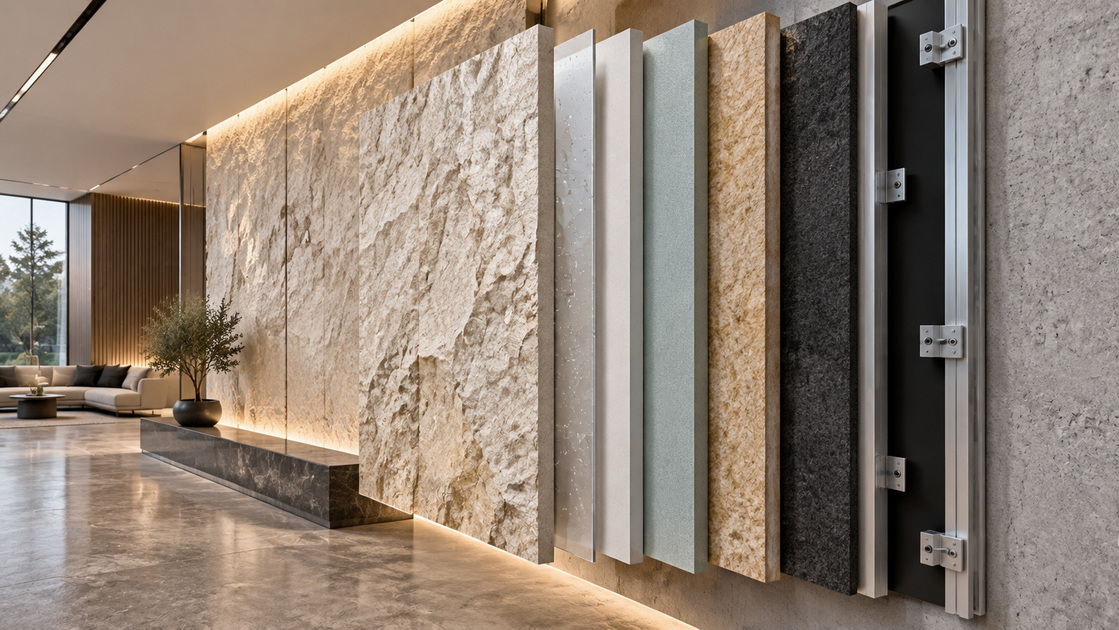
Ask these questions before ordering:
1. Is the panel itself water-resistant, or is the full system designed for wet-area use?
2. What happens at joints, cut edges, corners, and penetrations?
3. Which adhesive, sealant, trim, or mechanical fastener is recommended?
4. Can the product be installed directly on a damp wall?
5. Is the backing substrate suitable for humid conditions?
6. Are there installation instructions for bathrooms, kitchens, or semi-outdoor spaces?
7. Can the supplier provide water-resistance or moisture-resistance test reports?
For a bathroom or washroom project, the panel surface is only one part of the solution. Moisture can enter through improperly sealed joints, unprepared substrates, or poorly detailed plumbing penetrations.
Suppliers often use broad phrases such as "fireproof," "fire-resistant," "flame-retardant," or "B1 grade." These terms are not interchangeable, and the required standard varies by market and building code.
In the United States, ASTM E84 is commonly used to assess the surface-burning characteristics of building materials. It measures the Flame Spread Index and the Smoke Developed Index. Class A has a Flame Spread Index of 0–25 and a Smoke Developed Index of 0–450.
However, ASTM E84 is a surface-burning test. It does not by itself prove that a wall assembly has a specified fire-resistance duration, structural fire performance, or suitability for every building location.
Before specifying a wall panel, request:
- The full third-party test report, not only a certificate image
- The testing laboratory name and accreditation details
- The test standard and test date
- The tested product construction
- Product thickness and surface finish
- Installation method used during testing
- The actual fire-test classification or numerical results
- Batch or product identification matching the item being supplied
This evidence-based approach protects the designer, contractor, owner, and distributor from making assumptions based on incomplete marketing language.
As a manufacturer, we recommend treating decorative wall cladding as a project system rather than a single board purchase. Before finalizing your PU stone or wood wall panel order, use this checklist.
- Does the panel match the approved sample under the project's actual lighting?
- Is the texture realistic at close viewing distance?
- Can the supplier control color consistency across batches?
- Are custom width, depth, profile, and finish options available?
- Are corner pieces, trims, and accessories available?
- Can the panel integrate lighting, doors, access panels, or signage?
- Is the panel suitable for dry, humid, or wet areas?
- What is the substrate material?
- Is there E1, E0, TSCA Title VI, CARB, CE, or other applicable documentation?
- Is the product insect-resistant and mold-resistant?
- Is the fire-performance report relevant to your destination market?
- Is acoustic performance independently tested if sound control is required?
- What substrate is required?
- Is wall leveling necessary before installation?
- Which adhesive, screws, clips, battens, or trims are recommended?
- Can installers receive technical drawings or remote installation support?
- What is the waste allowance for cutting and corners?
- How should the material be stored before installation?
- What is the minimum order quantity?
- What is the production lead time?
- Can the supplier provide samples before mass production?
- What packaging protects panels during export shipping?
- Are installation manuals, test reports, and inspection records included?
- Can the factory support OEM, ODM, private-label, or project-specific development?
Traditional wall construction may involve masonry, plastering, sanding, painting, drying time, tile-setting, stone cutting, and multiple on-site trades. This can create dust, schedule risk, inconsistent workmanship, and costly disruption—especially in operating hotels, stores, and commercial spaces.
A well-engineered quick-install wall panel system can help project teams:
- Reduce wet-trade work
- Shorten renovation periods
- Limit on-site dust and waste
- Improve finish consistency
- Simplify future replacement of damaged sections
- Coordinate decorative, moisture-resistant, acoustic, and fire-performance needs
- Create repeatable installation standards across multi-site projects
The goal is not simply faster installation. The goal is more predictable project delivery.
For hotel renovation projects, this may mean reducing room downtime. For a villa project, it may mean achieving a premium material effect with fewer complex trades. For a retail chain, it may mean replicating the same branded interior identity across multiple locations.
Binmao Decor is a China-based integrated wall-panel manufacturer with 14 years of production experience. We focus on fast-install decorative wall solutions for modern hotels, villas, residences, and commercial spaces.
Our available product systems include:
- PU stone wall panels
- PU wood-effect decorative panels
- UV boards
- Waterproof wall panels
- Fire-retardant composite wall panels
- PVC and WPC wall cladding
- MDF panels in E1 and E0 grades
- Natural wood veneer panels, including oak and walnut options
- Acoustic-backed wall panel structures
- Customized widths, depths, surface finishes, and profiles
We understand that international buyers need more than attractive samples. They also need dependable production, clear technical communication, packaging protection, project-based customization, and product testing documentation.
Our team can provide professional installation support and help customers evaluate panel structure, finish selection, accessory matching, and application suitability before production.
Choosing the right PU stone or wood wall panel starts with the right technical questions. If you are sourcing decorative wall panels for a hotel, villa, apartment project, restaurant, office, or commercial renovation, Binmao Decor can help you develop a solution around your design concept and performance requirements.
Send us your drawings, target finish, project quantity, installation environment, and destination market. Our team can recommend suitable panel structures, customize dimensions and finishes, prepare samples, and provide relevant product testing documentation and installation guidance.
Contact Binmao Decor today to request PU stone samples, wood wall panel samples, technical specifications, and a customized quotation for your project.
Many PU stone wall panels have strong moisture resistance, but the suitability of a complete installation depends on the panel construction, joints, adhesive, edge treatment, wall condition, and location. For wet-area applications, verify the complete installation system rather than relying only on a "waterproof" product claim.
Yes. PU stone panels are generally much lighter than natural stone, which can make transport, handling, cutting, and installation easier. The exact weight depends on panel thickness, density, dimensions, and surface texture.
Yes. PU stone panels are commonly used for hotel lobbies, corridors, guestrooms, reception areas, restaurants, lounges, and feature walls. For hospitality projects, confirm fire-test documentation, cleanability, impact resistance, color consistency, and installation details before specification.
PU stone panels are typically used to reproduce stone, brick, slate, concrete, or carved architectural textures. WPC wall panels generally use a wood-plastic composite structure and are often selected for wood-grain, fluted, waterproof, or moisture-resistant wall-cladding applications.
Standard MDF is generally better suited to dry indoor areas. For humid spaces, project teams should consider moisture-resistant MDF where appropriate or choose PVC, WPC, or other wall-panel systems designed for higher-moisture conditions. Always verify the manufacturer's application recommendation.
ASTM E84 Class A refers to surface-burning characteristics. It generally means a Flame Spread Index of 0–25 and a Smoke Developed Index of 0–450 under the ASTM E84 test method. It does not automatically mean that the panel is noncombustible or that the entire wall assembly has a specific fire-resistance rating.
Yes. Binmao Decor can customize panel width, depth, texture, surface color, decorative profile, and other project details based on drawings, samples, application needs, and order requirements.
1. [U.S. Environmental Protection Agency — Formaldehyde Emission Standards for Composite Wood Products]. Explains U.S. TSCA Title VI formaldehyde-emission requirements and labeling obligations for composite wood products, including medium-density fiberboard. [epa]
2. [Intertek — ASTM E84: Surface Burning Characteristics of Building Materials]. Explains ASTM E84 testing, Flame Spread Index, Smoke Developed Index, and Class A, B, and C classifications. [intertek]
3. [Alaska Housing Finance Corporation — ASTM E84 Standard Test Method]. Provides the Class A, B, and C surface-burning classification thresholds used for interior wall and ceiling finishes. [ahfc]
4. [Capital Testing — ASTM E84 Surface Burning Characteristics]. Explains ASTM E84's comparative measurements, the two key test indexes, and the relevance of tested interior finish materials. [capitaltesting]
5. [Timber Pro Coatings — Surface Burning Characteristics Explained for Architects]. Clarifies that surface-burning characteristics measure early flame spread and smoke generation rather than full structural fire resistance. [timberprocoatingsusa]
6. [Luvie Industry — Wall Panel Standards and Independent Evidence Guide]. Discusses why ASTM E84 alone does not establish all aspects of fire risk or prove that a material is noncombustible. [luvieindustry]


