
Views: 268 Author: Sunny Publish Time: 2026-10-23 Origin: Site


Content Menu
● Why Source Aluminum Honeycomb Wall Panels from China?
>> An Established Aluminum and Composite-Materials Supply Chain
>> Manufacturing Clusters with Different Strengths
● Selection Criteria: How This Supplier Shortlist Was Developed
● Manufacturer Comparison: Capacity, MOQ, and Certification Evidence
● The Top 10 Suppliers and Sourcing Candidates
>> 1. Binmao Decor — A Customization-Focused Partner for Interior Collections
>> 2. HyCOMB / Liming Honeycomb Composites — Engineered Lightweight Cladding
>> 3. Huarui Honeycomb Technology — Integrated Core and Panel Manufacturing
>> 4. Suzhou BEECORE — Honeycomb Technology and Special Panel Formats
>> 5. Hongzan — Architectural Honeycomb Panels and Metal Fabrication
>> 6. RENOXBELL — Coated Panels and Architectural Fabrication
>> 7. TOPBOND — Lightweight Sandwich Panels with Core Expertise
>> 8. ALUCOBOND China — A Candidate Requiring Product-Line Confirmation
>> 9. YOOBOND — Decorative Composite-Panel Development
>> 10. WILLSTRONG — Architectural Honeycomb Panels and System Coordination
● Specify the Construction Before Comparing Prices
>> Match Fire Evidence to the Supplied Panel
>> Treat CE and RoHS Correctly
● Common Sourcing Traps and How to Avoid Them
>> Comparing Panels with the Same Thickness but Different Constructions
>> Approving Only a Decorative Swatch
>> Accepting "Waterproof" Without Defining the Exposure
● Factory Verification, Sampling, and Logistics
>> Verify the Manufacturing Chain
>> Request Evidence of Available Capacity
>> Specify Packaging and Landed-Cost Assumptions
>> 1. How Can I Check Whether a Factory's ISO Certificate Is Expired or Suspended?
>> 2. Can ASTM E84 Class A Replace EN 13501-1 A2-s1,d0?
>> 3. How Can We Detect Material Substitution After Approving a Sample?
>> 4. Does a Fire Report for a Standard Panel Cover a Customized Veneer or Finish?
>> 5. Does Every Aluminum Honeycomb Wall Panel Need CE and RoHS Certification?
China offers a broad sourcing base for aluminum honeycomb wall panels, from specialist core manufacturers to architectural cladding companies and customized interior-panel suppliers. For procurement managers, the challenge is not finding a factory that can produce an attractive sample. It is identifying a partner that can reproduce the approved construction, maintain consistent quality, and supply documentation that matches the delivered product.
This guide compares ten suppliers and sourcing candidates, explains their different strengths, and outlines the checks buyers should complete before placing a production order. Binmao Decor appears first as a customization-focused interior-panel partner, with an important distinction: its public company page supports its integrated wall-panel capabilities but does not independently establish an aluminum honeycomb production line. That capability should be confirmed during qualification.

China's aluminum industry provides a substantial upstream manufacturing base. The International Aluminium Institute's August 2026 statistics estimate Chinese primary aluminum production at 3.874 million metric tonnes, against a global total of 6.172 million tonnes. These figures describe primary metal production—not finished honeycomb panels—but help explain the scale of the country's supporting supply chain.
The downstream opportunity is also significant. Grand View Research's October 2026 report values the global aluminum honeycomb market at USD 542.7 million in 2025 and estimates USD 586.1 million for 2026. It identifies Asia Pacific as the largest regional market, with a 37.3% revenue share in 2025. Importantly, the report covers aluminum honeycomb across aerospace, transportation, marine, construction, and industrial applications; its figures should not be presented as the market size for architectural wall panels alone.
Foshan and the wider Guangdong region offer a practical concentration of honeycomb-panel and architectural-material suppliers. HyCOMB, Huarui, Hongzan, and TOPBOND all identify manufacturing operations in Foshan, while RENOXBELL and WILLSTRONG have roots in the wider Guangdong architectural-panel sector. Suzhou and Jiangyin provide additional options for honeycomb materials and composite-panel sourcing.
For buyers, this concentration creates opportunities to compare several factories during one sourcing trip. However, geographic proximity does not mean that suppliers use the same alloys, adhesives, production controls, or installation systems.
This is an application-based shortlist, not an independently audited ranking by revenue, export volume, or production quality. Public company information supports the profiles, while undisclosed or conflicting information is identified rather than replaced with assumptions.
The evaluation considers six procurement dimensions:
| Evaluation dimension | Evidence buyers should request |
|---|---|
| Manufacturing identity | Business license, production address, equipment list, and disclosure of subcontracted processes |
| Engineering and development | Construction drawings, material recommendations, prototype capability, and documented design changes |
| Quality control | Incoming-material inspection, bonding records, dimensional checks, and batch identification |
| Compliance | Current management-system certificates and product-specific laboratory reports |
| Delivery reliability | Production schedule, available line capacity, material procurement plan, and packing arrangements |
| OEM/ODM support | Custom dimensions, finishes, edge details, fixing systems, packaging, and technical communication |
Published capacity is treated as a supplier declaration, not proof of available production slots. Similarly, an ISO management-system certificate does not certify every product or establish that a particular panel meets a building project's fire requirements. ISO itself directs buyers to verify accredited certification through IAF CertSearch or the relevant certification and accreditation bodies.
No comparable, current minimum-order quantity was established across all ten suppliers. Buyers should request separate MOQs for stock finishes, custom colors, special dimensions, and complete project kits.
| Supplier | Main sourcing focus | Published capacity information | MOQ | Certification or testing information to verify |
|---|---|---|---|---|
| Binmao Decor | Customized interior wall-panel collections | Honeycomb-specific capacity not established | Project quotation required | Obtain reports for the exact proposed honeycomb construction; public company page does not establish this capability. |
| HyCOMB / Liming | Engineered aluminum, stone, and porcelain honeycomb panels | Automatic core and composite-panel lines reported; comparable annual output not disclosed | Project quotation required | ISO 9001:2015 claimed; verify applicable product and market-specific reports. |
| Huarui Honeycomb | Core materials, metal panels, and modular walls | Website lists normal honeycomb-panel output of 1,500 m²/day | Project quotation required | ISO 9001:2015, ISO 14001:2015, and IMO MED claimed. |
| Suzhou BEECORE | Honeycomb materials and engineered panel formats | Panel production lines reported; comparable annual output not disclosed | Project quotation required | Request current certificates and panel-specific reports. |
| Hongzan | Architectural metal and stone honeycomb panels | Current about page claims over 2 million m²/year of aluminum honeycomb composite panels | Project quotation required | Website includes legacy ISO 9001:2008 wording and other certification claims; current evidence required. |
| RENOXBELL | Coated architectural aluminum and honeycomb panels | Current honeycomb-specific capacity not disclosed | Project quotation required | Public profile references ISO 9001:2008; request updated certification. |
| TOPBOND | Honeycomb cores and lightweight sandwich panels | One company page reports over 200,000 m²/year of metal and nonmetal honeycomb panels | Project quotation required | ISO 9001:2015 claimed; resolve inconsistent company-history and testing wording. |
| ALUCOBOND China | Architectural composite-panel production | Changzhou honeycomb production and processing lines reported; output not disclosed | Project quotation required | Confirm the exact honeycomb product, manufacturing entity, and supporting documents. |
| YOOBOND | Multi-material decorative composite panels | Current honeycomb-specific capacity not disclosed | Project quotation required | Marketplace profile includes ISO certification claims and legacy wording; verify current documents. |
| WILLSTRONG | Architectural honeycomb panels and facade systems | Current honeycomb-specific capacity not disclosed | Project quotation required | Product page lists EN 13501-1 A2-s1,d0; obtain the underlying classification report. |
Capacity figures use different product scopes and time periods. They should not be converted into a simple "largest factory" ranking without checking operating hours, product mix, utilization, and the proportion available for export orders.
Binmao Decor is a Foshan-based integrated wall-panel manufacturer serving hotel, villa, residential, and commercial interiors. Its public page describes customizable widths, depths, and finishes, together with installation support and one-to-one service. Its stated material range includes MDF, wood veneers, PVC/WPC, PU, and acoustic backing structures.
- Establishment: The company page presents a 2012 founding timeline, consistent with the company-provided statement of 14 years' experience in 2026. However, the same page also contains "over 20 years" wording and references Harmony Furniture; buyers should reconcile the legal entity, brand history, and factory ownership.
- Market orientation: Domestic and overseas customers, particularly hospitality, residential, and commercial interiors; regional sales shares are not disclosed.
- OEM/ODM scope: Customized dimensions, surface treatments, decorative finishes, and installation coordination are described publicly.
Binmao is worth evaluating for smaller brands and project buyers seeking coordinated interior collections rather than a single industrial panel specification. Its direct-service model may suit development discussions involving finishes, trims, packaging, and installation details.
However, its honeycomb-specific production, bonding equipment, capacity, and test evidence remain a qualification requirement. Buyers should also measure communication efficiency through a live quotation and sample-development exercise rather than assuming response performance from marketing statements. A cost-performance advantage should be established through like-for-like quotations, not claimed without comparison.
HyCOMB identifies its manufacturing background with Liming Honeycomb Composites in Foshan and states that it was established in 2000. Its range includes aluminum honeycomb cores, aluminum and stainless-steel honeycomb panels, stone and porcelain composites, and patented interlocking clips.
- Establishment: 2000.
- Market orientation: China and international projects, with reported branches in the United States, United Kingdom, Australia, and Hong Kong.
- OEM/ODM scope: Custom panel construction, engineered cladding, specialized surface materials, fabrication, and fixing-system coordination.
Its principal attraction is the combination of panel manufacturing and system-oriented development. Buyers considering large-format stone or porcelain feature walls may find this more relevant than a supplier offering only unfinished aluminum sheets.
Request documentation for the exact panel finish, adhesive system, thickness, and mounting arrangement. A test completed on one HyCOMB construction should not automatically be applied to every product in the range.
Established in 2009, Huarui manufactures aluminum and steel honeycomb materials, aluminum honeycomb panels, stone honeycomb panels, and modular honeycomb wall products. Its website also describes an independent seven-person QC team.
- Establishment: 2009.
- Market orientation: Construction, rail, marine, furniture, aviation, and other technical sectors; geographic sales proportions are not disclosed.
- OEM/ODM scope: Core configuration, composite-panel structures, modular wall products, and application-specific development.
Huarui is a useful candidate when the procurement specification extends beyond appearance to core geometry, panel construction, and production control.
Its capacity disclosures are more detailed than those of many suppliers, but buyers should clarify the website's combined output categories and confirm how much capacity applies to their particular wall-panel specification.
Suzhou BEECORE's published history states that the Suzhou company was established in 2009 and added production lines for oversized, curved, and special honeycomb panels in 2015. A separate field on the same page lists 2010 as its establishment year, so the business license should resolve the discrepancy.
- Establishment: 2009 in the company timeline; 2010 in the profile field.
- Market orientation: North America, Europe, East and Southeast Asia, the Middle East, Africa, and Oceania.
- OEM/ODM scope: Honeycomb cores, specialized panel dimensions and shapes, and engineered honeycomb-based products.
BEECORE is particularly relevant for buyers whose specifications involve unusual geometry or engineered core requirements.
Procurement teams should distinguish its historical group references from the incorporation date of the contracting entity. They should also establish whether the quotation covers raw core, unfinished sandwich panels, or fully fabricated wall-panel kits.
Foshan Nanhai Hongzan Building Materials identifies 2002 as its establishment year on its about page. The company describes manufacturing aluminum honeycomb panels, marble honeycomb panels, wood-grain honeycomb panels, honeycomb cores, corrugated products, and custom ceilings.
- Establishment: 2002 on the company about page; other website wording references an earlier history.
- Market orientation: Architectural cladding, ceilings, and construction projects; regional sales shares require confirmation.
- OEM/ODM scope: Custom-shaped panels, decorative metal finishes, stone-faced composites, and architectural fabrication.
Hongzan's breadth makes it a candidate for projects combining wall cladding with ceilings or other fabricated architectural elements.
Its current website claims more than 2 million m² of annual aluminum honeycomb composite-panel capacity. Older supplier listings show lower figures, making it important to confirm the current production site, installed lines, and available capacity rather than combining historical claims.
RENOXBELL provides a relatively clear business timeline: distribution began in 1997, its own aluminum composite and honeycomb-panel factory opened in 2003, and subsequent manufacturing expansion followed.
- Establishment: Business roots in 1997; own panel manufacturing from 2003.
- Market orientation: Architectural curtain walls and decorative building panels; current geographic sales distribution is not disclosed.
- OEM/ODM scope: PVDF- and polyester-coated honeycomb panels, solid colors, stone-effect finishes, wood-effect finishes, and decorative patterns.
This supplier is worth considering when coating choice and architectural fabrication are central to the specification.
Its public profile still references ISO 9001:2008. That historical statement is not evidence of current certification. Request a current certificate and confirm that the manufacturing site named in it is the site producing the order.
TOPBOND supplies aluminum honeycomb cores, aluminum honeycomb panels, and other lightweight sandwich constructions. Its newer website states that the company was founded in 2017 and operates three Foshan workshops totaling approximately 8,000 m².
- Establishment: 2017 on the newer website; another page describes earlier production roots and reorganization.
- Market orientation: Lightweight sandwich-panel applications; regional sales shares are not disclosed.
- OEM/ODM scope: Core materials, metal and nonmetal sandwich panels, and customized lightweight constructions.
TOPBOND may suit buyers requiring both cores and finished panels, especially where different sandwich materials must be compared.
Due diligence should resolve inconsistent company-history and facility information. One company page also uses "A2" together with ASTM E84 terminology. Those are different classification systems, so the original reports—not the website summary—must determine suitability.
ALUCOBOND China's company page reports a Shanghai production base established in 1999 and subsequent consolidation of manufacturing operations in Changzhou, including honeycomb-panel production and processing lines.
- Establishment: Chinese production base reported from 1999; this is not necessarily the incorporation date of the current contracting entity.
- Market orientation: Architectural facades, interior applications, renovation, and corporate-identity projects.
- OEM/ODM scope: Project-specific fabrication should be confirmed directly for the honeycomb line.
The essential buying distinction is product identity. The company describes its standard ALUCOBOND product as aluminum cover sheets with a mineral-filled core. That is not the same construction as an aluminum honeycomb panel.
Include the supplier only after obtaining a honeycomb-specific datasheet, quotation, manufacturing identity, and report package. Brand familiarity should never replace construction verification.
YOOBOND publishes an aluminum honeycomb composite-panel product and appears in supplier profiles offering aluminum composite, aluminum honeycomb, aluminum/PVC, and decorative-film composite panels.
- Establishment: A supplier directory lists 2017; primary legal documentation is needed before treating this as confirmed.
- Market orientation: Domestic and export composite-panel sourcing; regional sales shares are not established.
- OEM/ODM scope: Decorative composite constructions, alternative surface materials, and product-development support are described in its supplier profile.
Its potential value lies in discussing several decorative composite options with one supplier.
However, buyers should verify the relationship between the YOOBOND brand, Jiangyin Yoobond, and any alternative entity named in commercial listings. The purchase contract, beneficiary account, certificates, and manufacturing address should identify a consistent, explainable supply chain.
WILLSTRONG states that its architectural cladding business dates to 1995. Its published range includes aluminum, stainless-steel, titanium-zinc, and stone honeycomb panels, alongside other facade materials.
- Establishment: 1995 according to current company materials.
- Market orientation: Chinese and international architectural projects; the company reports customers across more than 80 countries and regions.
- OEM/ODM scope: Custom architectural panels, multiple facing materials, shop drawings, fabrication, and system coordination.
WILLSTRONG is a relevant candidate when panel sourcing must align with drawings, edge details, and an architectural installation system.
Its aluminum honeycomb product page lists EN 13501-1 A2-s1,d0 performance. Buyers should obtain the classification report and confirm its scope, particularly because the same page discusses several different core constructions.
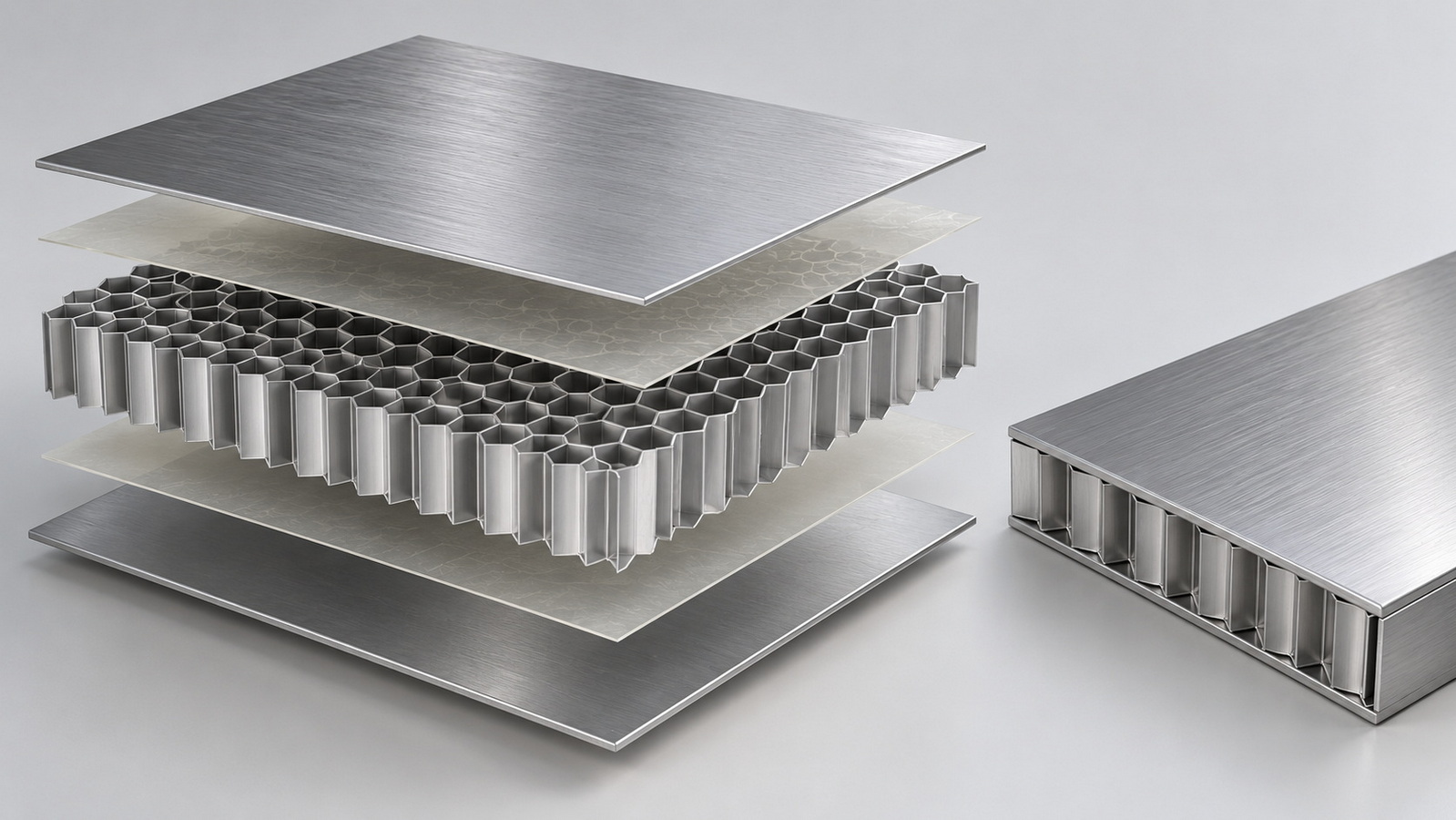
An aluminum honeycomb wall panel is a sandwich construction: face sheets bonded to a cellular core. Its performance depends on the complete construction, not simply the overall thickness or visible finish. Honeycomb manufacturing also requires control of cell dimensions, density, bonding, and flatness.
A procurement specification should identify:
- Face-sheet alloy, temper, and minimum metal thickness.
- Back-sheet alloy and thickness.
- Core alloy, foil gauge, cell size, density, and orientation.
- Overall panel thickness and dimensional tolerances.
- Adhesive system and bonding process.
- Surface pretreatment, coating, and finish.
- Edge closures, inserts, brackets, and mounting details.
- Intended indoor, wet-area, or exterior exposure.
Do not accept "premium aluminum" as a material grade. Supplier catalogs show constructions using alloys such as 3003 and 5052, while technical honeycomb specifications also identify alloy, foil gauge, cell size, and density as separate parameters. The appropriate combination depends on the application rather than a universal "higher grade is better" rule.
ASTM E84 measures surface-burning characteristics, including flame spread and smoke development. Its Class A designation is not the same as Euroclass A2 under EN 13501-1, and the systems are not interchangeable.
Request the full report and check:
1. Manufacturer and production address.
2. Product name and identification.
3. Face and backing materials.
4. Adhesive and decorative layers.
5. Tested thickness.
6. Mounting arrangement and substrate.
7. Classification limitations.
A metal-faced panel and a wood-veneered version should not be assumed to share the same classification. Equally, a surface-burning result should not be presented as an hourly fire-resistance rating for a complete wall assembly.
For European construction projects, CE marking requires an applicable legal route. The European Commission explains that a construction product can bear CE marking when covered by the relevant harmonized technical specification or European Technical Assessment, with the required declaration and technical documentation. Buyers should establish which route applies to the exact product and intended use.
RoHS primarily addresses restricted substances in electrical and electronic equipment. It is not a general building-panel approval and does not replace fire, structural, or indoor-emissions evidence for an ordinary passive wall panel.
Two nominally 20 mm panels may use different face-sheet thicknesses, foil gauges, cell sizes, and adhesives. These differences can affect both cost and performance. Honeycomb technical guidance treats those parameters separately for precisely this reason.
Require a signed construction schedule with every quotation. Prohibit material substitution without written approval.
A small finish sample cannot establish full-size flatness, joint appearance, fixing behavior, or packing suitability. Large-panel manufacturing requires consistent bonding and dimensional control, while machining, handling, and sealing can affect durability.
Use a staged approval process:
1. Approve the decorative finish.
2. Approve a cut-section sample showing the complete construction.
3. Approve a production-size panel.
4. Assemble a representative wall mockup.
5. Retain signed reference samples.
6. Inspect the first production batch before shipment.
This is a recommended procurement sequence, not a claim that every supplier currently follows it.
A moisture-resistant face does not by itself establish that joints, penetrations, inserts, adhesives, and adjacent substrates are suitable for prolonged wet exposure. The reviewed industry report specifically identifies moisture penetration and improper sealing as potential honeycomb-panel risks.
For bathrooms and other wet areas, define the cleaning regime, joint treatment, edge sealing, and installation conditions in writing. Avoid transferring broad waterproof claims from unrelated MDF, PVC, or composite product families to a honeycomb specification.
A less obvious issue is the direction of the honeycomb core.
Hexcel's technical guidance explains that conventional hexagonal honeycomb has different shear properties in its L and W directions, with higher values in the L direction. Therefore, matching panel thickness, alloy, and weight alone does not establish identical directional mechanical performance.
The procurement implication is important: rotating a core within a panel may leave the visible finish unchanged while altering its response under the intended loading arrangement.
For large panels or demanding support conditions:
- Ask the engineer to specify any required core orientation.
- Show that orientation on approved drawings.
- Mark panel direction where installation depends on it.
- Require production samples to match the approved construction.
- Assess performance using the actual panel dimensions and support layout.
This is not an allegation against any supplier. It is a specification gap that can be prevented before production.
Ask the supplier to show the processes actually performed at the quoted factory: core production or purchasing, sheet preparation, adhesive application, pressing, curing, cutting, fabrication, and packing. The manufacturing sequence matters because honeycomb quality depends on multiple precision-controlled stages.
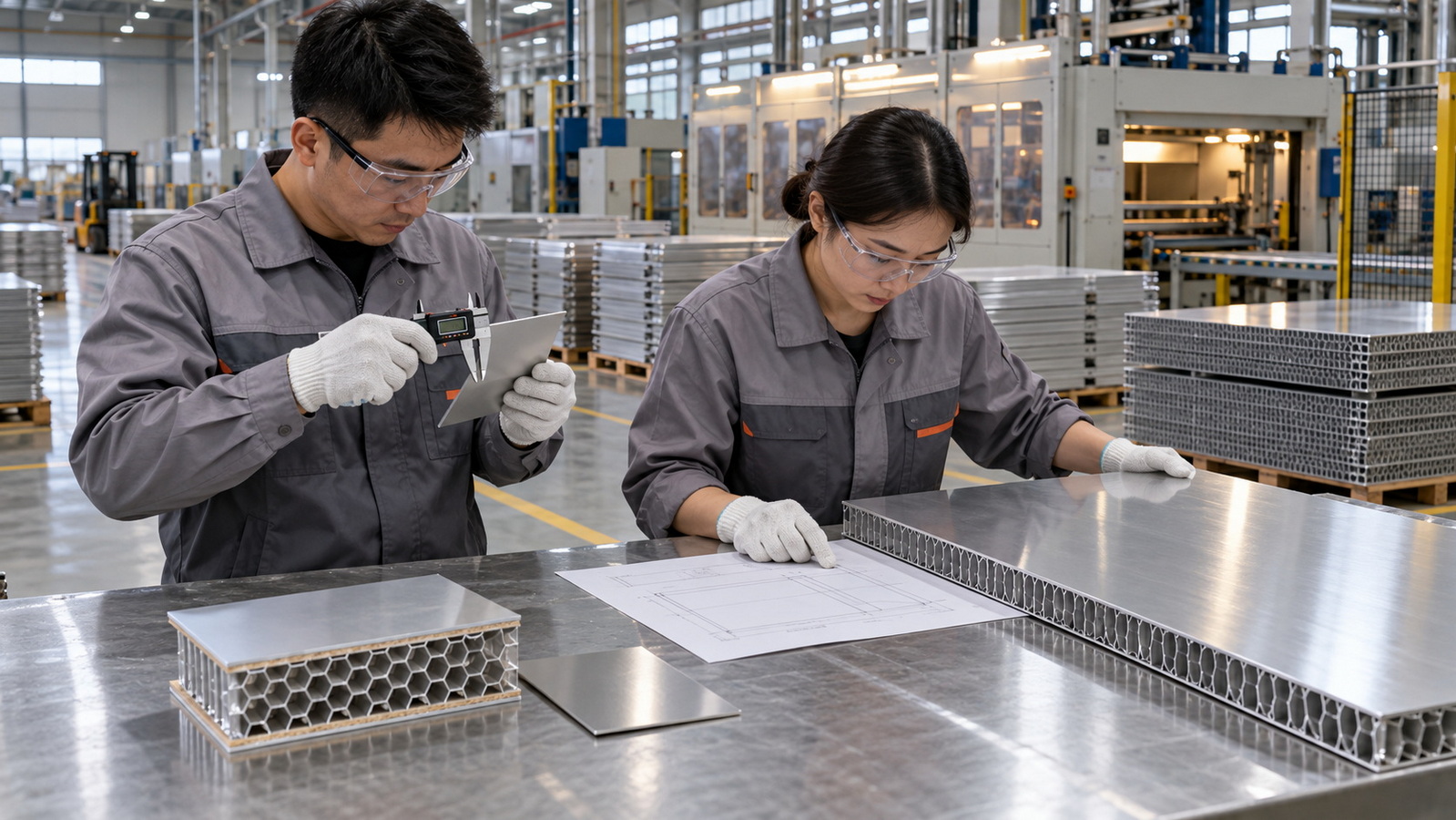
A supplier may legitimately outsource some operations. What matters is disclosure, control, and accountability.
Use published output only as an initial screening indicator. Before confirming delivery, ask for:
- Material availability.
- Current line loading.
- Sample-approval deadline.
- Production and curing sequence.
- Inspection date.
- Packing completion date.
- Contingency arrangements for rejected panels.
A large annual capacity claim does not establish that a custom finish or specialized construction can meet a particular shipment date.
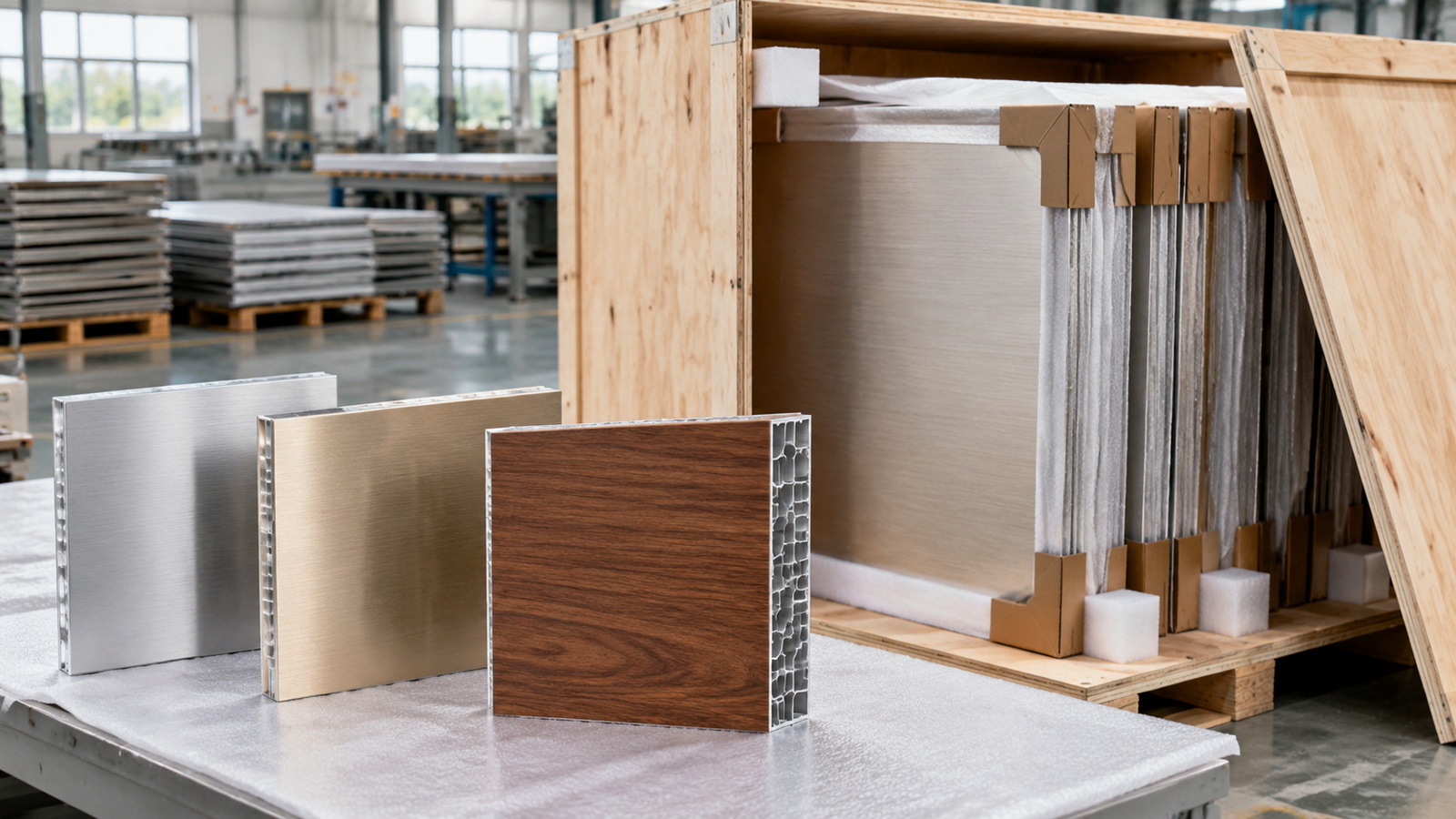
Panel handling can create localized damage, making transport preparation part of product qualification.
Ask the quotation to state:
- Crate dimensions and gross weight.
- Panel orientation and separation materials.
- Edge and corner protection.
- Lifting and unloading instructions.
- Identification matching installation drawings.
- Responsibility for replacement panels.
- Freight basis and agreed delivery terms.
Have a destination customs broker confirm classification and applicable duties for the actual construction. Do not select a customs code solely because another supplier used it for a different aluminum product.
The strongest long-term sourcing relationship is built around an agreed construction, controlled production, relevant documentation, and predictable delivery—not a low price unsupported by technical detail.
HyCOMB, Huarui, BEECORE, Hongzan, RENOXBELL, TOPBOND, and WILLSTRONG offer different combinations of core expertise, architectural fabrication, and system support. ALUCOBOND China and YOOBOND require particular attention to product-line and contracting-entity verification. Binmao Decor provides a customization-oriented interior-panel option, subject to confirming its honeycomb-specific manufacturing and compliance capabilities.
For a Binmao Decor project assessment, submit the intended application, drawings, panel dimensions, quantity, finish, destination, and required performance standards. Request a construction proposal, manufacturing disclosure, sample-development plan, and applicable test documents before approving the order.
Search the legal company name or certificate number in IAF CertSearch. Check the status, standard, scope, covered locations, issuing certification body, and accreditation details. A valid-looking PDF is insufficient if the certificate has subsequently been suspended or withdrawn. ISO also recommends contacting the relevant certification body or accreditation body when verification is needed.
If a record cannot be found, investigate directly rather than automatically concluding that the certificate is counterfeit.
No. ASTM E84 and EN 13501-1 use different methods and classification systems. ASTM E84 assesses surface flame spread and smoke development; Euroclass classification evaluates reaction to fire through a different framework. Request the evidence required by the project's jurisdiction and specification rather than accepting a supplier's informal conversion.
Make the approved construction contractually identifiable: alloys, minimum face-sheet thicknesses, core specification, adhesive, finish, and panel identification.
Then use independent sampling from production—not only samples selected by the supplier—to compare dimensions, cut sections, and the agreed mechanical or durability tests. Technical honeycomb guidance identifies alloy, foil gauge, cell configuration, cell size, and density as distinct specification parameters, so all should remain controlled where relevant.
Not automatically. Obtain the full report and have the laboratory or qualified technical reviewer confirm whether the customized construction falls within its scope. Changes to surface layers, adhesive, backing, thickness, or mounting conditions must not be assumed acceptable simply because the underlying core remains aluminum. Test configuration matters when interpreting surface-burning and reaction-to-fire results.
No universal certificate package applies to every market and application. For European construction use, establish whether the exact product is covered by an applicable harmonized specification or an assessment route supporting CE marking. RoHS primarily concerns electrical and electronic equipment, so it is not a blanket approval requirement for ordinary passive wall panels. Confirm destination-specific obligations before placing the order.
1. Binmao Decor. "About Us." Company background, integrated wall-panel products, customization options, and installation support. [binmaomaterials]
2. HyCOMB. "Lightweight Cladding Solution Provider." Manufacturing history, honeycomb composite materials, production capabilities, and international operations. [honeycombsolution]
3. Huarui Honeycomb Technology Co., Ltd. "About Us." Establishment date, product range, declared production capacity, quality-control arrangements, and certification claims. [alcomb]
4. Suzhou BEECORE Honeycomb Materials Co., Ltd. "Company Profile." Company development, honeycomb production technology, specialized panel formats, and export-market coverage. [bee-core]
5. Foshan Nanhai Hongzan Building Materials Co., Ltd. "About Us." Architectural honeycomb products, manufacturing background, and declared production capacity. [hongzanhoneycomb]
6. RENOXBELL. "About Us." Business history, aluminum honeycomb manufacturing, coating options, and architectural-panel applications. [renoxbell]
7. Foshan Sanshui TOPBOND Building Materials Co., Ltd. "Company Overview." Honeycomb cores, lightweight sandwich panels, manufacturing facilities, and company background. [honeycombtop]
8. ALUCOBOND China. "About Us." Chinese manufacturing operations, composite-panel construction, and honeycomb production-line information. [en.alucobond.com]
9. YOOBOND. "Aluminum Honeycomb Composite Panel." Product construction and decorative composite-panel applications. [yoobond]
10. WILLSTRONG. "WILLSTRONG AHP: Aluminium Honeycomb Panel." Architectural honeycomb-panel specifications, system applications, and published fire-classification information. [willstrong360]
11. Grand View Research. "Aluminum Honeycomb Market Size, Share & Trends Analysis Report, 2026–2033." Global market estimates and application coverage. The report concerns the broader aluminum honeycomb market, not exclusively architectural wall panels. [grandviewresearch]
12. International Aluminium Institute. "Primary Aluminium Production." Global and Chinese primary aluminum production statistics, used as upstream industry context rather than finished honeycomb-panel output data. [international-aluminium]
13. International Organization for Standardization. "Certification." Guidance on management-system certification and verification through accredited certification bodies and IAF CertSearch. [iso]
14. European Commission. "Declaration of Performance and Conformity: CE Marking." Official guidance on CE marking, applicable technical specifications, and supporting declarations for construction products. [single-market-economy.ec.europa]
15. European Commission. "RoHS Directive." Official explanation of restrictions on hazardous substances in electrical and electronic equipment and the directive's scope. [environment.ec.europa]
16. Intertek. "ASTM E84: Standard Test Method for Surface Burning Characteristics of Building Materials." Explanation of surface-burning testing, flame spread, and smoke development. [intertek]
17. Hexcel. "HexWeb Honeycomb: Attributes and Properties." Technical guidance covering honeycomb configurations, material specifications, and directional mechanical properties. [hexcel]


