
Views: 266 Author: Sunny Publish Time: 2026-08-30 Origin: Site


Content Menu
● What Is the Difference Between WPC and PVC Wall Panels?
● WPC Wall Panels: Strengths, Limits, and Best Uses
>> Why designers choose WPC wall panels
>> Where WPC requires more care
● PVC Wall Panels: Strengths, Limits, and Best Uses
>> Why buyers choose PVC wall panels
● Waterproof Does Not Mean Installation-Proof
>> Use this wet-area specification checklist
● Fire Performance: Ask for Test Reports, Not Vague Claims
>> What to request from a wall-panel supplier
● Indoor Air Quality: Why E0, E1, and Documentation Matter
>> A smarter material-selection approach
● How to Choose Between WPC and PVC Wall Panels
● Why Customization Changes Project Outcomes
● Request a Custom Wall Panel Solution
>> 1. Are PVC wall panels better than WPC wall panels for bathrooms?
>> 2. Are WPC wall panels completely waterproof?
>> 3. Which panel looks more like real wood: WPC or PVC?
>> 4. Do WPC and PVC wall panels need expansion gaps?
>> 5. Can PVC and WPC wall panels meet fire requirements?
>> 6. Are MDF wall panels safe for interior projects?
>> 7. What should I send a manufacturer before requesting a quotation?
Choosing between WPC wall panels and PVC wall panels is not simply a matter of selecting a wood-look finish or the lowest material price. For hotels, villas, apartments, retail environments, offices, and other commercial interiors, the right panel system must balance moisture protection, fire-test documentation, visual quality, installation conditions, indoor-air requirements, maintenance expectations, and project-specific customization.
At Binmao Decor, we have spent 14 years manufacturing integrated wall-panel systems for global customers. From fast-install PVC wall panels and UV boards to waterproof, fire-retardant composite wall systems, we see one principle repeatedly in real projects: the best panel is the one specified for the actual environment, substrate, compliance requirements, and design goal—not the one with the most generic claims.
This guide explains the practical differences between WPC and PVC wall panels, where each material performs best, what buyers should verify before ordering, and how to build a lower-risk wall-panel specification for modern hospitality, residential, and commercial projects.
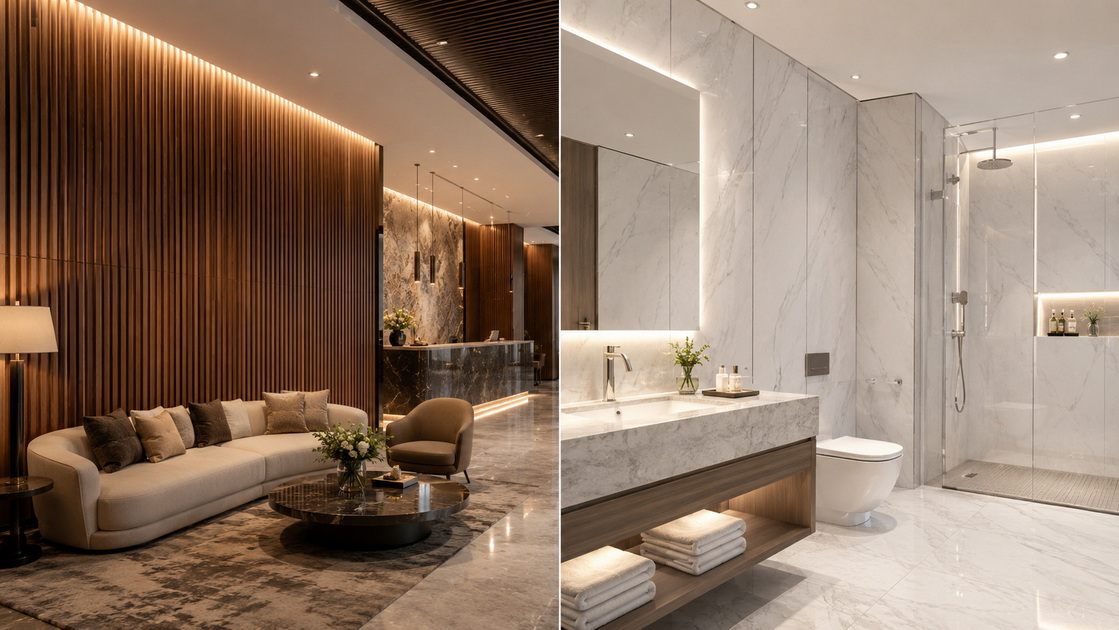
WPC wall panels are typically made from a blend of polymer resin, wood fiber or wood flour, and performance additives. Their composition gives them a more substantial feel and allows manufacturers to create embossed wood grains, fluted profiles, slatted surfaces, and decorative finishes that resemble natural timber.
PVC wall panels are primarily based on polyvinyl chloride. Depending on the product design, they may be hollow, foam-core, rigid, laminated, printed, or UV-coated. PVC panels are generally lighter, highly moisture-resistant, easy to clean, and especially suitable for spaces that require fast installation and frequent wash-down maintenance.
The distinction matters because a wall panel is not only a decorative surface. It is part of an interior system that may include a substrate, adhesive or mechanical fixing, trims, joints, backing structure, insulation, and acoustic layers.
| Decision factor | WPC wall panel | PVC wall panel |
|---|---|---|
| Typical visual effect | Warm, textured, wood-inspired | Smooth, modern, printed, marble, high-gloss, or simple decorative finish |
| Material structure | Polymer + wood fiber/wood flour + additives | PVC-based formulation; may be rigid, foamed, hollow, laminated, or UV-coated |
| Relative weight | Usually heavier | Usually lighter |
| Moisture performance | Suitable for moisture-prone interiors when correctly specified and installed | Excellent moisture resistance; commonly preferred for bathrooms, kitchens, and utility areas |
| Surface feel | More tactile and wood-like | Often smoother and more uniform |
| Cleaning | Depends on finish and embossing depth | Usually quick to wipe clean |
| Project suitability | Feature walls, hotel rooms, villas, lounges, commercial décor | Wet areas, hygienic interiors, rapid renovation, cost-sensitive projects |
| Movement allowance | Must be considered in installation | Must be considered in installation |
| Customization options | Profile, color, wood grain, acoustic backing, dimensions | Color, print, UV finish, dimensions, thickness, profile |
Important: These are broad product categories, not guaranteed performance ratings. A high-quality PVC wall panel may outperform a poorly formulated WPC panel in certain applications, and the reverse can also be true. Always compare the actual product specification, test report, installation method, and warranty conditions.
WPC panels are commonly selected when the project needs a richer wood appearance without the routine maintenance associated with natural timber veneer or solid wood cladding. Their visual advantage is particularly relevant in hotel guestrooms, villa living rooms, reception areas, restaurants, corridors, and retail environments.
WPC can create a more architectural appearance than many basic PVC panels. Manufacturers can develop fluted, slatted, grooved, flat, curved, and decorative profiles, making WPC useful for feature walls where texture and depth matter.
Key advantages include:
- A more natural-looking wood-grain surface than standard smooth PVC panels.
- Good dimensional body for decorative profiles and deeper grooves.
- Strong visual compatibility with modern hotel, villa, and commercial interiors.
- Opportunities for customized width, depth, surface color, and matching trims.
- Potential integration with acoustic backing systems for projects requiring improved sound absorption.
- A practical alternative when buyers want a wood-effect wall without relying entirely on natural wood.
For premium interiors, the surface finish often matters more than the category name. A WPC panel with a realistic oak, walnut, smoked wood, or matte technical veneer finish can help a designer create a layered, hospitality-grade atmosphere.
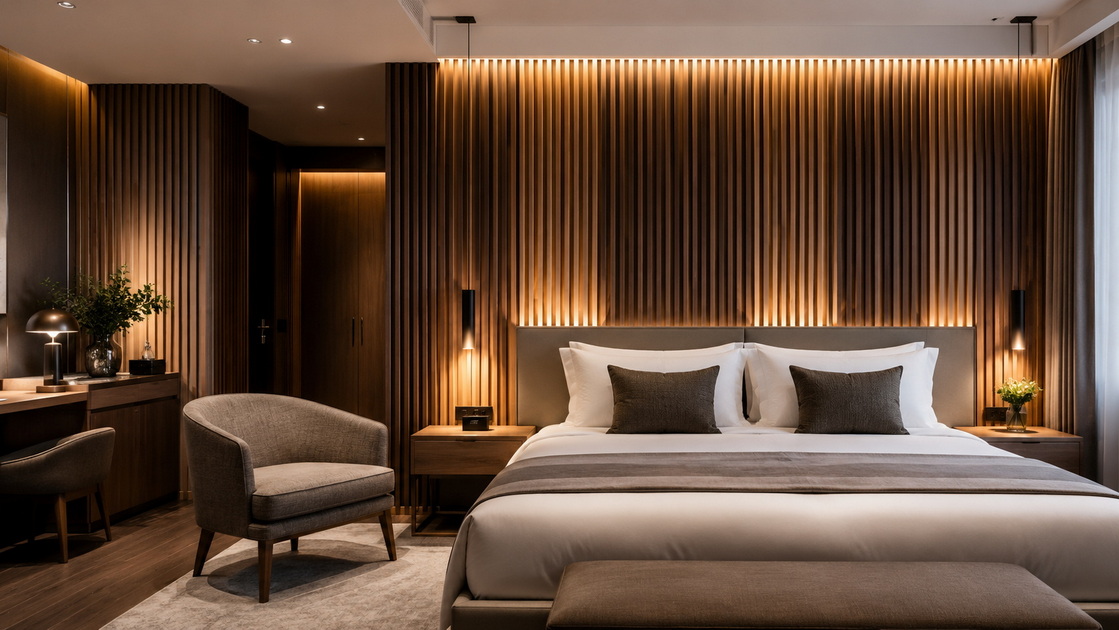
WPC is not a "install anywhere without planning" material. Like other polymer-based composites, it can respond to temperature changes. Installation must account for expected movement, particularly on long walls, near large windows, in sun-exposed interiors, and in areas with changing heating or cooling conditions.
A practical installation plan should address:
- Conditioning or acclimatizing panels in the installation environment.
- Providing manufacturer-specified perimeter and end gaps.
- Using compatible clips, screws, battens, adhesive, or hybrid fixing systems.
- Avoiding over-tightened fasteners that restrict normal movement.
- Designing expansion joints on larger wall runs where required.
- Using flexible trims or detailing that can accommodate slight movement.
Industry installation guidance consistently emphasizes acclimatization, appropriate fasteners, and gaps that accommodate thermal movement. These requirements are not cosmetic details—they help prevent buckling, stress at joints, and visible alignment issues after installation.
PVC wall panels are widely valued for their waterproof performance, light weight, easy maintenance, and quick installation potential. They can be a highly practical solution for bathrooms, kitchens, laundries, corridors, rental-property renovations, healthcare-adjacent spaces, retail fit-outs, and commercial utility areas.
For a hotel or residential project, PVC can be especially effective where a traditional painted wall or ceramic tile system would create more labor, downtime, grout maintenance, or water-exposure risk.
The main benefit of PVC is not only that it is waterproof. It is that a properly designed PVC panel system can create a large, easy-clean surface with fewer joints than small-format tile.
Common benefits include:
- 100% waterproof surface performance for suitable interior wet-area applications.
- Strong mold- and mildew-resistance potential because the panel surface does not absorb water like untreated porous materials.
- Fast renovation potential with lightweight panels and simplified handling.
- Easy cleaning with a soft cloth and compatible mild cleaner.
- Decorative options such as marble effect, stone effect, solid colors, metallic finishes, high-gloss finishes, and UV-coated designs.
- Lower installation burden than many tile systems, depending on substrate conditions and local labor requirements.
- A clean visual result for projects that require fast turnover, such as hotel refurbishment or rental-property renovation.
At Binmao Decor, PVC wall-panel systems can be customized in width, depth, and finish to suit residential, commercial, and hospitality applications. That flexibility matters because a narrow panel, a wide decorative board, a UV marble board, and a fire-retardant composite panel can serve very different visual and installation purposes.
PVC is not automatically the best answer for every wall. If the brief calls for a deeply textured timber appearance, thicker fluted profile, strong acoustic contribution, or premium tactile finish, WPC, MDF-based decorative panels, wood veneer systems, or acoustic composite structures may provide a better result.
PVC panels should also be selected carefully for areas with elevated heat exposure, unusual ventilation conditions, code-driven fire-performance requirements, or aggressive chemicals. The performance of the complete panel assembly—not merely the face material—matters.
One of the biggest information gaps in many WPC vs. PVC wall-panel comparisons is the assumption that "waterproof" eliminates all project risk. It does not.
A panel may have a waterproof face, but the overall installation can still fail if water enters unsealed joints, penetrates behind trims, reaches an unsuitable substrate, or becomes trapped behind the panel system.
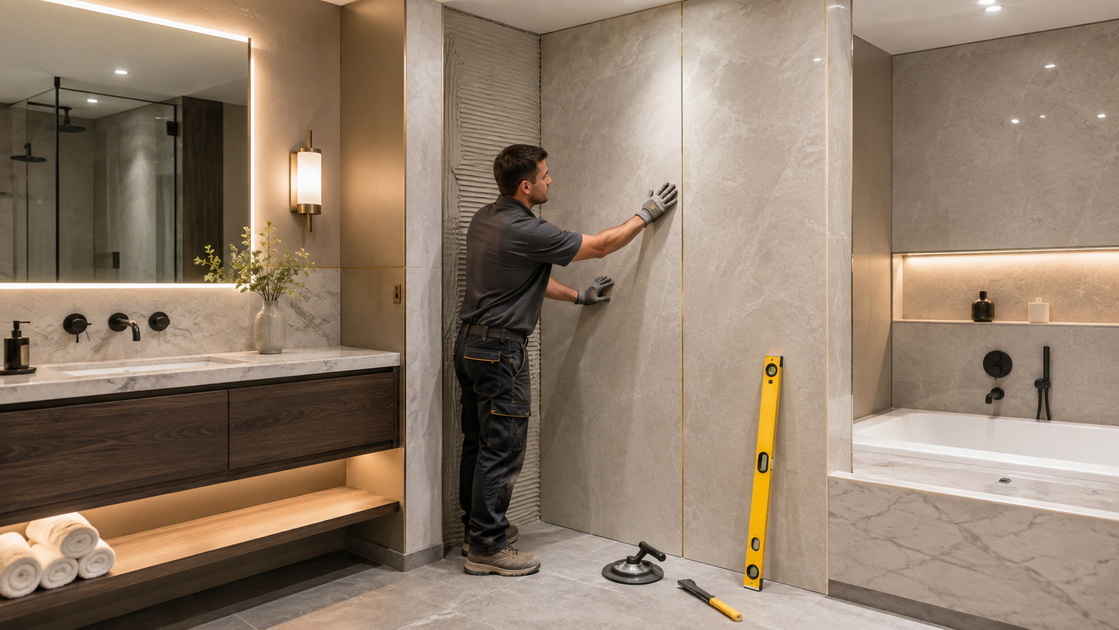
Before ordering panels for a bathroom, spa, kitchen, laundry room, or humid hospitality environment, confirm the following:
1. Define the exposure level. Is the wall exposed to humidity only, occasional splashes, direct shower water, cleaning chemicals, or continuous wash-down conditions?
2. Check the substrate. The wall should be sound, clean, dry, and reasonably flat. Fixing a waterproof panel over an actively damp or mold-affected wall hides the problem rather than solving it.
3. Specify joint treatment. Determine whether joints are tongue-and-groove, sealed, covered with trims, or mechanically overlapped. Confirm which sealant is compatible with the panel.
4. Plan corners and penetrations. Pipes, shower fittings, electrical boxes, window edges, and wall-to-floor transitions need specific details—not improvised site cutting.
5. Confirm adhesive compatibility. Some adhesives are unsuitable for certain PVC or composite formulations. Use the panel manufacturer's recommended adhesive and curing process.
6. Clarify cleaning procedures. Ask which detergents, disinfectants, solvents, and abrasives should be avoided.
7. Request product documentation. For commercial projects, ask for relevant test reports, technical data sheets, installation instructions, and declarations appropriate to the target market.
This process is more valuable than choosing based on a single generic phrase such as "waterproof wall panel."
Fire safety language is frequently oversimplified in wall-panel marketing. Terms such as "fireproof," "fire resistant," "flame retardant," and "B1 fire rating" are not interchangeable, and they should never be accepted without knowing the applicable test method, product construction, and market requirement.
For U.S.-oriented projects, ASTM E84 is commonly used to measure surface-burning characteristics, including flame-spread and smoke-developed indexes. Under the commonly referenced classification thresholds, Class A requires a flame spread index of 25 or less and a smoke-developed index of 450 or less. ASTM E84 evaluates the tested material under defined laboratory conditions; it is not the same as proving a wall system has a universal "fireproof" rating.
For certain wall and ceiling finish scenarios, NFPA 286 room-corner testing can be relevant because it evaluates fire behavior in a larger-scale room configuration. The appropriate standard depends on the code, occupancy, jurisdiction, wall assembly, and project design.
For every project with fire-performance requirements, request:
- The exact product name, thickness, finish, and backing structure tested.
- The test standard and report number.
- The issuing laboratory and test date.
- Flame-spread and smoke-developed results where applicable.
- Whether the report applies to the panel alone or the installed assembly.
- Installation conditions used during testing.
- Confirmation that the offered product matches the tested product.
At Binmao Decor, we can provide product test reports for relevant product selections and help buyers match PVC, WPC, UV board, MDF, wood veneer, PU, or acoustic-backed structures to project needs. However, final code compliance must always be confirmed by the project architect, fire consultant, contractor, and local authority having jurisdiction.
For decorative systems that use MDF, plywood, laminated wood components, or other composite wood elements, indoor air quality deserves the same attention as surface appearance.
E0 and E1 are commonly used emissions classifications in global wood-panel markets, but buyers should not rely only on a label printed in a quotation. They should request the applicable test report, identify the test method, and confirm whether it applies to the exact panel structure being supplied.
For products imported or manufactured for the United States, EPA TSCA Title VI sets formaldehyde emission standards and labeling requirements for regulated composite wood products, including medium-density fiberboard (MDF). Covered composite wood products manufactured or imported after March 22, 2019 must be labeled as TSCA Title VI compliant.
For a hotel, villa, apartment, office, or retail interior, buyers can define the panel system according to the zone:
| Interior zone | Recommended decision focus |
|---|---|
| Bathroom and shower-adjacent walls | Waterproof PVC or waterproof composite panel, sealed edges, compatible trims, documented wet-area method |
| Hotel guestroom feature wall | WPC, wood veneer, MDF decorative panel, or acoustic-backed system based on visual and acoustic target |
| Lobby or reception | Premium WPC slats, UV decorative board, veneer, PU stone, or mixed-material feature system |
| Restaurant or retail wall | Cleanability, impact exposure, fire documentation, brand finish, maintenance plan |
| Office meeting room | Acoustic backing, speech comfort, low-emission substrate, cable/access integration |
| Villa living room | Wood grain, panel proportion, lighting integration, customized profile and trim details |
This zone-based approach prevents a common procurement error: using one low-cost panel type across all spaces, even though bathrooms, corridors, guestrooms, and lobbies have different technical needs.
The best selection process begins with use conditions, not material preference.
Choose PVC wall panels when your priority is:
- High moisture resistance.
- Fast, lightweight installation.
- Easy cleaning and low day-to-day maintenance.
- Bathroom, kitchen, laundry, or utility-area application.
- A smooth, marble-effect, stone-effect, high-gloss, or practical decorative surface.
- Budget control for high-volume renovation projects.
Choose WPC wall panels when your priority is:
- A warmer, more natural wood-inspired appearance.
- Fluted, slatted, grooved, or tactile architectural detailing.
- A premium feature wall for a hotel, villa, restaurant, office, or showroom.
- Greater perceived material depth and decorative versatility.
- Compatibility with acoustic backing or more elaborate wall-design systems.
- A custom profile or finish that supports a distinctive brand environment.
Choose a hybrid wall-panel solution when your project includes multiple zones. For example, a boutique hotel may use waterproof PVC or UV boards in bathroom wet zones, WPC fluted panels in guestrooms, acoustic-backed panels in meeting rooms, and decorative PU or UV marble panels in public-area feature walls.
That is often the most cost-effective and design-consistent strategy.
The dimensions and finishing details of a wall panel can determine whether a finished space looks professionally designed or visibly modular.
A standardized panel may be acceptable for a small renovation. But for commercial and hospitality projects, customization can reduce awkward joints, minimize waste, improve proportion, and help integrate lighting, access panels, skirting, corner trims, and door surrounds.
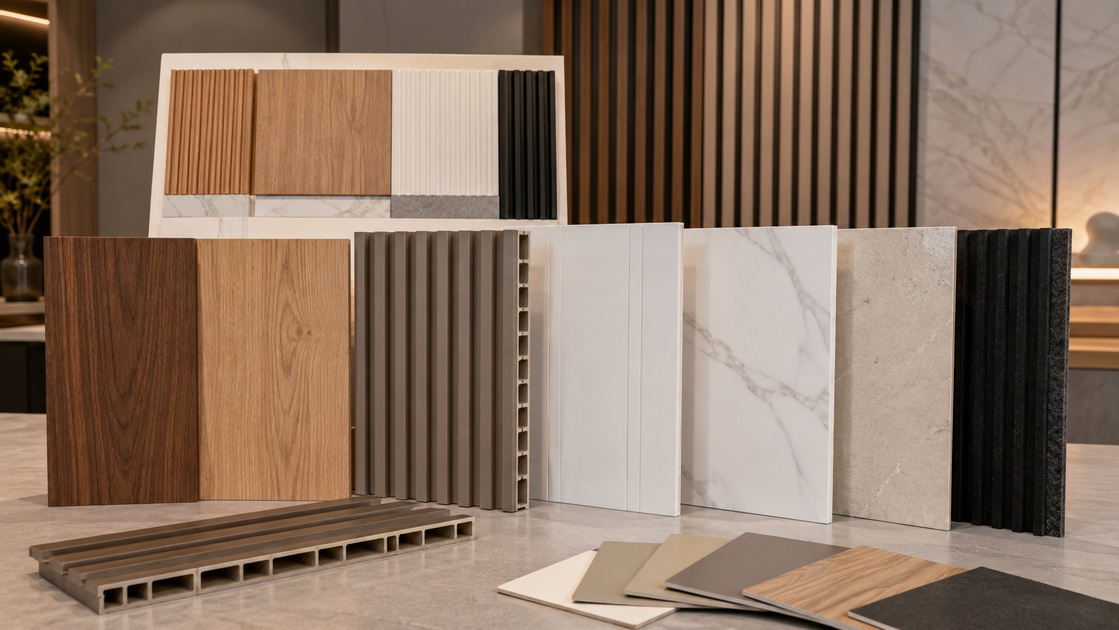
Binmao Decor supports customization for:
- Panel width and depth.
- Surface colors and decorative finishes.
- PVC and WPC formats.
- UV decorative board solutions.
- E1/E0 MDF-based components where applicable.
- Oak, walnut, and other wood-veneer appearances.
- PU decorative materials.
- Acoustic backing structures.
- Waterproof and fire-retardant composite wall-panel configurations.
- Installation guidance and technical support.
For international buyers, this is especially important because product selection must align with local installation practices, shipping constraints, project drawings, sample approval, and target-market documentation.
Whether you need waterproof PVC wall panels for hotel bathrooms, WPC fluted panels for villa interiors, UV decorative boards for commercial renovations, or acoustic-backed composite panels for offices, the right solution begins with a project-specific review.
Share your drawings, target application, finish preferences, dimensions, quantity, and compliance requirements with Binmao Decor. Our team can recommend a customized fast-install wall-panel system, provide available product test reports, prepare samples, and offer professional installation support for your global project.
PVC wall panels are often the more practical choice for bathrooms because they are lightweight, highly moisture-resistant, and easy to clean. However, performance depends on correct joint sealing, trim details, substrate preparation, and installation quality. For direct shower areas, confirm that the exact panel system is approved and detailed for that exposure level.
WPC wall panels are generally moisture-resistant and can be suitable for many interior environments, but "waterproof" should be evaluated at the system level. The panel core, joints, trims, fasteners, substrate, and installation method all affect real wet-area performance.
WPC generally offers a more textured and wood-like visual effect, particularly in fluted, embossed, slatted, or deep-grain profiles. PVC can also achieve attractive wood-look prints, but it usually has a smoother and more uniform surface.
Yes. Polymer-based panels can move with temperature changes. Installers should follow the manufacturer's guidance for panel acclimatization, perimeter clearances, end gaps, fasteners, and expansion-joint design. Proper movement allowance helps avoid buckling, joint stress, or distortion.
Some products can meet specified fire-performance criteria, but compliance depends on the exact panel construction and test standard. Ask for the correct test report for the precise panel, thickness, finish, backing, and installation configuration. Do not rely on an unverified "fireproof" claim.
MDF-based wall panels can be appropriate when they meet applicable emission requirements and are correctly specified for the intended market. In the United States, regulated composite wood products must comply with EPA TSCA Title VI labeling and emission rules. Ask for relevant test documentation and material declarations.
Provide wall dimensions, application area, target finish, project location, expected quantity, desired panel width/depth, fire or emission requirements, installation method, drawings or reference images, and delivery timeline. This enables the supplier to recommend a more accurate panel structure and quotation.
1. George Panel. "[A Guide to WPC vs PVC Wall Panels](https://www.georgepanel.com/a-guide-to-wpc-vs-pvc-wall-panels/)." Accessed August 2026. Used as the original comparison article reviewed and substantially restructured for this guide. [georgepanel](https://www.georgepanel.com/a-guide-to-wpc-vs-pvc-wall-panels/)
2. U.S. Environmental Protection Agency. "[Formaldehyde Emission Standards for Composite Wood Products](https://www.epa.gov/formaldehyde/formaldehyde-emission-standards-composite-wood-products)." Updated February 12, 2026. Explains TSCA Title VI labeling and compliance requirements for regulated composite wood products, including MDF. [epa](https://www.epa.gov/formaldehyde/formaldehyde-emission-standards-composite-wood-products)
3. Society of Fire Protection Engineers. "[Trends in Interior Finish Requirements](https://www.sfpe.org/FPEETIssue16)." Discusses ASTM E84 surface-burning classifications and NFPA 286 room-corner test criteria for interior finish materials. [sfpe](https://www.sfpe.org/FPEETIssue16)
4. Capital Testing. "[ASTM E84 – Surface Burning Characteristics](https://www.capitaltesting.org/astm-e84-surface-burning-laboratory-testing)." Describes ASTM E84 as a 10-minute comparative fire-test method for flame spread and smoke density. [capitaltesting](https://www.capitaltesting.org/astm-e84-surface-burning-laboratory-testing)
5. Oakio. "[Will WPC Cladding Suffer From Thermal Expansion?](https://www.oakio.com/blog/wpc-decking-thermal-expansion/)." Published January 29, 2024. Discusses the need for correct expansion gaps, fasteners, acclimatization, and manufacturer installation guidance for WPC materials. [oakio](https://www.oakio.com/blog/wpc-decking-thermal-expansion/)
6. LTPVC Factory. "[How Are Architectural WPC Wall Panels Installed on Interior Walls?](https://www.ltpvcfactory.com/news/how-are-architectural-wpc-wall-panels-installed-on-interior-walls.html)." Published January 15, 2026. Provides examples of acclimatization, mechanical fixing, adhesive fixing, and flexible joint detailing for WPC wall-panel installation. [ltpvcfactory](https://www.ltpvcfactory.com/news/how-are-architectural-wpc-wall-panels-installed-on-interior-walls.html)


