
Views: 277 Author: Sunny Publish Time: 2026-09-29 Origin: Site


Content Menu
● Are Wall Panels Better Than Paint?
● Why Paint Is Still a Practical Interior Finish
>> Paint works well when color flexibility is the priority
>> The hidden cost of paint is often preparation and repainting
● Why Wall Panels Are Increasingly Used in Commercial Interiors
>> Wall panels create depth that paint cannot replicate
>> Waterproof wall panels are valuable in moisture-prone areas
>> Rigid panels can protect high-contact walls
>> What to request before specifying decorative wall panels
● A Major Advantage for Renovation Projects
>> Common wall-panel installation methods
● How to Choose Between Paint and Wall Panels
>> Choose a hybrid design when:
● Why Material Customization Matters
● Paint for Color, Panels for Performance
>> 1. Are PVC wall panels better than paint for bathrooms?
>> 2. Are wall panels more expensive than paint?
>> 3.Can wall panels be installed over damaged or uneven walls?
>> 4. Are all decorative wall panels fireproof?
>> 5. Do acoustic slat wall panels really reduce echo?
>> 6. Can I use paint and wall panels in the same room?
>> 7. What information should I provide when requesting customized wall panels?
Choosing between wall panels vs. paint is no longer only a design decision. For hotels, villas, offices, retail stores, restaurants, and high-traffic residential interiors, it is also a decision about moisture control, fire performance, installation time, maintenance workload, acoustics, and lifecycle cost.
Paint remains useful when a project needs a fast color update at the lowest initial material cost. However, premium PVC wall panels, WPC wall panels, UV marble sheets, acoustic panels, and waterproof fire-retardant composite wall cladding can offer a more durable and operationally efficient solution—especially where walls face frequent cleaning, humidity, impact, or strict handover schedules.
At Binmao Decor, we have focused on integrated wall-panel manufacturing for 14 years. From waterproof PVC and WPC systems to UV panels, E0/E1 MDF decorative panels, oak and walnut veneers, PU finishes, and acoustic-backed structures, our work with hospitality, residential, and commercial projects has led to one practical conclusion: the right wall finish depends on the building's use—not just its opening budget.

For low-budget rooms with dry conditions and frequent style changes, paint is often the simplest option. For environments that need water resistance, easier cleaning, faster dry installation, decorative depth, impact protection, or acoustic improvement, wall panels are usually the stronger long-term choice.
The most effective solution is often a hybrid wall design:
- Use paint on large, low-contact surfaces where color flexibility matters.
- Use wall panels in lobbies, feature walls, corridors, wet areas, reception zones, bedrooms, restaurants, elevator halls, and other high-wear locations.
- Add acoustic-backed panels where speech privacy and reverberation control are important.
- Specify verified fire-performance materials according to local project requirements.
This article explains the practical differences between painted walls and interior wall panels, including cost logic, performance limits, specification priorities, and installation considerations.
| Decision factor | Paint | PVC/WPC/UV wall panels |
|---|---|---|
| Initial material cost | Usually lower | Usually higher |
| Decorative effect | Flat color, broad color choice | Texture, grooves, wood grain, stone, metal, fabric, or 3D finishes |
| Moisture performance | Depends on paint system and substrate | Waterproof options are available for suitable PVC/WPC systems |
| Impact resistance | Can scuff, chip, or mark easily | Better protection with rigid composite structures |
| Installation process | Surface repair, primer, multiple coats, drying time | Dry installation using adhesive, clips, nails, battens, or frameworks |
| Maintenance | Touch-up painting may be needed | Typically wipe-clean for non-porous panel surfaces |
| Uneven-wall coverage | Defects may remain visible | Can cover imperfect substrates with appropriate framing |
| Acoustic options | Paint does not provide meaningful sound absorption | Acoustic-backed panels can help reduce room reverberation |
| Design customization | Custom colors are easy | Custom width, depth, finish, veneer, and backing can be specified |
| Fire performance | Depends on the complete wall system | Must be verified through relevant test reports and local code requirements |
| Best fit | Low-cost color refreshes | Hospitality, villas, retail, offices, wet areas, and high-traffic interiors |
A balanced comparison should recognize paint's strengths. Paint is not outdated; it is simply better suited to certain project conditions.
Paint offers nearly unlimited color selection. A hotel operator, retail brand, or homeowner can update a wall color relatively easily when rebranding, changing a seasonal concept, or refreshing a room.
It is particularly suitable for:
- Bedrooms and living spaces with low impact exposure
- Temporary commercial displays
- Budget-focused renovation projects
- Ceilings and large wall areas where texture is unnecessary
- Projects with a stable, smooth, dry substrate
- Interiors that may require frequent color changes
However, a painted wall is only as good as the surface beneath it. If drywall joints are uneven, plaster has cracks, or the wall has dampness, paint may reveal rather than solve the underlying problem.
The price of a paint bucket does not represent the full cost of a wall-finishing project. A professional paint system can involve:
1. Surface cleaning and repair
2. Crack filling or drywall-joint treatment
3. Sanding and dust control
4. Primer application
5. Multiple finish coats
6. Drying time between coats
7. Future touch-ups after scuffs, stains, or moisture damage
For a small room, this may be manageable. For a hotel corridor, serviced apartment, clinic, restaurant, or office renovation, the cumulative labor time can become significant.
Painted walls can also need repeated maintenance in areas exposed to luggage, chairs, carts, cleaning equipment, children, pets, moisture, or high visitor traffic.
Modern wall panels are not simply decorative boards. Depending on the material and construction, they can function as a decorative finish, protective layer, substrate-covering solution, acoustic treatment, and installation-speed tool.
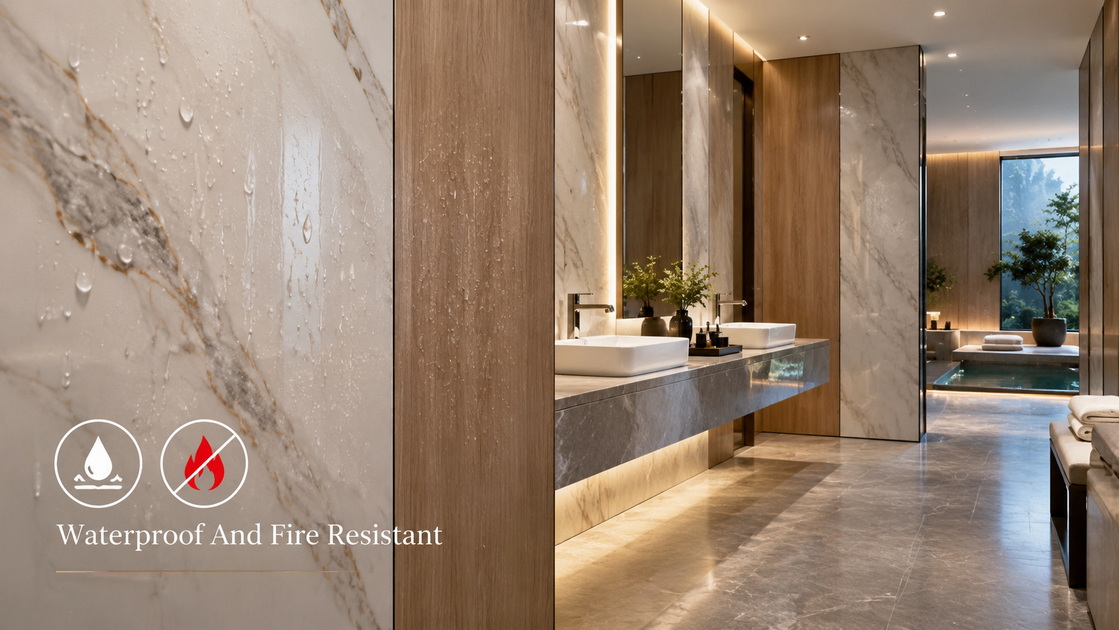
Paint delivers color, but most paint systems remain visually flat. Decorative wall panels can introduce geometry, texture, shadow, and material contrast.
For example:
- Fluted PVC or WPC wall panels create vertical rhythm and shadow lines.
- UV marble sheets provide a large-format stone-like appearance without installing natural stone.
- Wood veneer wall panels add warmth to executive offices, villas, boutique hotels, and premium retail spaces.
- PU decorative panels can imitate stone, concrete, leather, or sculptural surfaces while remaining lightweight.
- Acoustic slat panels combine linear wood aesthetics with sound-management potential.
In hospitality design, these effects matter because guests often judge a space within seconds. A well-designed wall can become a reception backdrop, a branded photo point, a headboard wall, or a visual divider that makes a standard room feel more intentional.
Moisture is one of the most important reasons to consider PVC or WPC wall cladding. Bathrooms, utility rooms, basements, spa corridors, kitchens, coastal properties, and hotel washroom-related areas can place constant stress on conventional wall finishes.
A properly specified waterproof PVC wall panel can be easier to clean and less sensitive to surface moisture than painted drywall. But buyers should distinguish between a waterproof panel surface and a fully waterproof wall system.
Before installation, evaluate:
- The condition of the structural wall behind the panel
- Existing leaks, condensation, or mold
- Joint-sealing requirements
- Adhesive compatibility
- Ventilation conditions
- Penetrations around outlets, pipes, and fixtures
- Whether the system is approved for the intended wet-area application
Important: A decorative panel should not be used to conceal an active water leak. Repair the building-envelope or plumbing issue first, then install the finished wall system.
In hotels and commercial interiors, walls are often damaged by luggage, carts, chairs, shoes, cleaning tools, and everyday traffic. Paint can scratch, chip, or show stains. A rigid wall-panel system can add a more protective face layer.
This makes panels especially useful for:
- Hotel corridors and elevator halls
- Restaurant seating areas
- Retail fitting rooms
- Reception areas
- Hospital and clinic waiting spaces
- Child-friendly residential interiors
- Rental apartments and serviced apartments
- Villa entryways and staircases
For high-traffic applications, consider darker finishes, textured surfaces, modular replacement capability, protective trims, and easy-to-clean material options.
Terms such as "fireproof," "fire-resistant," and "flame-retardant" are often used loosely in the decorative-materials market. Project owners, contractors, designers, and distributors should ask for the actual test standard, test report, sample construction, and classification—not rely on a general marketing claim.
In the United States, interior wall and ceiling finish materials are commonly evaluated under ASTM E84 or UL 723. These tests measure flame-spread index and smoke-developed index. Under the classifications referenced in building-code materials, Class A corresponds to a flame-spread index of 0–25 and a smoke-developed index of 0–450; Class B is 26–75 for flame spread, and Class C is 76–200, with the same smoke-developed limit.
For hotel, public, commercial, or export projects, request:
- The full fire-test report, not only a certificate image
- The test standard and issuing laboratory
- The tested material thickness and composition
- The exact backing, adhesive, substrate, and installation method where applicable
- Smoke-performance information
- Product identification matching the supplied goods
- Local-code confirmation from the architect, consultant, or authority having jurisdiction
A high-quality manufacturer should help customers match the correct panel construction to the project requirement. At Binmao Decor, this means discussing the real application before recommending a structure—whether that is PVC/WPC, E1/E0 MDF, wood veneer, PU, UV board, or an acoustic-backed panel.
Painted drywall is typically reflective. In a minimally furnished room with hard flooring, glass, stone, or metal, sound can bounce between surfaces and create an uncomfortable echo.
Acoustic wall panels can improve the perception of comfort by helping manage reverberation. This is especially relevant for:
- Meeting rooms
- Restaurants
- Hotel lounges
- Open-plan offices
- Home theaters
- Podcast and content-creation rooms
- Executive offices
- Educational facilities
- Villa entertainment spaces
Not every decorative slat panel is truly acoustic. The performance depends on the total assembly: face material, slat spacing, felt or acoustic backing, air cavity, insulation behind the panel, wall condition, and room geometry.
When acoustic performance is important, ask for a documented sound-absorption test result, such as an NRC-related report where applicable. Avoid assuming that "wood slat appearance" automatically equals measurable acoustic performance.
For many commercial projects, time is more expensive than material. A hotel room cannot generate revenue while it is closed for wet construction, sanding, repainting, and odor dissipation. A retail store may need to reopen before a campaign launch. A villa owner may need a clean renovation with limited disruption.
This is where dry-install wall-panel systems can create real project value.
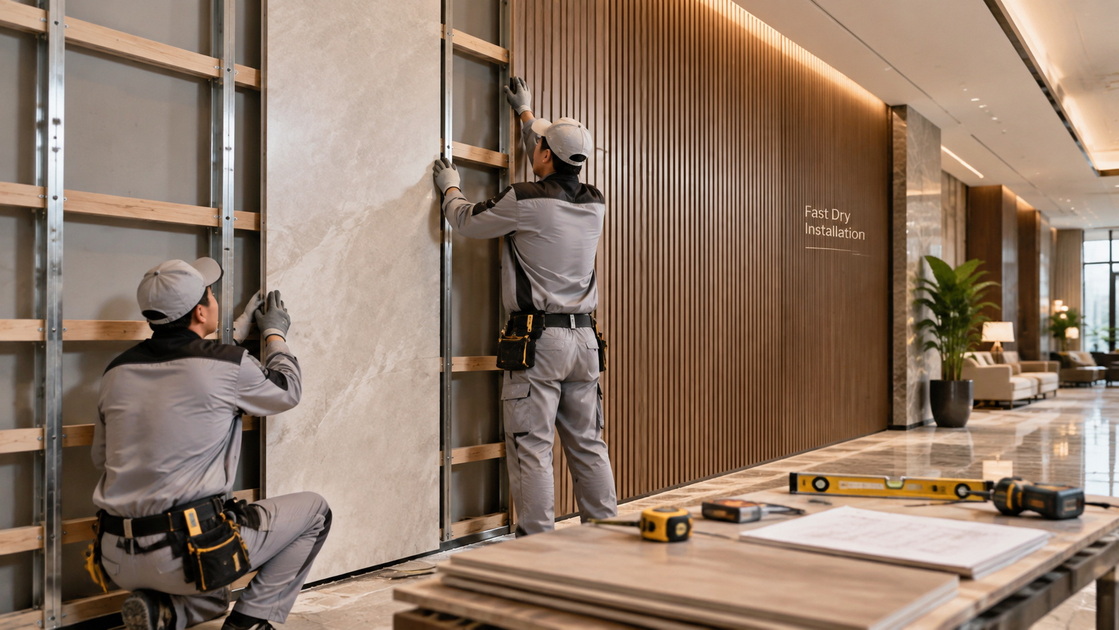
The right installation method depends on panel type, substrate condition, local requirements, and project scale.
1. Direct adhesive installation
Suitable for clean, dry, stable, and relatively flat wall surfaces. It can be efficient for lightweight panels but requires correct adhesive selection and surface preparation.
2. Nails, clips, or tongue-and-groove fixing
Often used for slat panels, interlocking systems, and timber-support applications. It can create a clean finish with concealed fasteners.
3. Batten or metal-framework installation
Useful for uneven concrete, brick, damaged drywall, or walls requiring a service cavity. This method may also support acoustic infill or concealed wiring.
4. Hybrid installation
Combines mechanical fixing and adhesive when project conditions or panel dimensions require extra security.
Before ordering, confirm panel dimensions, expansion gaps, cutting requirements, corner trims, transition profiles, electrical-box details, and installation tolerances.
Use this practical decision framework before selecting materials.
- You need the lowest initial finishing cost
- The wall is smooth, dry, and in good condition
- You expect to change colors often
- The area has low traffic and low moisture exposure
- Decorative texture and acoustic performance are not priorities
- You need a waterproof or wipe-clean decorative surface
- The project includes bathrooms, kitchens, basements, corridors, or humid zones
- The existing wall is uneven, old, cracked, or visually unattractive
- The space needs a premium feature wall or branded design
- Installation speed matters
- You need stronger impact resistance
- You want wood, stone, fluted, fabric, or 3D decorative effects
- The project requires an acoustic-backed wall solution
- You need custom sizes, finishes, structures, or installation support
- You want to control budget without sacrificing key visual areas
- You need durable paneling in the lower "impact zone" and paint above
- You want panels at bedsides, reception walls, corridors, and wet areas, but paint elsewhere
- You want painted color flexibility combined with panel texture
For example, a hotel corridor may use PVC/WPC protective wall panels around corners and lower wall areas, decorative UV or wood-grain panels around elevator halls, and paint on upper wall areas or ceilings. This approach balances durability, visual hierarchy, maintenance, and budget.
Generic panels may be acceptable for basic projects, but hotel, villa, and commercial buyers often need a system tailored to their project rather than a standard catalog item.
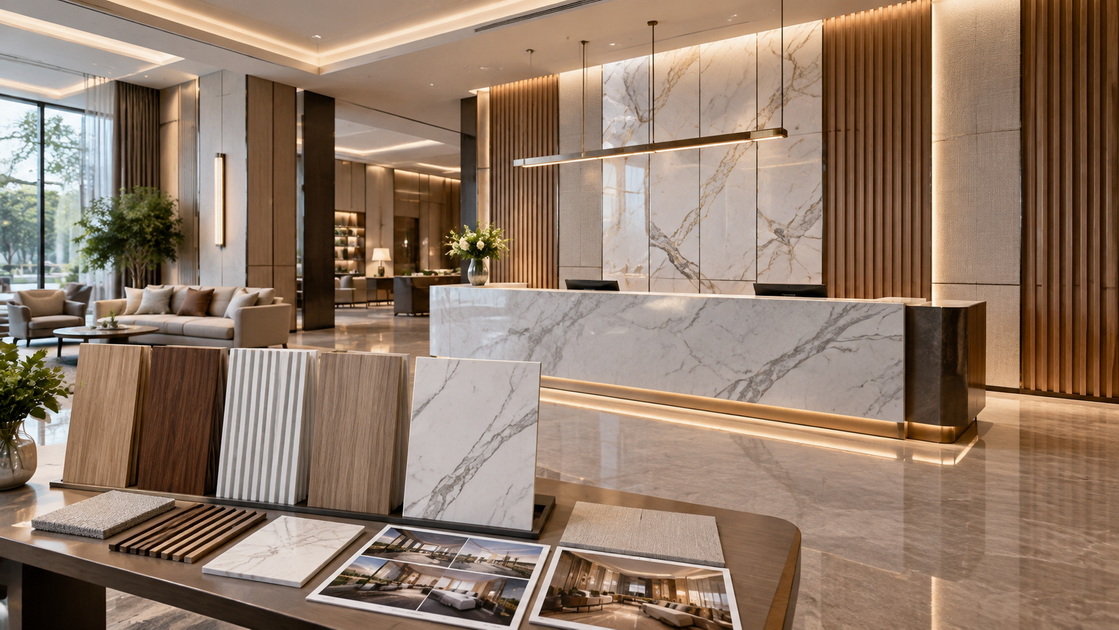
Binmao Decor can support wall-panel development based on project needs, including:
- Customized width and depth
- PVC, WPC, UV, PU, MDF, veneer, and composite constructions
- E1/E0 MDF options
- Oak, walnut, and other wood-veneer appearances
- Waterproof and mold-resistant panel options
- Fire-performance documentation based on available product systems
- Acoustic backing structures
- Surface finishes for modern, luxury, natural, or commercial interiors
- Installation guidance and technical support
- Product test-report support for international buyers
The best panel is not always the most expensive one. It is the one that matches the environment, design target, installation method, maintenance plan, and compliance requirements.
Paint remains a smart choice for simple, dry, low-wear spaces. But for projects where wall surfaces need to work harder, wall panels offer a broader performance package: decorative depth, moisture resistance, fast dry installation, easier cleaning, substrate coverage, impact protection, and optional acoustic functionality.
For modern hotels, villas, apartments, offices, restaurants, and commercial spaces, the question is rarely "paint or panels everywhere?" The smarter question is: which wall areas need long-term protection, premium visual impact, and faster project delivery?
Binmao Decor helps global buyers, designers, contractors, and distributors develop customized fast-install wall-panel solutions for real project conditions. Contact us to discuss your required dimensions, materials, finishes, fire-test documentation, waterproof needs, acoustic structure, and installation details—and request samples for your next project.
PVC wall panels can be a better option for suitable bathroom and moisture-prone applications because their surfaces can be waterproof and easy to wipe clean. However, installers must still manage joints, edges, penetrations, ventilation, and any existing leaks behind the wall.
Wall panels typically have a higher initial material cost than standard paint. However, their total project value can be stronger when they reduce surface-preparation work, installation time, repainting cycles, and wall-repair costs in high-use areas.
Often, yes. Direct installation may work on flat, stable surfaces. For uneven concrete, brick, cracked drywall, or rough walls, installers can use a wood-batten or metal-framework system to create a level mounting surface.
No. "Fireproof" should not be assumed from appearance or marketing language. Fire performance varies by material, thickness, backing, adhesive, and full wall assembly. Always request the relevant test report and check local code requirements before specification.
They can, but results depend on the complete panel assembly and the room itself. Panels with acoustic felt, an air cavity, suitable insulation, and appropriate coverage usually perform better than decorative slats installed directly on a hard wall.
Yes. A hybrid design is often the most cost-effective approach. Use panels for feature walls, high-contact zones, wet areas, and acoustic locations, while using paint on low-contact wall sections and ceilings.
Provide the project type, wall dimensions, desired finish, installation country, moisture exposure, fire-performance requirement, acoustic target, substrate condition, quantity, delivery schedule, and any drawings or reference images. This allows the manufacturer to recommend a more accurate panel structure.
1. George Panel. "[Wall Panels vs. Paint: Which Is the Best Investment for Modern Interiors?]" Accessed September 2026. Source used for review of the original article's structure, comparison points, and installation themes. [georgepanel]
2. Seattle Department of Construction and Inspections. "[2021 Seattle Fire Code, Chapter 8: Interior Finishes]." Source for interior wall and ceiling finish classification references under ASTM E84/UL 723. [seattle]
3. Society of Fire Protection Engineers. "[Trends in Interior Finish Requirements]." Source for explanation of ASTM E84-based Class A, B, and C flame-spread and smoke-developed classifications. [sfpe]
4. U.S. Environmental Protection Agency. "[Indoor AirPlus: How to Find Compliant Building Materials]." Source for VOC-emission considerations relating to site-applied paints, finishes, and coatings. [epa]
5. Intertek. "[ASTM E84: Standard Test Method for Surface Burning Characteristics of Building Materials]." Source for an overview of ASTM E84, flame-spread index, and smoke-developed index terminology. [intertek]


