
Views: 298 Author: Sunny Publish Time: 2026-09-17 Origin: Site


Content Menu
>> Supplier evaluation criteria
>> What "quality" means for interior wall panels
● Interior Wall Panel Supply Options for Kyrgyzstan
>> 1. Binmao Decor — Flexible OEM/ODM Wall Panel Supply for Export Buyers
>>> Core strengths
>>> Best fit
>> 2. Bishkek Construction-Material Wholesalers — Fast Access to Ready Stock
>>> Core strengths
>>> Limitations
>>> Best fit
>> 3. Kyrgyzstan Project Contractors and Interior Fit-Out Suppliers
>>> Core strengths
>>> Best fit
>> 4. Turkish Decorative Panel Suppliers — Design-Led MDF and Laminate Options
>>> Core strengths
>>> Limitations
>>> Best fit
>> 5. Chinese PVC and WPC Wall Panel Export Manufacturers
>>> Core strengths
>>> Buyer risks
>>> Best fit
>> 6. Eurasian Distribution Channels — Replenishment and Regional Warehousing
>>> Core strengths
>>> Limitations
>>> Best fit
● Why Kyrgyzstan Buyers Source Internationally
● Technical Requirements Buyers Should Specify
>> PVC wall panel RFQ checklist
>> WPC fluted wall panel RFQ checklist
>> MDF veneer and acoustic panel checklist
● The Hidden Risk Most Buyers Miss
>> Internal buyer tip: lock the "golden sample"
● Common Sourcing Problems and How to Avoid Them
● Buyer's Guide for Importing to Kyrgyzstan
>> 1. Start with a project-specific product brief
>> 2. Request samples in stages
>> 3. Verify factory identity and production scope
>> 4. Verify ISO certificates correctly
>> 5. Use third-party inspection before shipment
>> 6. Plan logistics around product fragility
● FAQ
>> 1. How can I verify whether a manufacturer's ISO certificate is expired or unrelated to the factory?
>> 2. Is a CE mark enough to prove that interior wall panels meet European compliance requirements?
>> 3. What is the safest first order quantity for a new wall-panel supplier?
>> 4. How do I compare PVC wall panels that look identical in photos?
>> 5. What should be included in an OEM wall-panel agreement?
Sourcing Interior Wall Panels for projects in Kyrgyzstan requires a different approach from sourcing in major manufacturing hubs. Kyrgyzstan has an active construction, renovation, hospitality, and retail-fit-out market, but its domestic decorative-panel manufacturing base is comparatively limited. Most buyers therefore work with a combination of local distributors, project contractors, regional importers, and export-oriented manufacturers—especially from China, Turkey, Russia, and neighboring Central Asian markets.
For professional procurement managers, the right supplier is not simply the one offering the lowest price per square meter. A dependable wall-panel partner should provide consistent material specifications, traceable test reports, stable lead times, clear packing standards, and enough OEM/ODM flexibility to support local market needs. This guide evaluates practical supplier types and leading sourcing options for buyers seeking PVC wall panels, UV marble sheets, WPC fluted panels, MDF veneer panels, PU stone panels, acoustic panels, and fire-resistant waterproof composite wall cladding for Kyrgyzstan.

This list is designed for buyers looking for long-term supply partners rather than one-off spot purchases. The evaluation framework focuses on the operational factors that affect project risk, product compliance, and repeat-order stability.
| Evaluation Area | What Buyers Should Verify | Why It Matters |
|---|---|---|
| Manufacturing capability | Factory equipment, production lines, raw-material control, monthly output, warehouse capacity | Helps prevent delayed delivery and inconsistent batches |
| Product range | PVC panels, UV sheets, WPC wall panels, MDF veneer panels, acoustic panels, PU panels, accessories | Reduces the need to manage multiple suppliers |
| Quality control | Incoming raw-material inspection, color matching, thickness checks, surface inspection, packing controls | Protects project quality and minimizes installation claims |
| Certifications and reports | ISO system certificates, CE-related declarations where applicable, SGS reports, fire-performance and formaldehyde tests | Supports commercial tenders, hotel projects, and regulated markets |
| Customization depth | Width, thickness, length, color, wood grain, finish, packaging, private label, accessories | Important for distributors, retailers, and branded projects |
| Export experience | Documentation, HS-code experience, packaging for long-distance transit, multilingual communication | Reduces logistics and customs mistakes |
| Lead-time reliability | Production scheduling, container-loading capability, spare-stock policy, clear production milestones | Critical for hotels, villas, retail chains, and contractor schedules |
| After-sales support | Installation instructions, trimming details, technical drawings, replacement policy | Helps local installers avoid avoidable defects |
Interior decorative panels may look similar in online photos while performing very differently after installation. Procurement teams should evaluate specifications by panel type rather than relying on generic claims such as "waterproof," "fireproof," or "eco-friendly."
For example:
- PVC wall panels should be checked for surface hardness, impact resistance, pigment consistency, wall thickness, joint accuracy, and deformation resistance.
- UV marble sheets should be evaluated for substrate quality, UV coating adhesion, gloss consistency, scratch resistance, and edge damage after cutting.
- WPC fluted wall panels require verification of wood-plastic formulation, extrusion stability, density, warpage resistance, color consistency, and clip or fastener compatibility.
- MDF veneer wall panels should be assessed by substrate emission grade, veneer thickness, lacquer quality, moisture resistance, and dimensional stability.
- Acoustic wall panels should be reviewed by slat spacing, felt density, backing composition, adhesive quality, and whether acoustic claims are supported by test data.
- PU stone or flexible stone panels should be checked for fire behavior, surface realism, density, impact resistance, edge protection, and installation adhesive compatibility.
For projects requiring European-market documentation, buyers should confirm exactly which product, material composition, and production batch the test report covers. A supplier's general brochure or a certificate issued for another product category is not enough.
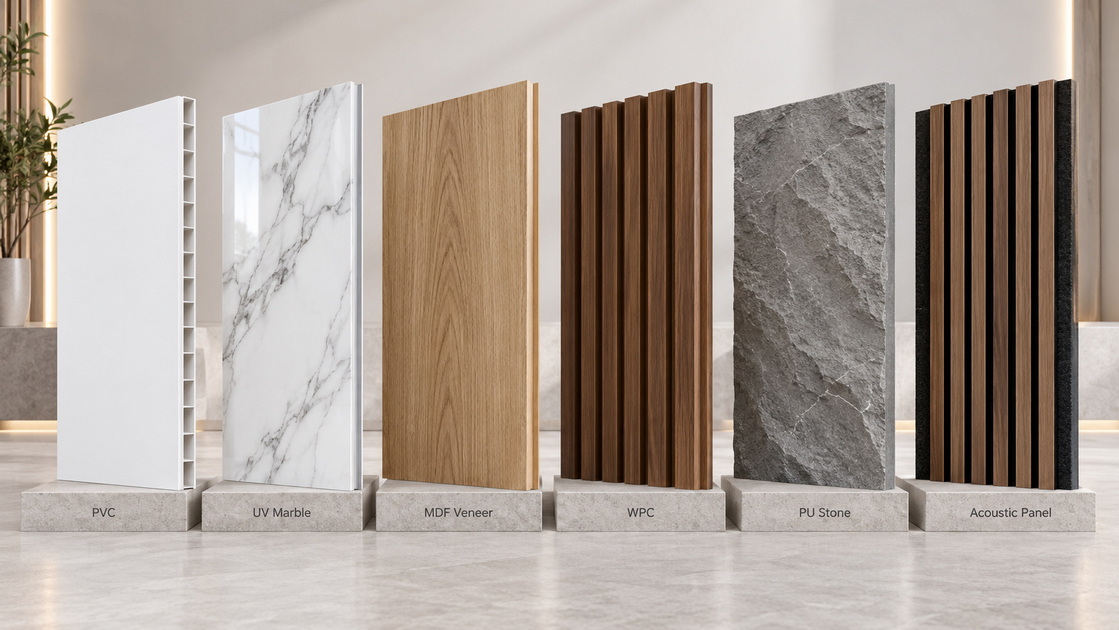
The following suppliers and sourcing channels represent practical options for buyers serving Kyrgyzstan's residential, hospitality, retail, villa, and commercial-interior sectors. The list includes an export-oriented manufacturer suitable for customized bulk purchasing, as well as local and regional sourcing channels that may be more suitable for smaller stock orders or project fulfillment.
| Supplier / Supply Channel | Base | Primary Focus | Typical MOQ | Capacity Position | Customization | Documentation Approach |
|---|---|---|---|---|---|---|
| Binmao Decor | Foshan, China | PVC/UV panels, WPC panels, MDF veneer panels, PU stone, acoustic solutions | Flexible by product and finish | Export-oriented factory supply | Strong OEM/ODM support | Product test reports and project-oriented specification support |
| Local construction-material wholesalers | Bishkek, Kyrgyzstan | Ready-stock PVC panels, decorative sheets, accessories | Low or stock-based | Distribution model | Limited | Varies by importer and product batch |
| Project-fit-out and interior contractors | Bishkek and major cities | Supply-plus-installation for hotels, retail, offices, villas | Project-based | Project delivery model | Moderate for design selection | Often project-specific |
| Regional Turkish panel suppliers | Turkey / Central Asian distribution | MDF, laminate, decorative boards, wall cladding | Medium to high | Established regional export supply | Moderate to strong | Often suitable for commercial-grade interior products |
| Chinese PVC/WPC export factories | China | PVC ceiling panels, PVC wall panels, WPC cladding, UV sheets | Usually container or mixed-container dependent | High-volume manufacturing | Strong, but varies by factory | Must be verified product by product |
| Russian and Eurasian distributors | Russia / Eurasian trade routes | Decorative panels, laminate boards, accessories | Distributor dependent | Regional warehousing | Limited to stocked lines | May simplify replenishment but product selection varies |
The table should be treated as an initial sourcing map, not a substitute for factory audits, samples, contracts, or third-party inspection.
Binmao Decor is a China-based decorative-materials manufacturer and export supplier positioned for buyers seeking a broad range of fast-installation interior wall systems. Its portfolio includes PVC wall panels, UV wall panels, fluted wall panels, WPC decorative panels, PU stone panels, SPC flooring-related products, MDF-based decorative solutions, veneer finishes, and project-oriented wall-cladding accessories.
For Kyrgyzstan-focused importers, distributors, hotel-project contractors, and growing building-material brands, Binmao Decor is particularly relevant when the requirement goes beyond standard ready-stock panels. The company is suitable for buyers who need coordinated materials, customizable dimensions, finish matching, private-label packaging, and product documentation that can be reviewed before shipment. Binmao Decor presents itself as an export-oriented China factory supplying customized wall-panel and flooring products.
- Supports waterproof decorative-panel solutions for bathrooms, corridors, kitchens, retail interiors, hotel spaces, villas, and renovation projects.
- Offers material choices including PVC/WPC structures, UV-coated panels, MDF panels in E1/E0-related specifications, wood-veneer finishes such as oak and walnut, PU decorative surfaces, and acoustic backing structures.
- Can support customization of panel width, thickness, length, surface color, wood grain, profile style, packaging, and accessory matching.
- Provides technical guidance for installation, including joining profiles, edge trims, substrate preparation, cutting considerations, and product application recommendations.
- Better suited than many high-MOQ factories for importers and mid-sized brands that need practical communication and deeper OEM coordination.
- Located in Foshan, Guangdong, a major Chinese manufacturing region associated with building materials, furniture, ceramics, aluminum profiles, lighting, and interior-finish supply chains.
Binmao Decor can be considered by buyers needing:
- Private-label wall-panel collections for a local showroom or distributor network.
- Mixed product lines, such as PVC marble sheets plus WPC fluted panels plus trims.
- Custom colors or wood-grain styles aligned with hotel, villa, apartment, or retail concepts.
- Product samples before committing to a container order.
- Custom carton artwork, logos, barcode labels, and packing configurations.
- Installation guidance for local contractors who may be unfamiliar with Chinese panel profiles.
Binmao Decor is a practical candidate for buyers that value flexibility, efficient communication, product-development support, and a broader decorative-material portfolio rather than sourcing only one basic PVC panel specification.
Before placing an order, request the applicable test reports for the exact product structure, surface finish, thickness, and intended use. For example, a fire-rating report for a PU stone panel should not automatically be treated as evidence for an MDF veneer panel or a PVC hollow panel.
Bishkek remains the most practical local sourcing center for many Kyrgyzstan-based buyers because it concentrates importers, building-material markets, renovation contractors, logistics agents, and retail showrooms. Local wholesalers typically carry standard PVC ceiling panels, basic PVC wall panels, decorative sheet materials, trims, adhesives, and fasteners.
This channel is often appropriate for small renovation contractors, retailers needing quick replenishment, or projects where speed matters more than private-label customization.
- Faster local availability than overseas factory production.
- Lower minimum purchase quantities for standard stock items.
- Easier physical inspection before purchase.
- Local currency transactions may simplify small procurement.
- Suitable for emergency replacement materials and small commercial renovations.
- Product origin and exact material composition may not always be transparent.
- The same visual design may change between incoming import batches.
- Technical documentation may be unavailable, incomplete, or not linked to the exact stock item.
- Color matching can be difficult for repeat project orders.
- Custom sizing, branded packaging, and unique finishes are usually limited.
Use local wholesalers when you need standard panels immediately, when the order is too small for direct import, or when you need spare materials for a completed project. For long-term distribution programs, request supplier traceability and consider maintaining a direct relationship with the upstream manufacturer.
Some buyers prefer a supply-and-installation model rather than purchasing panels separately. Interior contractors and fit-out companies may provide design coordination, material supply, installation crews, transportation, and warranty responsibility for hotels, restaurants, retail stores, apartment common areas, offices, and villas.
This option can reduce coordination effort for property owners and developers. However, it may be less transparent for buyers seeking factory-level pricing or independent material control.
- Combines material selection and installation accountability.
- Can coordinate site measurement, wall preparation, lighting integration, trims, and finishing details.
- Reduces the risk of installation errors from inexperienced labor.
- Useful for hospitality and retail projects with fixed opening dates.
- Which manufacturer produced the proposed wall panels?
- What is the exact panel construction and thickness?
- Are fire, emissions, moisture, and installation claims supported by reports?
- Is the quoted price based on net panel area or gross panel area including waste?
- Which accessories, adhesives, battens, fasteners, and trim profiles are included?
- Who is responsible if a finish batch differs from the approved sample?
- Is the warranty covering material only, installation only, or both?
This route is suitable for property owners and developers who prioritize project execution. Distributors and brand owners usually need more direct control and should source from manufacturers or importers instead.
Turkey has a strong furniture, board, door, laminate, and interior-decoration manufacturing ecosystem. Turkish suppliers are often considered by Central Asian buyers looking for MDF-based wall panels, laminated boards, decorative profiles, engineered-wood products, and more design-led interior finishes.
For Kyrgyzstan importers, Turkish suppliers may offer a middle ground between local stock availability and direct sourcing from China. They can be a useful option for premium commercial interiors, furniture-integrated wall systems, and MDF or wood-based decorative applications.
- Broad experience with MDF, laminated board, furniture components, interior doors, and decorative surfaces.
- Product designs may align well with commercial interiors, cabinetry, hotel rooms, offices, and residential projects.
- Geographic and trade connections can be favorable for Central Asian supply chains depending on route, customs, and freight conditions.
- Often suitable for buyers looking for coordinated furniture and wall-decoration collections.
- Not every Turkish decorative-board supplier specializes in waterproof PVC or WPC wall panel systems.
- Buyers must distinguish between decorative furniture board and wall cladding designed for wet-area or high-moisture environments.
- Pricing may be higher than high-volume Chinese PVC/WPC options.
- MOQ and payment requirements may be less flexible for new distributors.
Turkish suppliers are worth evaluating when the product brief emphasizes MDF, veneer, melamine, laminate aesthetics, furniture integration, or a premium residential and hospitality positioning.
China remains the largest practical sourcing base for buyers requiring a broad variety of interior wall-panel systems, competitive tooling options, color and profile customization, and container-scale production. Production clusters are concentrated in regions such as Guangdong, Zhejiang, Shandong, Jiangsu, and Hebei, depending on the panel category and manufacturing process.
For example, Haining Longtime Industry states that it was established in 2005 and developed from PVC ceiling and wall panel manufacturing into decorative films and fluted wall panels, demonstrating the type of specialized PVC/WPC supplier available in China. Other manufacturers focus more narrowly on WPC panels, PVC sheets, or project-specific decorative systems.
- Large supplier pool across PVC, WPC, UV-coated sheets, PU stone, SPC-related systems, acoustic panels, MDF panels, and accessories.
- Strong potential for custom extrusion profiles, surface films, UV printing, lamination, embossing, and branded packaging.
- Competitive container-level pricing for standardized products.
- Easier mixed-container sourcing if managed through a qualified factory or consolidated supplier.
- Broad availability of OEM/ODM services.
- Product quality varies widely even among panels with identical online images.
- Some suppliers trade products rather than manufacture them.
- "Fireproof" may mean only a basic material characteristic rather than a verified fire-performance classification.
- Panels may use different core formulas, wall thicknesses, and surface-film grades while being sold under the same name.
- Sample quality can differ from mass-production quality if specifications are not contractually locked.
Chinese export factories are most effective for importers, distributors, contractors, and private-label brands planning medium-to-large volume, customized product collections, or repeat container orders.
Russian and broader Eurasian distributors may supply decorative wall cladding, laminate-based boards, PVC products, trims, and construction finishing materials to nearby markets. This route can be practical where buyers value shorter replenishment cycles or wish to purchase from a regional warehouse rather than manage direct overseas imports.
However, availability can fluctuate due to freight, currency, inventory cycles, and cross-border trade conditions. Buyers should compare landed cost—not only unit price—against direct imports from China or Turkey.
- Potentially shorter restocking cycles for selected products.
- May provide familiar regional documentation and sales support.
- Suitable for distributors needing smaller replenishment orders.
- May reduce the administrative workload of direct factory importing.
- Product assortment depends on warehouse stock.
- Custom OEM/ODM opportunities are generally limited.
- Technical specifications may be inherited from upstream suppliers and not independently verified by the distributor.
- Price competitiveness can change quickly based on exchange rates and logistics conditions.
Regional distribution is a practical secondary source for replacement stock, smaller retail orders, and products where customization is not essential.
Kyrgyzstan's construction and renovation demand is shaped by urban development, residential upgrades, retail expansion, hotel renovation, and commercial real-estate projects. Bishkek is the central commercial hub, while demand also comes from Osh and regional projects requiring moisture-resistant, easy-to-install, visually consistent finishing materials.
However, the domestic market is more strongly positioned as an import, distribution, and project-installation market than as a global-scale manufacturing base for advanced wall-panel systems. This creates a sourcing reality:
- Local suppliers can offer convenience, faster delivery, and low-quantity purchases.
- Regional suppliers can offer selected design and warehousing advantages.
- Chinese manufacturers typically offer stronger customization, broader product coverage, and lower unit cost at scale.
- Turkish suppliers can be attractive for MDF, wood-based, and premium decorative interior applications.
- A dual-sourcing strategy often works best: retain local stock for urgent projects while importing customized core collections directly from qualified factories.
For distributors, the opportunity is not simply to sell panels. It is to build a reliable system around samples, color cards, accessories, installation instructions, project photography, and replacement-stock discipline.
A professional RFQ for interior wall panels should go beyond "PVC wall panel, waterproof, white color." Ambiguous requests cause vague quotations, inconsistent samples, and disputes after shipment.
Include:
- Panel type: hollow PVC, foam PVC, laminated PVC, PVC marble sheet, UV board, or other construction.
- Panel dimensions: width, thickness, length, and allowable tolerance.
- Surface: matte, high gloss, wood grain, marble print, film lamination, UV coating, embossed texture, or co-extrusion.
- Core structure: hollow-cell pattern, foam density, wall thickness, or substrate composition.
- Application: bathroom, kitchen, corridor, hotel room, lobby, retail wall, ceiling, or decorative partition.
- Fire requirement: specify required standard and target classification rather than writing only "fireproof."
- Packaging: pieces per carton, corner protection, palletization, moisture protection, and container-loading method.
- Accessories: U-trim, H-trim, L-trim, corner profiles, skirting, adhesive, clips, and fasteners.
- Brand requirements: logo, carton artwork, labels, barcodes, product manuals, and sample boards.
Include:
- Surface type: PVC film, hot stamping, co-extruded layer, wood-grain film, or painted finish.
- Panel profile: slat width, groove depth, backing thickness, overall face width, and connection structure.
- Material formulation: requested WPC/PVC composition or performance target.
- Indoor application details: dry indoor wall, semi-humid corridor, bathroom exterior wall, hotel reception, or ceiling.
- Surface durability: scratch resistance, UV fading expectations for sunlit interiors, and cleaning requirements.
- Installation method: adhesive only, screws, concealed clips, wood battens, metal framing, or direct wall mounting.
- Batch consistency: approved color standard and visual tolerance.
Include:
- MDF emission class: E1, E0, CARB Phase 2, TSCA Title VI, or other applicable requirement.
- Core: standard MDF, moisture-resistant MDF, fire-rated MDF, plywood, PET felt, or acoustic backing.
- Veneer: natural oak, walnut, ash, teak, smoked oak, engineered veneer, melamine, or PVC film.
- Coating: PU lacquer, UV coating, water-based coating, oil finish, or matte finish.
- Acoustic construction: felt composition, slat spacing, backing thickness, and any tested acoustic performance.
- Edge treatment: square edge, micro-bevel, concealed joint, tongue-and-groove, or trim-based finishing.
The most overlooked risk in the interior wall panel trade is not the headline panel price. It is the difference between the approved sample specification and the actual mass-production bill of materials.
A panel can look acceptable when viewed under factory showroom lighting but fail during installation because of small, cumulative differences:
- The surface film is thinner than the approved sample.
- The panel's real wall thickness is lower than the quotation.
- The UV coating has lower scratch resistance.
- The WPC profile has a weaker internal rib structure.
- The MDF core has a different density or emission grade.
- The wood-grain batch shifts warmer or cooler.
- The trim profile does not match the panel thickness.
- The adhesive selected by installers reacts poorly with the panel backing.
- Cartons lack adequate corner protection, resulting in damaged edges after long-distance transport.
Experienced importers do not approve a product only by product name or catalog code. They create a golden sample system.
A golden sample should include:
- One signed physical sample from the approved production specification.
- A product code and revision number.
- Exact dimensions and tolerance range.
- Panel weight per piece or weight per square meter.
- Surface finish reference.
- Core material description.
- Packaging configuration.
- Required accessories and profiles.
- Photo records under neutral lighting.
- Test-report references linked to that product type.
- A signed pre-shipment inspection checklist.
The factory should retain one matched sample, and the buyer should retain one. This process is especially important for repeat orders, multi-container orders, hotel projects, and private-label programs.
| Common Problem | Why It Happens | How to Reduce the Risk |
|---|---|---|
| Panel thickness is lower than quoted | Buyers approve only photos or general catalogs | Specify minimum thickness, tolerance, and random inspection method |
| “Waterproof” panel warps after installation | Product is used in unsuitable heat, moisture, or wall conditions | Confirm application limits, installation method, and expansion gap requirements |
| Color differs between containers | No signed color standard or batch control | Approve a physical color standard and require batch identification |
| Fire claim is unclear | Supplier uses generic marketing language | Request test standard, report number, issuing body, sample description, and validity |
| MDF emissions are uncertain | Certificate is unrelated to the actual board used | Request substrate supplier information and a report matching the core material |
| Edges arrive damaged | Weak cartons, no corner protection, poor palletization | Approve packing photos and require pre-shipment drop/handling controls |
| Accessories do not fit | Panels and trims come from different sources | Order matching profiles from the same factory and test-install them |
| Sample quality differs from production | No approved BOM or production sample confirmation | Use golden samples and pre-shipment inspection |
| MOQ becomes higher after sampling | Custom film, printing, or profile tooling has hidden limits | Confirm MOQ by color, profile, finish, and packaging before development |
| Installation complaints increase | Installers lack technical instructions | Request installation manuals, cutting guidance, and recommended adhesives |
Do not request quotations from ten suppliers using only a photo. Build a one-page specification sheet covering intended application, product dimensions, surface finish, annual volume, target price range, packaging needs, compliance requirements, and delivery destination.
For example:
"We require indoor WPC fluted wall panels for hotel corridor and lobby use in Bishkek. Target width: 160–200 mm. Target thickness: 18–25 mm. Matte walnut surface. Quantity: one 40HQ trial order with repeat potential. Need matching trims, English/Russian installation guide, carton artwork with private label, and product-specific moisture/fire documentation."
A clear brief produces comparable quotations and reduces the chance that suppliers quote incompatible products.
A reliable sample process usually has three stages:
1. Catalog sample: Used to compare colors, textures, and panel structures.
2. Customized development sample: Used to approve your selected size, color, finish, and packaging concept.
3. Pre-production sample: Used to confirm the actual production-ready version before mass manufacturing.
Do not approve a custom order based solely on a catalog sample that may have been produced using different materials or a different surface film.
Before paying a deposit, request:
- Business registration details.
- Factory address and production-line photos or videos.
- Product catalog matched to actual manufacturing capability.
- Quality-control workflow.
- Recent container-loading records with sensitive buyer information removed.
- Test reports for the exact product category.
- References from relevant export markets where possible.
- Video call through the factory floor, warehouse, sample room, and packing area.
- Confirmation of whether the supplier is the manufacturer, trading company, or a hybrid model.
A trading company is not automatically a poor choice. It may provide valuable sourcing, consolidation, inspection, and communication services. The risk appears when a supplier claims to be a factory but cannot explain where or how the product is made.
A valid ISO certificate should be checked using more than a PDF file. Buyers should verify:
- Certificate number.
- Legal company name.
- Factory address.
- Scope of certification.
- Issuing certification body.
- Accreditation mark and accreditation body.
- Issue date and expiry date.
- Whether surveillance audits are still current.
- Whether the certificate covers manufacturing rather than only sales or trading activities.
If the certification body has an online database, search the certificate number and legal entity name. If the supplier provides a certificate for a parent company, confirm that the actual production site is included within the certified scope.
For a first order, a pre-shipment inspection is usually a practical risk-control measure. An inspection checklist should include:
- Quantity count.
- Color consistency.
- Dimensions and thickness.
- Surface defects.
- Edge condition.
- Panel straightness and warpage.
- Film adhesion or coating quality.
- Packaging strength.
- Carton marks.
- Accessory matching.
- Container loading condition.
For commercial projects, consider inspecting not only finished products but also the first production batch before full-scale output begins.
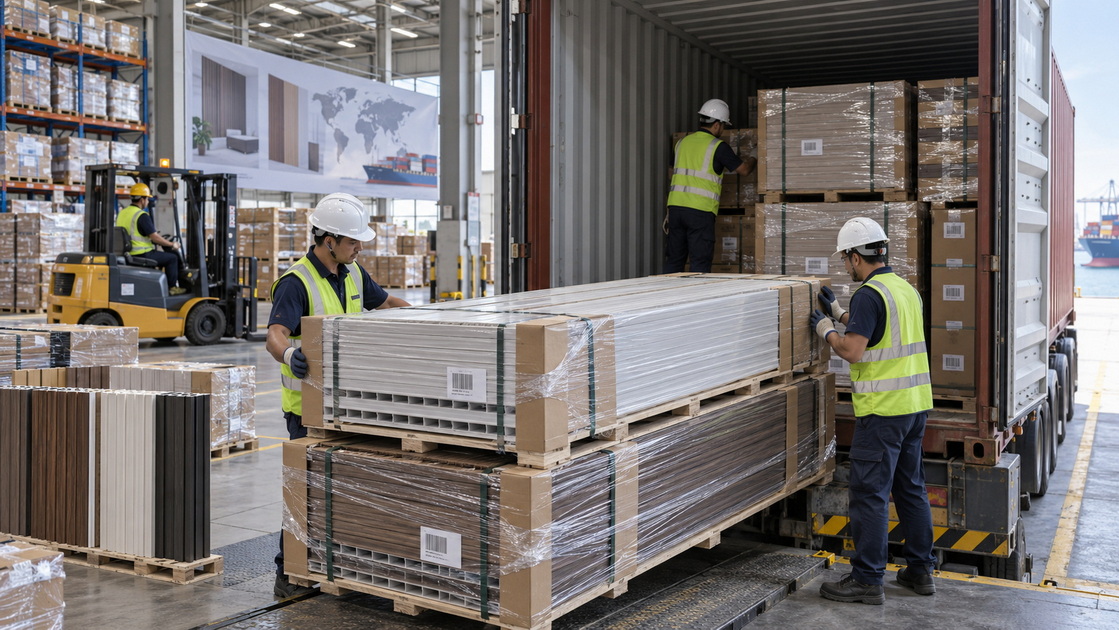
Wall panels can be lightweight but bulky, which makes container utilization, protective packaging, and damage prevention important. Buyers should confirm:
- Container type: 20GP, 40GP, 40HQ, or LCL.
- Maximum panel length compatible with the selected container.
- Whether long panels need special loading protection.
- Carton stacking limits.
- Pallet or non-pallet loading method.
- Corner guards, protective film, moisture barriers, and straps.
- Whether the container floor is dry and clean before loading.
- Required customs documents for Kyrgyzstan and any transit country.
- Incoterms: EXW, FOB, CFR, CIF, DAP, or another agreed arrangement.
- Insurance responsibility.
For new buyers, FOB or CIF arrangements can be simpler than EXW because they reduce the risk of uncoordinated inland transport from the factory. However, the best Incoterm depends on your freight forwarder, import experience, and control over the logistics chain.
For buyers seeking Interior Wall Panels in Kyrgyzstan, the most effective sourcing strategy is usually not limited to one local seller or one overseas factory. Local distributors can support urgent replenishment and low-volume purchases, while export manufacturers can provide deeper product customization, private-label support, more consistent production control, and stronger cost efficiency for container-scale programs.
Binmao Decor is a relevant option for procurement teams looking for customizable PVC, UV, WPC, MDF veneer, PU stone, and acoustic wall-panel solutions backed by export-oriented communication and technical support. Its position in Foshan also provides access to China's broad decorative-building-material supply ecosystem.
Before selecting any supplier, request product-specific samples, verify documentation, establish a golden sample, confirm the bill of materials, inspect pre-shipment production, and ensure that packaging is designed for the actual Kyrgyzstan logistics route. These steps matter more than a small difference in quoted unit price.
If you are building a wall-panel distribution line, preparing a hotel or villa project, or developing a private-label collection for the Kyrgyzstan market, begin with a detailed RFQ and a structured sample-and-inspection process. This will help you identify a supplier capable of supporting repeat orders—not simply the first shipment.
Ask for the certificate number, legal entity name, factory address, scope, issue date, expiry date, issuing body, and accreditation information. Then check the issuing certification body's database if available. Confirm that the certificate covers the manufacturing site and relevant activity—not merely a sales office or unrelated product category.
No. A CE mark should not be treated as a blanket quality guarantee. Whether CE marking applies depends on the product category and applicable European rules. Buyers should request the relevant declaration, test reports, product identification, and evidence that the document applies to the exact material structure being purchased. For wall panels, fire behavior, formaldehyde emissions, and construction-product requirements may require different documentation depending on the market and application.
For many importers, a trial order based on one mixed container or one standardized container load is safer than immediately committing to a large annual contract. The best quantity depends on MOQ, product value, warehouse capacity, local demand, shipping cost, and the ability to sell slow-moving colors. Start with a controlled SKU range and reserve broader customization for repeat orders after quality and delivery performance have been verified.
Compare measurable specifications: total thickness, wall thickness, weight per square meter, core structure, surface-film thickness, UV coating type, scratch resistance, panel flatness, impact resistance, joint design, trim compatibility, packaging, and test reports. Request cut samples so you can inspect the internal profile rather than judging only the front surface.
At minimum, include the product drawing, material construction, approved color standard, dimensions and tolerances, surface finish, packaging requirements, private-label artwork, testing requirements, inspection procedure, delivery time, payment terms, claim process, spare-parts policy, intellectual-property ownership for custom artwork, and conditions for repeat-order color consistency.
1- [Binmao Decor official website] — company overview and stated product focus, including SPC flooring, PVC/UV/fluted wall panels, PU stone, and custom wholesale supply. [binmaomaterials]
2- [Binmao Decor / Guangdong Binmao New Building Materials Co., Ltd.] — company information and Foshan, Guangdong location details. [binmaodecor]
3- [Haining Longtime Industry Co., Ltd.] — example of a Chinese PVC ceiling, PVC wall-panel, decorative-film, and fluted-wall-panel manufacturer established in 2005. [ltpvcfactory]
4- [European Commission: Construction Products Regulation] — official EU information on construction-product rules and CE-marking context.
5- [International Organization for Standardization] — official source for ISO standards and certification-system background.
6- [European Accreditation] — information on accreditation and conformity-assessment bodies.
7- [World Bank Data: Kyrgyz Republic] — macroeconomic and development indicators useful for high-level market context.
8- [Statista] — market-research platform for construction, interior, housing, and building-material sector data; consult the latest available regional reports for current project planning.


