
Views: 266 Author: Sunny Publish Time: 2026-09-02 Origin: Site


Content Menu
● Why Guinea Is a Sourcing Market
>> Important compliance clarification
● Leading Suppliers for Guinea
>> 1. Binmao Decor — Flexible OEM Partner for Waterproof Interior Systems
>> What buyers should still verify
>> 2. George Panel — Broad Decorative Wall-Panel Range
>> 3. OPPEIN — Integrated Interior-Project Capability
>> 4. COOWIN — WPC-Focused Interior and Composite Panels
>> 5. DECNO — SPC and Renovation-Oriented Systems
>> 6. MUMU — Custom Wood and Hospitality-Grade Panels
>> 7. CYATCO — Architectural Acoustic Systems
>> 8. FeltCombo — PET Acoustic and Wood-Slat Panel Programs
>> 9. Protex — SPC Systems for Distribution Programs
>> Choose the panel by application
>> The hidden risk: calcium-carbonate loading
>> The second hidden risk: a test report for a different product
>> The third hidden risk: "100% waterproof" without system design
● Import and Verification Checklist
>> How to verify ISO certification
>> 1. How can I verify that an ISO 9001 certificate has not expired or been misused?
>> 2. Is CE marking mandatory for PVC or WPC interior wall panels shipped to Guinea?
>> 3. What fire documents should I request for a hotel wall-panel project?
>> 4. How should I compare two PVC wall panels with the same thickness?
>> 5. What is a safe first-order process for a new supplier?
Guinea's interior wall-panel market is primarily import-led, rather than being supported by a large domestic manufacturing base. For procurement managers, contractors, hotel developers, and distributors in Guinea, the practical task is therefore not simply to find a "Guinean factory," but to identify qualified international manufacturers and local supply partners that can provide stable specifications, verifiable test documentation, export-ready packaging, and dependable support for projects in Conakry and beyond.
This guide reviews manufacturers and supplier types that can serve Guinea's growing hospitality, residential, retail, office, and infrastructure-related finishing market. It also explains how buyers should evaluate PVC wall panels, WPC panels, UV marble sheets, wood veneer panels, acoustic wall systems, and fire-retardant composite panels before committing to a container order or a project contract.
Guinea still imports most construction and finishing materials, while construction activity in Conakry has remained an important driver of demand. The U.S. International Trade Administration notes that most construction materials in Guinea must be imported. Guinea's investment-promotion platform also estimates that approximately 90% of finishing materials—including tiles, paints, fixtures, and glass—are imported, highlighting a clear opportunity for specialist wall-finish distributors and project suppliers.
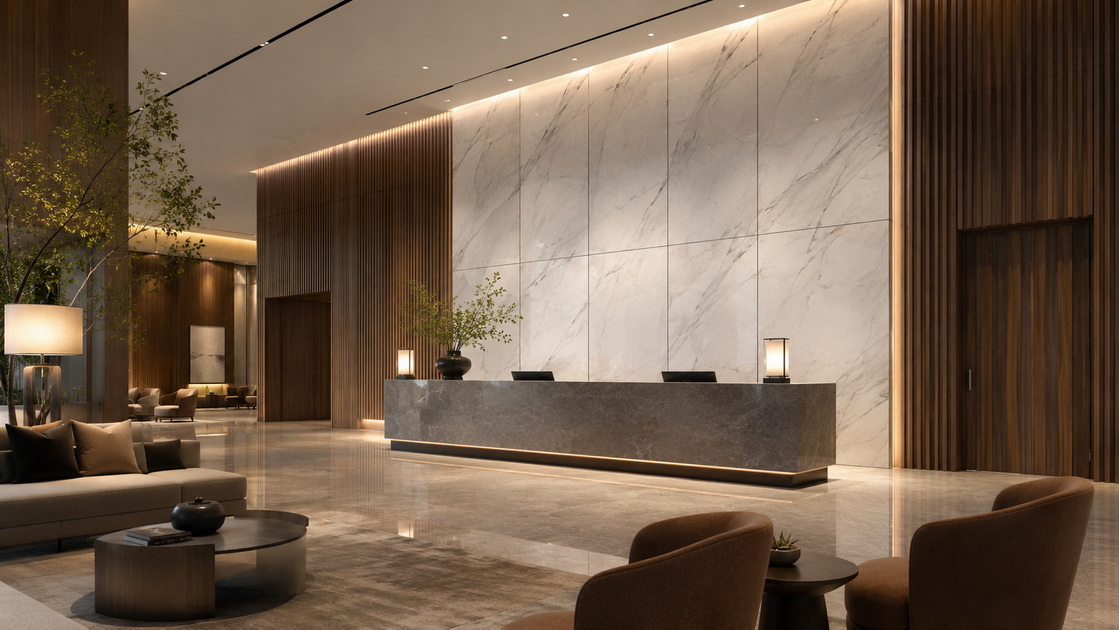
Guinea is not yet widely recognized as a global production hub for decorative interior wall panels. Unlike Foshan and Guangzhou in China for building-decoration materials, or Dongguan and Jiangmen for customized wood and composite finishing systems, Guinea's current market is more accurately described as a distribution, import, and project-installation market.
That distinction is important for international buyers and local distributors. A company promoting itself as a "Guinea wall-panel supplier" may be:
- A local importer or hardware distributor
- A project contractor sourcing products order by order
- A trading company without panel-production capability
- An overseas manufacturer with distribution partners in Guinea
- A regional West African wholesaler supplying Conakry from another country
For buyers, the commercial opportunity lies in supplying products that solve real local conditions:
- High humidity and mold risk in coastal environments
- Demand for quick renovation in hotels, rentals, offices, and retail spaces
- Limited tolerance for long wet-trade construction cycles
- Need for easy-to-clean surfaces in commercial interiors
- Requirement for compact, stackable, export-safe packaging
- Growing preference for decorative finishes that offer a marble, wood, fluted, or acoustic appearance without the cost and installation time of natural materials
Guinea's official investment platform describes an annual construction-material import bill of approximately US$1.2 billion and identifies finishing materials as a major import category. Its figures should be treated as investment-promotion estimates rather than a substitute for HS-code-level import analysis, but they reinforce a key sourcing conclusion: imported finishing systems remain central to the market.
For most panel buyers serving Guinea, the strongest model is:
1. Source technically defined panels from a proven export manufacturer.
2. Consolidate accessories, trims, adhesives, and installation tools.
3. Use a local distributor or project partner for customs clearance and site delivery.
4. Establish approved installation procedures before project rollout.
5. Maintain safety stock for matching trims, replacement panels, and high-turnover finishes.
This approach is usually more reliable than buying a low-priced mixed container from unrelated traders.
This is not a "best of" ranking. It is a procurement-focused shortlist based on the capabilities buyers should verify when selecting an interior wall panel manufacturing partner for Guinea.
| Criterion | What professional buyers should verify | Why it matters in Guinea projects |
|---|---|---|
| Manufacturing identity | Business registration, factory address, production lines, workshop videos, audit access | Separates actual producers from trading-only sellers |
| Material control | PVC resin grade, calcium-carbonate ratio, WPC formulation, MDF class, veneer species, adhesive system | Affects panel rigidity, odor, color stability, moisture resistance, and service life |
| Fire performance | Applicable test standard, report number, issuing laboratory, product construction tested | “Fireproof” is not a universal claim; performance depends on the exact panel build-up |
| Moisture performance | Water absorption, swelling, mold-resistance data, edge-sealing design | Essential for humid coastal and wet-area-adjacent installations |
| Environmental documentation | Formaldehyde class for MDF, VOC evidence where applicable, material safety documentation | Reduces health, compliance, and tender risk |
| OEM/ODM capability | Width, thickness, surface film, color, texture, branding, packaging, trim compatibility | Necessary for distributors and projects seeking differentiated collections |
| Quality control | Incoming-material inspection, in-process checks, final inspection, batch traceability | Prevents mixed shades, weak lamination, thickness variation, and damaged panels |
| Delivery reliability | Raw-material sourcing, capacity planning, lead-time commitments, export packing standard | Important when ocean transit and port delays add uncertainty |
| After-sales support | Installation drawings, cutting guidance, trim system, replacement policy | Reduces avoidable site failures and rework |
Buyers often ask for "CE" and "RoHS" as if they automatically apply to every wall-panel product. That is not always technically correct.
For construction products covered by a relevant harmonized European standard or European Technical Assessment, the European Commission states that the manufacturer must provide a Declaration of Performance and apply CE marking. The CE mark relates to the product's declared performance under the Construction Products Regulation, not a general marketing statement that a panel is "European quality."
RoHS primarily regulates hazardous substances in electrical and electronic equipment. It may be relevant where wall systems incorporate lighting, electronic controls, or electrical components, but it should not be requested as a blanket substitute for construction-product or indoor-air-quality evidence.
For interior wall panels, buyers should normally prioritize the documents that match their product and market, such as:
- Fire-test report for the exact panel construction
- Formaldehyde/emission evidence for MDF- or wood-based substrates
- Product technical data sheet
- Declaration of Performance where CE/CPR applies
- ISO 9001 quality-management certification, if held
- Factory inspection report
- Third-party pre-shipment inspection report
- Country-specific or project-specific compliance documents
The companies below should be treated as a practical sourcing shortlist, not as a claim that each operates a local manufacturing factory in Guinea. Because Guinea relies heavily on imported construction materials, the relevant question is whether a supplier can reliably serve Guinea-bound orders with technically suitable products, documentation, and export support.
| Supplier / supplier type | Manufacturing base | Core wall-panel focus | Suitable buyer profile | Typical MOQ approach* | Documentation to request |
|---|---|---|---|---|---|
| Binmao Decor | China | PVC wall panels, UV panels, waterproof/fire-retardant composite wall systems, MDF and wood veneer options | Distributors, mid-sized brands, hotel/villa/commercial project buyers | Flexible by profile, finish, and customization level | Material specification, test reports, QC records, packaging standard |
| George Panel | Foshan, China | WPC, solid wood, acoustic, decorative and custom wall panels | Multi-category distributors and interior-project buyers | Usually SKU and customization dependent | Factory audit, acoustic/fire reports, finish samples |
| OPPEIN | Guangzhou, China | Whole-house customization and integrated interior systems | Large residential developments and coordinated-fit-out projects | Generally project-based | Project drawings, system specifications, quality documents |
| COOWIN | Qingdao, China | WPC interior panels, ceilings, cladding | WPC distributors and composite-panel buyers | Profile/color dependent | WPC formulation data, UV/weathering data where applicable |
| DECNO | Hebei, China | SPC wall panels, acoustic panels, flooring-linked interior systems | Renovation distributors and commercial projects | Product-series dependent | Dimensional tolerance, fire/emission reports, installation guide |
| MUMU | Dongguan, China | Custom wood panels, carved panels, slat/acoustic systems, woodwork | Hospitality, villas, designer-led projects | Project/customization dependent | Veneer/substrate details, acoustic data, mock-up approval |
| CYATCO | Heshan/Jiangmen, China | Architectural acoustic and sound-absorbing wall systems | Offices, schools, cinemas, meeting spaces | Project quantity dependent | NRC/acoustic reports, fire test, installation details |
| FeltCombo | Suzhou, China | PET acoustic panels and acoustic wood-slat panels | Acoustic distributors and commercial interior brands | Color/design dependent | Recycled-content statement, acoustic/fire reports |
| Protex | Wuxi, China | SPC wall-panel systems, LVT/WPC/SPC surface products | Flooring and wall-finish distributors | Program/order-volume dependent | System compatibility, test reports, private-label terms |
MOQ is not presented as a fixed figure because it changes materially by thickness, profile, surface film, private-label packaging, color development, accessory sets, and container loading. Buyers should insist on written MOQ confirmation by SKU.
The broader Chinese supply base includes companies specializing in WPC, SPC, acoustic, wood-slatted, and custom decorative panels. A recent industry buyer guide identifies Foshan, Guangzhou, Qingdao, Dongguan, Jiangmen, Suzhou, and Wuxi as active locations for these different product categories.
Binmao Decor is positioned as a China-based integrated wall-panel manufacturer with approximately 14 years of experience in PVC wall panels, UV decorative sheets, waterproof composite wall panels, and customized interior finishing systems.
For Guinea-focused buyers, Binmao Decor is particularly relevant when the project requires a balance of product flexibility, practical export support, and responsive communication rather than a highly standardized, high-volume-only purchasing model.
Its product scope can address several common application scenarios:
- PVC wall panels for wet-area-adjacent spaces, rental renovations, kitchens, corridors, and commercial interiors
- UV decorative panels and marble-effect sheets for reception spaces, retail, hotel public areas, and feature walls
- WPC/PVC composite decorative wall panels for wood-look and fluted-wall designs
- MDF-based systems in E1/E0 grade where a warmer wood or veneer aesthetic is required
- Natural wood veneer options such as oak and walnut for premium villa, hotel, and commercial design concepts
- PU and acoustic-backed structures where sound absorption, visual depth, or soft-surface performance is needed
- Customized width, depth, profile, finish, packaging, and private-label solutions
The company's positioning is especially suitable for small and medium-sized brands, distributors launching a private-label collection, and project buyers who need more than a catalog product. Instead of forcing every buyer into a fixed panel size or stock color, the strongest value proposition is the ability to discuss the application first—humidity exposure, wall flatness, installation method, desired finish, local labor skill, packaging constraints—and then develop a workable specification.
- Customization depth: Buyers can discuss panel width, thickness, surface film, wood-grain or stone pattern, edge treatment, and matching accessories.
- Project adaptability: The range can support hospitality, villas, commercial spaces, retail interiors, and residential renovations.
- Moisture-oriented solutions: PVC and selected composite constructions are suitable for buyers prioritizing waterproof and anti-mold performance.
- OEM practicality: Better fit for buyers who need branded cartons, localized product naming, sample kits, display boards, or SKU rationalization.
- Communication efficiency: This matters when a buyer is working with a local contractor, a freight forwarder, and a project deadline at the same time.
- Technical support: Installation guidance is a crucial part of the offer, particularly where the local installer has more experience with tile, gypsum, paint, or woodwork than with click-lock or trim-based wall-panel systems.
Even when a supplier offers waterproof and flame-retardant products, buyers should request evidence for the exact item being quoted:
- The precise panel construction and thickness tested
- Fire-test classification, test method, report date, and issuing laboratory
- MDF formaldehyde class, if MDF is part of the structure
- Water absorption or dimensional-stability information where relevant
- Surface film and lamination adhesion requirements
- Batch color-control procedure
- Export carton strength, palletization, corner protection, and moisture protection
- Sample approval signed against the mass-production color and texture standard
The correct procurement mindset is: a product claim is only as reliable as its linked specification and test report.
George Panel, based in Foshan, is listed as a supplier of WPC, solid-wood, acoustic, and custom decorative wall panels. Foshan is widely associated with building and decorative-material manufacturing, providing access to component ecosystems, surface-finishing resources, hardware, packaging, and export logistics.
This type of manufacturer may suit distributors that want to build a wide wall-panel portfolio rather than focus on one category. For example, a Guinea distributor may combine fluted WPC panels for living rooms with acoustic slat panels for offices, PVC options for moisture-prone areas, and premium wood styles for hotel projects.
Best fit: Buyers requiring multiple decorative categories and a broad sourcing program.
Verify before purchase: Whether each category is produced in-house, outsourced, or assembled through partner factories; mixed sourcing can affect quality consistency and lead times.
OPPEIN, headquartered in Guangzhou, is known for whole-house customization and integrated interior solutions. It may be more relevant to large residential, hospitality, or coordinated interior projects where cabinets, doors, wall systems, and other interior elements must follow a common design language.
For Guinea project developers, an integrated-systems supplier can reduce design coordination risk. However, buyers should expect a more project-oriented process, potentially higher entry thresholds, and less flexibility for small, mixed-SKU trial orders.
Best fit: Larger developments, branded residences, hotels, and projects needing coordinated interior packages.
Verify before purchase: Project ownership of drawings, spare-part availability, site measurement responsibilities, and whether local installation supervision is included.
COOWIN is associated with indoor WPC wall panels, ceilings, and composite cladding. WPC can be useful for buyers looking for wood-look decorative surfaces with lower maintenance demands than some natural-wood applications.
However, "WPC" is not one material with one level of performance. Formulations vary by PVC or PE base, wood-fiber content, mineral filler, additives, surface treatment, extrusion process, and core design. A low-priced WPC panel may contain more filler, have weaker impact resistance, or show inconsistent surface quality.
Best fit: Buyers building a WPC-focused distribution line or combining ceiling and wall-panel programs.
Verify before purchase: Panel weight per square meter, core density, wall thickness, impact resistance, surface wrapping adhesion, color consistency, and installation expansion allowance.
DECNO is associated with SPC wall panels, acoustic panels, and flooring-related product lines. SPC systems can appeal to renovation markets because they are rigid, relatively quick to install, and often coordinated with flooring or other surface finishes.
For commercial renovation projects in Guinea, SPC systems may be worth evaluating where buyers want consistent design across walls and floors. Yet installers must understand substrate preparation, trim management, expansion gaps, and cutting methods.
Best fit: Renovation distributors, retail chains, office fit-outs, and contractors seeking rigid-panel systems.
Verify before purchase: Flatness tolerance, wall-substrate requirements, thermal movement behavior, trim compatibility, and fire performance for the exact wall configuration.
MUMU, located in Dongguan, is associated with custom wood wall panels, carved designs, slatted acoustic panels, and project woodwork. This profile is relevant to boutique hotels, villas, executive offices, restaurants, and high-end commercial spaces where visual detailing matters as much as basic moisture resistance.
Buyers should distinguish among natural veneer, engineered veneer, melamine paper, PVC film, and printed decorative surfaces. They can look similar in a small catalog image but differ substantially in repairability, color variation, cost, moisture tolerance, and perceived quality.
Best fit: Architect-led, hospitality, villa, and premium commercial projects.
Verify before purchase: Substrate class, veneer thickness, finish system, allowable color variation, mock-up approval procedure, and replacement-panel availability.
CYATCO focuses on architectural acoustic and sound-absorbing systems for offices, schools, cinemas, auditoriums, and other performance-sensitive spaces.
For Guinea, acoustic wall panels can be an important differentiated category for meeting rooms, hotels, educational facilities, worship spaces, restaurants, and cinemas. But buyers should avoid confusing decorative slatted panels with engineered acoustic systems. A visually attractive wood-slat product does not automatically provide meaningful sound absorption.
Best fit: Commercial projects with genuine acoustic requirements.
Verify before purchase: Test method, NRC value, installation cavity, backing material, panel spacing, fire performance, and whether the report applies to the complete installed system—not just the PET backing.
FeltCombo supplies PET acoustic panels and acoustic wood-slat systems. PET-backed panels have become popular because they combine linear wood aesthetics with potential sound absorption, especially in offices, hotels, cafés, and home-theater spaces.
The critical issue is the full system design. Acoustic performance depends on the density and thickness of the felt, slat geometry, mounting method, air cavity, insulation behind the panel, and test setup.
Best fit: Distributors seeking stock-friendly acoustic designs and commercial buyers seeking contemporary slatted-wall aesthetics.
Verify before purchase: Fire-test results, acoustic data, recycled-content claims, color-fastness, panel backing thickness, and edge finishing.
Protex is associated with SPC wall-panel systems alongside SPC, LVT, and WPC flooring. This can be advantageous for distributors looking to cross-sell coordinated surfaces and accessories through one supply relationship.
Best fit: Flooring distributors expanding into wall systems and commercial renovation suppliers.
Verify before purchase: Whether wall and floor collections share stable batch color control, whether accessories are system-matched, and whether the supplier can maintain recurring stock for repeat orders.
A wall-panel specification should begin with the room and installation environment—not with a product photo.
| Application | Recommended panel direction | Key specifications to confirm |
|---|---|---|
| Hotel bathroom-adjacent areas, corridors, utility rooms | PVC or waterproof composite panels | Waterproof construction, mold resistance, joint/trim design, cleaning chemical resistance |
| Villa living rooms and feature walls | WPC fluted panels, wood veneer panels, UV marble sheets | Surface realism, impact resistance, color consistency, trim detailing |
| Retail stores and reception areas | UV panels, PVC marble sheets, SPC systems, decorative composites | Scratch resistance, lighting reflection, replaceability, fire documentation |
| Offices and meeting rooms | Acoustic slat systems, PET panels, wood veneer acoustic panels | NRC/test method, full-wall installation design, fire performance |
| Restaurants and cafés | Easy-clean PVC/WPC/UV decorative panels | Stain resistance, cleaning method, impact resistance, service access |
| Commercial renovations | SPC, PVC, WPC, lightweight composite systems | Substrate tolerance, installation speed, cutting method, stock of accessories |
| High-end hospitality | Veneer, engineered wood, acoustic-backed custom systems | Mock-up approval, veneer matching, substrate emissions, replacement stock |
One of the least-discussed risks in PVC panel purchasing is excessive calcium-carbonate filler. Calcium carbonate is a legitimate component in many PVC formulations, but the ratio matters.
An overfilled panel may appear attractively priced and can look acceptable in a showroom sample. Yet it may be more brittle during transport and cutting, less resistant to impact, more likely to crack around fasteners, and less stable under temperature variation.
Ask suppliers for:
- Finished panel weight per square meter
- Thickness measurement at several points
- PVC resin and filler formulation range, where commercially disclosable
- Impact-test method or internal QC criteria
- Cutting demonstration video
- Drop-test or carton-strength data
- A physical sample large enough to cut, bend, and install
Do not accept a "same thickness" comparison alone. A 9 mm panel can vary greatly in density, core structure, wall thickness, and actual performance.
A supplier may provide a legitimate fire-test report that does not correspond to the panel you intend to buy. Common mismatches include:
- Report is for a thicker panel than the quoted product
- Report is for a different substrate
- Report is for an uncoated board while the purchase order includes a laminated film
- Report is for a panel installed over a different backing or wall system
- Report is expired under a tender's specific validity rules
- Report identifies a brand or factory entity that does not match the contracting seller
The safest procedure is to list the panel's exact construction in the purchase order: thickness, core, decorative surface, backing, dimensions, density range, and fire-test report reference.
A PVC face surface may resist water, yet the full installation can still fail if water reaches an MDF core, unsealed cut edge, poor adhesive, unprotected joint, or non-waterproof backing wall.
For wet or humid areas, ask:
- What happens at cut edges?
- Are joints tongue-and-groove, trim-covered, sealed, or open?
- Is silicone or another sealant required?
- Is the substrate wall dry and flat enough?
- Are mechanical fasteners permitted?
- Is the adhesive compatible with the panel's back surface?
- Does the installation guide distinguish splash zones from full wet-room conditions?
A waterproof panel is not automatically a waterproof wall system.
1. Verify the legal supplier identity.
Check the registered company name, factory address, bank-account name, export entity, and relationship between the manufacturer and trading company.
2. Request a product-specific document pack.
Ask for a technical data sheet, panel cross-section drawing, test reports, packing list example, installation guide, and quality-control checklist.
3. Order physical samples—not only a color card.
Request a panel sample large enough for cutting, bending, cleaning, scratch testing, and a small installation mock-up.
4. Approve a written specification.
Include material, dimensions, thickness tolerance, color/finish reference, weight range, accessories, packaging, labeling, inspection level, and test-report references.
5. Confirm the trade term.
Clarify whether the quote is EXW, FOB, CFR/CIF to Conakry, or DDP. For first orders, FOB or CFR/CIF with a buyer-controlled forwarder or clearly defined logistics responsibility is often easier to audit.
6. Plan container loading early.
Long wall panels can reduce container utilization. Confirm panel length, carton dimensions, pallet strategy, total cubic volume, gross weight, and whether a 20-foot or 40-foot container gives better landed cost.
7. Book third-party inspection.
Inspection should happen before balance payment and should cover quantity, dimensions, appearance, color variation, packing, labels, accessories, and basic functional checks.
ISO itself does not issue certificates. ISO explains that organizations seeking certification work with independent certification bodies. For a certificate issued by an accredited body, buyers can use the International Accreditation Forum's IAF CertSearch database or contact the certification body and accreditation body directly to verify status.
When checking an ISO 9001 certificate, confirm:
- Legal company name exactly matches the supplier
- Factory address matches the actual production site
- Certificate number and validity dates are current
- Scope includes relevant manufacturing activity
- Certification body is identifiable
- Accreditation body is identifiable
- The certificate is not only for a sales office or unrelated product category
- Any factory producing your order is covered by the certificate scope

The main port gateway is typically Conakry. For wall panels, logistics planning should account for:
- High humidity exposure during ocean transit and storage
- Container desiccants where appropriate
- Strong cartons and edge protection for long profiles
- Clear product labels to support customs classification and warehouse receiving
- Spare trims and 2–5% replacement allowance for project orders, depending on complexity
- Separate packing for sample boards, installation tools, and display materials
- Insurance coverage appropriate to the selected Incoterm
For a distributor launch, a mixed container may be commercially attractive, but it also increases SKU complexity. Limit the first trial order to a controlled range of high-confidence colors, matching trims, and proven thicknesses.
For buyers sourcing interior wall panels for Guinea, the main opportunity is not local mass manufacturing; it is building a dependable import and distribution program around technically suitable, export-ready products. Guinea's continued reliance on imported finishing materials makes supplier selection, documentation control, packaging, and installation support central to commercial success.
Binmao Decor is a relevant starting point for buyers seeking waterproof PVC wall panels, UV decorative boards, WPC/PVC composites, MDF or veneer-based decorative systems, and customized OEM support without requiring an inflexible, very large-volume program. Its strongest fit is for distributors, small and medium-sized brands, and hotel, villa, or commercial projects that need responsive specification work, customized finishes, and practical installation support.
Before selecting any supplier, request product-specific samples, confirm the exact tested construction, verify factory credentials, compare total landed cost rather than ex-factory price alone, and use third-party inspection before shipment. A properly documented panel program may cost slightly more initially, but it can prevent far more expensive claims, project delays, breakage, or replacement orders after arrival.
For a Guinea-focused wall-panel sourcing program, the next practical step is to prepare a concise RFQ covering project type, target panel material, dimensions, finish, fire requirement, required documentation, estimated annual volume, preferred Incoterm, and destination port. This will allow manufacturers such as Binmao Decor to quote the correct system rather than a generic catalog item.
First, compare the legal company name and factory address on the certificate with the commercial invoice, quotation, and bank beneficiary. Then use IAF CertSearch where records are available, or contact the named certification body and accreditation body. ISO specifically identifies IAF CertSearch and direct contact with certification or accreditation bodies as routes for verification.
Do not treat a PDF certificate alone as proof. Also check the certification scope: a certificate covering "trading of building materials" does not prove that the seller manufactures wall panels.
Guinea is not part of the EU/EEA, so CE marking is not automatically a Guinea import requirement. CE may matter if the product is also intended for the European market or where a project specification requires it. Under the EU Construction Products Regulation, CE marking and a Declaration of Performance apply when a construction product is covered by a harmonized European standard or a European Technical Assessment.
For Guinea-bound projects, prioritize the tender specification, the local authority requirement, insurer requirements, and the actual product performance evidence.
Request the full fire-test report—not only a certificate image or a marketing statement. Confirm the tested panel construction, thickness, surface film, substrate, backing, installation method, test standard, laboratory, report number, issue date, and classification.
If the panel will be installed with acoustic felt, insulation, timber battens, adhesive, or an air cavity, ask whether the report applies to that full installed system. The performance of a bare panel may differ from the performance of a completed wall assembly.
Compare more than thickness:
- Weight per square meter
- Core structure and wall thickness
- PVC resin-to-filler balance
- Surface film thickness and adhesion
- Impact resistance
- Flatness and dimensional tolerance
- Cutting behavior
- Fire and moisture test evidence
- Carton strength and transport protection
- Batch consistency from a large production run
A lower-priced panel may use more mineral filler or thinner structural walls, which can increase brittleness even if the advertised thickness is the same.
Start with a product and documentation audit, then purchase samples. Approve the final sample against a written specification, issue a purchase order with measurable tolerances, and arrange independent pre-shipment inspection before final payment.
For a new wall-panel line, avoid launching with too many colors and profiles. Begin with a controlled group of best-selling designs, matching trims, and a small replacement-stock allowance. After installation feedback from Guinea, expand the range using actual sales and performance data.
1. - U.S. International Trade Administration, [Guinea: Construction and Semi-Finished Materials](https://www.trade.gov/country-commercial-guides/guinea-construction-and-semi-finished-materials) — notes that construction in Conakry remains active and that most construction materials must be imported. [trade](https://www.trade.gov/country-commercial-guides/guinea-construction-and-semi-finished-materials)
2. - Invest in Guinea, [Construction Materials Opportunity](https://yesinvestguinea.com/opportunities/manufacturing-and-industrialization/construction-materials/) — provides investment-promotion estimates on Guinea's construction-material imports and imported finishing-material demand. [yesinvestguinea](https://yesinvestguinea.com/opportunities/manufacturing-and-industrialization/construction-materials/)
3. - European Commission, [Declaration of Performance and CE Marking](https://single-market-economy.ec.europa.eu/sectors/construction/construction-products-regulation-cpr/declaration-performance-and-ce-marking_en) — explains CE marking and Declarations of Performance under the Construction Products Regulation. [single-market-economy.ec.europa](https://single-market-economy.ec.europa.eu/sectors/construction/construction-products-regulation-cpr/declaration-performance-and-ce-marking_en)
4. - International Organization for Standardization, [ISO Certification](https://www.iso.org/certification.html) — explains how to verify accredited certificates through IAF CertSearch or certification and accreditation bodies. [iso](https://www.iso.org/certification.html)
5. - European Commission, [RoHS Directive](https://environment.ec.europa.eu/topics/waste-and-recycling/rohs-directive_en) — outlines the directive's focus on hazardous substances in electrical and electronic equipment. [environment.ec.europa](https://environment.ec.europa.eu/topics/waste-and-recycling/rohs-directive_en)
6. - Industry supplier overview, [10 Wall Panel Manufacturers in China: 2026 Buyer Guide](https://www.mumu-ing.com/info/wall-panel-manufacturers-china-103616905.html) — identifies Chinese manufacturing locations and product specializations across WPC, SPC, wood, and acoustic wall-panel categories. [mumu-ing](https://www.mumu-ing.com/info/wall-panel-manufacturers-china-103616905.html)


