
Views: 288 Author: Sunny Publish Time: 2026-10-12 Origin: Site


Content Menu
● Why Source Interior Flooring in Saudi Arabia?
>> What the Latest Market Evidence Shows
● How This Supplier Shortlist Was Built
● Top Interior Flooring Manufacturers and Suppliers for Saudi Projects
>> 1. Binmao Decor — A China-Based Customization Option for Saudi Buyers
>>> Core Strengths and Project Fit
>>> Establishment, Markets, and OEM/ODM Scope
>> 2. Saudi Ceramic Company — Established Domestic Ceramic and Porcelain Manufacturing
>>> Core Strengths and Project Fit
>>> Main Markets and Customization Scope
>> 3. Arabian Tile Company — ARTIC: Terrazzo and Concrete-Based Flooring Expertise
>>> Core Strengths and Project Fit
>>> Main Markets and Customization Scope
>> 4. ARTEX Industrial Investment Company — Formerly Al Abdullatif Industrial Investment Company
>>> Core Strengths and Project Fit
>>> Main Markets and Customization Scope
>> 5. Alsorayai Co. for Trading — A Broad Local Flooring Supply Option
>>> Core Strengths and Project Fit
>>> Establishment, Main Market, and OEM/ODM Scope
● Supplier Comparison: Capacity, MOQ, and Certification
● Compare Performance, Not Product Names
>> SPC and LVT: Separate the Layers in Your Specification
>> Ceramic and Porcelain: Request Classification and Installation Evidence
>> Fire, Emissions, and Environmental Claims
● Resolve the Product Route Before Shipping
● Common Procurement Pitfalls—and How to Prevent Them
>> 1: Substituting a Cheaper Construction After Sample Approval
>> 2: Treating Waterproof Material as a Waterproof Installation
>> 3: Accepting Certificates for the Wrong Factory
>> 4: Comparing Ex-Factory Prices Instead of Installed Cost
● An Overlooked Risk-Control Tip: Buy Replacement Compatibility, Not Just Matching Colour
● A Practical Sampling and Logistics Workflow
● FAQ
>> 1. How Can Buyers Verify Whether a Manufacturer's ISO Certificate Has Expired?
>> 2. Can One Fire-Test Report Cover Every Thickness, Finish, and Backing?
>> 3. How Can Buyers Prove That the Delivered Wear Layer Matches the Quotation?
>> 4. Does CE Marking Eliminate Saudi Certification Requirements?
>> 5. How Should Buyers Allocate Responsibility When Flooring Problems Appear After Installation?
Choosing an interior flooring supplier in Saudi Arabia requires more than comparing finishes and prices. Professional buyers need to verify manufacturing capabilities, product-specific compliance, quality-control procedures, design-development support, and delivery reliability before committing to a long-term contract.
This guide examines five sourcing options for Saudi residential, hospitality, and commercial projects. It includes Saudi manufacturers, a local flooring distributor, and Binmao Decor—a China-based manufacturing alternative for buyers considering customized imported materials.
The central purchasing principle is traceability: the flooring delivered to your project should match the approved sample, technical specification, manufacturing location, and supporting test documentation.
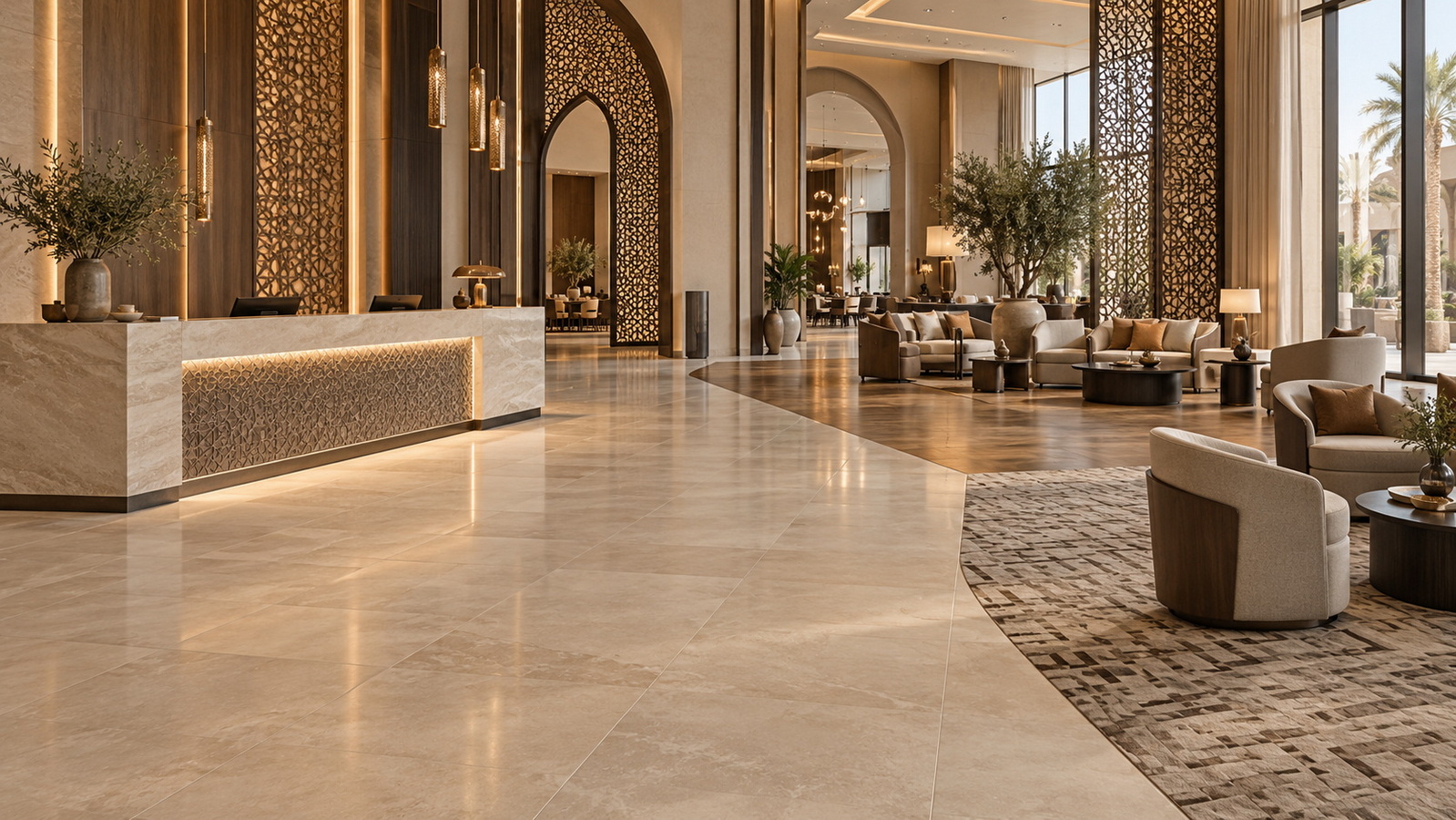
Saudi Arabia combines established tile and carpet manufacturing with distribution channels offering imported resilient flooring, parquet, and specialist commercial surfaces. Buyers can therefore choose between domestic production, locally stocked imported products, and direct overseas manufacturing arrangements.
The country's manufacturing footprint is distributed rather than concentrated in one flooring city. Saudi Ceramics operates manufacturing facilities in Riyadh's Second Industrial City. ARTIC has plants in Riyadh, Jeddah, Al-Kharj, and Dammam. This geographic coverage gives buyers several regional options when evaluating production access and distribution support.
For professional procurement teams, local sourcing can simplify factory visits, sample approvals, replacement orders, and communication with installers. However, buyers should distinguish between a Saudi manufacturer and a Saudi supplier selling products made elsewhere. Both business models can be useful, but their responsibilities and customization capabilities differ.
IMARC Group's current Saudi Arabia vinyl flooring report estimates that the market reached USD 905.3 million in 2025. It forecasts USD 1,622.1 million by 2034, representing a projected compound annual growth rate of 6.43% during 2026–2034. These figures describe vinyl flooring specifically—not the entire interior flooring industry.
Official trade statistics provide broader context. Saudi Arabia's General Authority for Statistics reported that non-oil exports, including re-exports, increased by 18.6% year-on-year in the fourth quarter of 2025. National non-oil exports excluding re-exports fell by 1.5%, while re-exports increased by 67.4%. These preliminary figures should not be presented as flooring export growth.
The practical conclusion is that buyers should assess each supplier's actual production and sourcing model rather than assume that expanding trade activity proves local manufacturing strength in every flooring category.
This is an editorial sourcing shortlist, not an audited ranking or a claim that every listed company is equally suitable for every project. Binmao Decor appears first as the international customization option requested for this guide; its position does not imply independently verified superiority.
The assessment uses public company information, official regulatory documents, current market reporting, and the company background supplied for Binmao Decor.
Six criteria guide the comparison:
1. Manufacturing identity: Does the company manufacture the relevant product, distribute it, or combine both activities?
2. Product suitability: Does its portfolio match the intended application, traffic conditions, cleaning regime, and installation system?
3. Quality control: Can it demonstrate incoming-material checks, in-process inspection, finished-product testing, and batch identification?
4. Development capability: Can it support new finishes, construction changes, installation details, or coordinated interior specifications?
5. Compliance evidence: Are certificates and reports relevant to the exact product and manufacturing site?
6. Commercial reliability: Can it document available capacity, realistic lead times, replenishment arrangements, and warranty responsibilities?
Public information does not consistently disclose minimum order quantities, current available capacity, or private-label agreements. Where these details are unavailable, this guide identifies them as quotation-stage questions rather than inventing figures.
Binmao Decor is a Foshan-based integrated decorative-panel manufacturer. Its public company page describes quick-install panels for hotels, villas, commercial interiors, and residential spaces, with customizable dimensions, surface finishes, and technical installation support.
According to the company background supplied for this guide, Binmao Decor has 14 years of experience and manufactures SPC flooring alongside UV panels and composite wall panels. Its public About Us page primarily documents wall-panel capabilities, so buyers should request a separate SPC flooring catalogue and production dossier before approving a flooring order.
Binmao Decor is positioned as a cost-conscious customization candidate for small and medium-sized brands, distributors, and fit-out buyers seeking coordinated interior materials.
Its documented material options include:
- MDF identified as E1/E0 grade.
- Oak, walnut, and other wood veneers.
- PVC/WPC constructions.
- PU materials.
- Acoustic backing structures.
- Painted, stained, lacquered, and textured finishes.
These options are relevant to coordinated wall-and-floor procurement, but they should not be treated as interchangeable flooring constructions. A decorative wall-panel specification does not establish that the same material is suitable for pedestrian traffic.
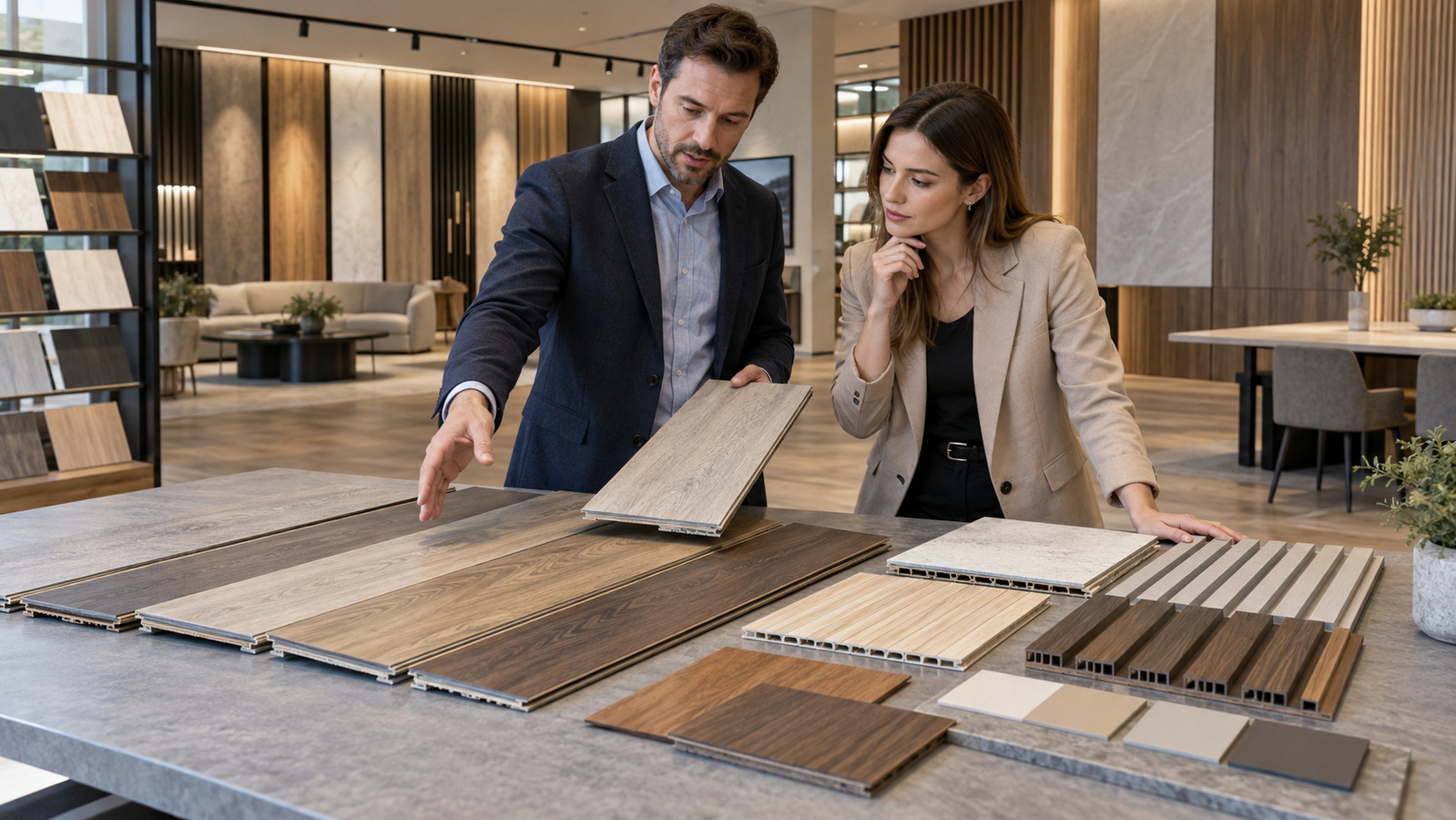
The supplied 14-year history corresponds approximately to a 2012 operating start. However, the public page contains inconsistent experience statements and a timeline using "Harmony Furniture Solutions." Buyers should confirm the legal entity's establishment date through its business registration rather than rely solely on website wording.
The public page describes domestic and overseas cooperation but does not identify a verified list of principal export markets. Saudi buyers should therefore request evidence of relevant export experience.
Documented customization includes panel widths, depths, finishes, and one-to-one project support. For flooring OEM/ODM work, confirm separately:
- Available core constructions and wear-layer options.
- Décor development and sample approval procedures.
- Private-label packaging and carton artwork.
- Minimum quantities per colour and specification.
- Ownership of custom designs.
- Production and warranty responsibilities.
Its potential advantage is flexibility and direct technical communication. Validate these qualities through a specification workshop and pilot order—not a general promise of low prices.
The company promotes waterproof, mold-resistant, and fire-retardant features. These claims must be checked against the exact product construction, exposure conditions, and relevant test reports; they should not automatically be extended to every MDF, veneer, or composite product.
Saudi Ceramic Company was established in 1977 and is headquartered in Riyadh. Its Saudi Exchange profile identifies ceramic and porcelain tiles among its principal products and states that it serves both domestic and international markets, exporting to more than 35 countries.
Saudi Ceramics is a relevant candidate for buyers seeking Saudi-made ceramic and porcelain interior flooring with established national distribution.
Its public disclosures support a substantial manufacturing and sales footprint. However, buyers should avoid combining factory counts from different reporting periods or treating a website production figure as current annual capacity.
For a large project, request capacity and delivery information for the exact tile family, dimensions, finish, and production site.
The company's documented market coverage includes Saudi Arabia and international export destinations. Its exchange profile refers to ISO 9001, SASO, and CE standards or conformity credentials, but buyers still need current documents covering the selected products.
Public information reviewed for this guide does not establish a universal private-label or OEM programme. Treat custom colours, dimensions, packaging, and exclusive collections as matters requiring written acceptance.
For repeat hospitality or residential projects, prioritize:
- Consistent shade and calibre.
- Technical suitability for floor use.
- Confirmed production batches.
- Replacement-stock availability.
- Installation-system compatibility.
Arabian Tile Company, commonly known as ARTIC, dates its terrazzo manufacturing history to 1975. Its official page lists five plants across Riyadh, Jeddah, Al-Kharj, and Dammam, with 26 production lines covering several concrete-product categories.
ARTIC is particularly relevant to buyers evaluating terrazzo, steps, and concrete-based architectural surfaces rather than SPC or conventional vinyl planks.
Its multi-location production footprint can be useful for projects combining interior flooring with related architectural components. However, the 26-line figure is company-wide: it is not a measure of interior flooring capacity alone.
ARTIC reports a wholesale distribution network covering Saudi Arabia and other GCC countries. It also states that it holds ISO 14001:2015 and ISO 45001:2018 certification. These are environmental and occupational-health-and-safety management standards, not substitutes for product performance reports.
Its architectural product range makes it a candidate for project-specific discussions about dimensions, finishes, aggregates, and coordinated components. Nevertheless, private-label manufacturing and bespoke flooring acceptance should be confirmed contractually.
For indoor terrazzo, ask about:
- Surface finish and intended maintenance regime.
- Dimensional tolerances.
- Staining and cleaning compatibility.
- Slip performance under anticipated conditions.
- Repair and replacement methods.
ARTEX's official website traces the business's origins to 1958 and states that the company introduced its ARTEX identity by 2024. It also identifies its former listed name as Al Abdullatif Industrial Investment Company. Historical industry information dates the Saudi Carpet Factory manufacturing business to 1981. These dates represent different stages of the company's development and should not be treated as interchangeable founding dates.
ARTEX is relevant to textile flooring procurement, including carpets, rugs, moquettes, and associated production inputs.
Its official portfolio describes an integrated supply chain encompassing spinning, BCF yarns, masterbatches, carpet backings, and non-wovens. This integration makes it a useful candidate for buyers investigating control over textile-flooring components.
The company describes service to residential, commercial, and industrial market segments, with international manufacturers, suppliers, and traders among its intended customers. A current country-by-country export breakdown is not established by the reviewed page.
Custom carpet constructions, colours, dimensions, and branding should be discussed directly. The public information does not establish that every product family is available through a standardized OEM/ODM programme.
For hotel and office applications, buyers should request construction-specific details rather than approve a carpet based on appearance alone:
- Fibre composition.
- Pile construction and density.
- Backing system.
- Intended traffic classification.
- Fire and emissions documentation.
- Cleaning instructions and warranty limitations.
Confirm that quotations, certificates, and invoices use the correct current contracting entity.
Alsorayai Co. for Trading is a Saudi flooring supplier whose official portfolio includes carpets, carpet tiles, parquet, LVT, SPC, vinyl flooring, rubber flooring, and hotel-oriented printed nylon carpet.
Its principal value for procurement teams is product breadth. A buyer comparing several flooring types for a hotel, office, gym, or mixed-use development can investigate multiple categories through one local supplier.
The company's website also promotes installation and after-sales services, making it relevant to buyers seeking local supply coordination rather than direct factory management.
The reviewed official company page does not disclose a verified incorporation year. Historical information about the wider Al-Sorayai name should not automatically be assigned to this specific trading entity.
Its stated focus is the Saudi market. Buyers should confirm branch coverage, stock locations, installation availability, and project references for their destination city.
As a trading company, its customization capabilities depend on the original manufacturer. Request confirmation of:
- Actual manufacturer and country of origin.
- Authorized distribution status where relevant.
- Private-label availability.
- Factory MOQ for custom products.
- Responsibility for technical claims and warranties.
- Whether replacement material will come from the same manufacturer and specification.
The table distinguishes disclosed manufacturing scale from available order capacity. "Not publicly disclosed" means the information was not established from the sources reviewed; it does not mean the supplier lacks the capability.
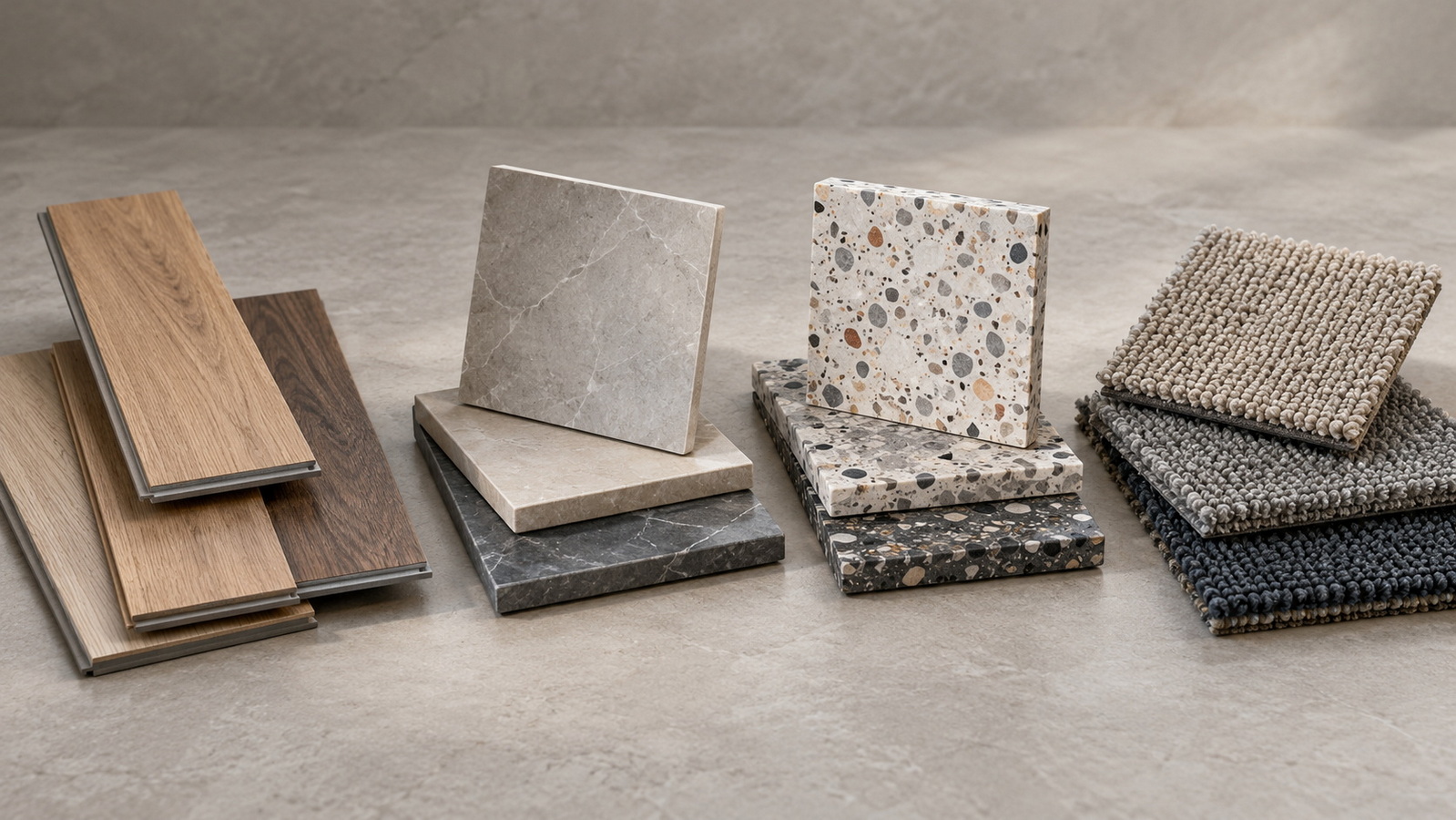
| Supplier | Primary sourcing role | Capacity or scale evidence | MOQ | Certification and documentation position | Most relevant purchasing focus |
|---|---|---|---|---|---|
| Binmao Decor | China-based decorative-panel manufacturer; SPC capability stated in supplied company background | Public page mentions production lines but provides no numerical flooring capacity | Not publicly disclosed; confirm by product and décor | Request current product reports and independently verifiable certificates; generic website claims are insufficient | Coordinated interior materials and customization |
| Saudi Ceramics | Saudi ceramic and porcelain manufacturer | Substantial factory network disclosed; obtain current product-specific capacity | Not publicly disclosed | Exchange profile references ISO 9001, SASO, and CE; verify exact scope and validity | Domestic tile supply and repeat projects |
| ARTIC | Saudi terrazzo and concrete-products manufacturer | Five plants and 26 company-wide lines; not all flooring lines | Not publicly disclosed | Company states ISO 14001:2015 and ISO 45001:2018; request flooring test reports separately | Terrazzo and architectural components |
| ARTEX | Saudi integrated textile-flooring manufacturer | Integrated yarn, backing, and carpet operations; current numerical flooring capacity not established | Not publicly disclosed | Request current certificates and construction-specific fire/emissions reports | Carpet and textile flooring |
| Alsorayai Co. for Trading | Saudi distributor and flooring-service supplier | Own manufacturing capacity not established; evaluate stock and upstream supply | Confirm stock-order versus custom-order minimums | Verify original manufacturer’s documents and local supply responsibilities | Multi-category local procurement |
Supplier descriptions and disclosure positions are based on their published company information and the Saudi Exchange profile.
"SPC flooring" is not a complete purchasing specification. Require a construction drawing identifying the core, decorative film, wear layer, surface coating, and attached backing, if present.
Do not accept total plank thickness as evidence of wear-layer thickness. ASTM F410 provides an optical measurement method for the wear layer of resilient flooring, reporting average, minimum, and maximum measurements. This gives buyers a verifiable alternative to catalogue claims.
Your inspection plan should define:
- Total thickness and permitted variation.
- Wear-layer thickness and acceptance method.
- Dimensions and squareness.
- Locking-profile compatibility.
- Surface appearance and colour tolerance.
- Residual indentation and dimensional stability requirements.
- Permitted changes to materials and backing.
Residual indentation deserves particular attention where heavy furniture or equipment will remain in place. Intertek describes ASTM F970 as a method assessing recovery after specified static loading; the chosen test and load must match the procurement specification.
Saudi Arabia's published building-materials regulation references SASO-ISO 13006 for ceramic-tile classification and marking, SASO-ISO 10545-1 for sampling and acceptance, and SASO-ISO 13007 standards for adhesives and grouts.
Ask the supplier to document the selected tile's classification and relevant performance—not merely describe it as "premium porcelain."
The purchase specification should also address shade, calibre, surface finish, permitted dimensional variation, and the proposed adhesive-and-grout system.
A supplier's ISO management certificate does not prove that a particular flooring product meets a project's fire, emissions, or slip requirements.
Flooring laboratories test different properties using different methods. OETI's testing information, for example, identifies EN 13501-1 and associated fire-test methods, alongside residual-indentation and laminate-performance testing. Buyers should have the project consultant specify the applicable method and acceptance level.
MDF labels such as E0 or E1 also require a stated testing basis. Ask for the method, numerical result, product identity, and report date rather than accepting the grade abbreviation alone.
CE marking relates to applicable European requirements and is not Saudi market approval. RoHS addresses hazardous substances in electrical and electronic equipment; it should not be used as the principal compliance credential for ordinary non-electrical flooring.
The published SASO Technical Regulation for Building Materials—Part IV requires ceramic-tile suppliers to obtain the Saudi Quality Mark or a recognized equivalent under its provisions. It also specifies conformity procedures for other products within its scope.
However, do not assume that every flooring material follows the same route simply because it is installed indoors.
Before production, ask the Saudi importer and an approved conformity-assessment body to confirm:
1. The exact product description and construction.
2. The applicable customs classification.
3. The current technical regulation.
4. Required testing and marking.
5. Applicable product and shipment documentation.
6. Any project-specific requirements beyond market-entry compliance.
The regulation explicitly identifies the product and customs-code information on SABER as the updated version and requires suppliers to use current applicable standards. This makes live classification verification more reliable than copying an old competitor's shipping documents.
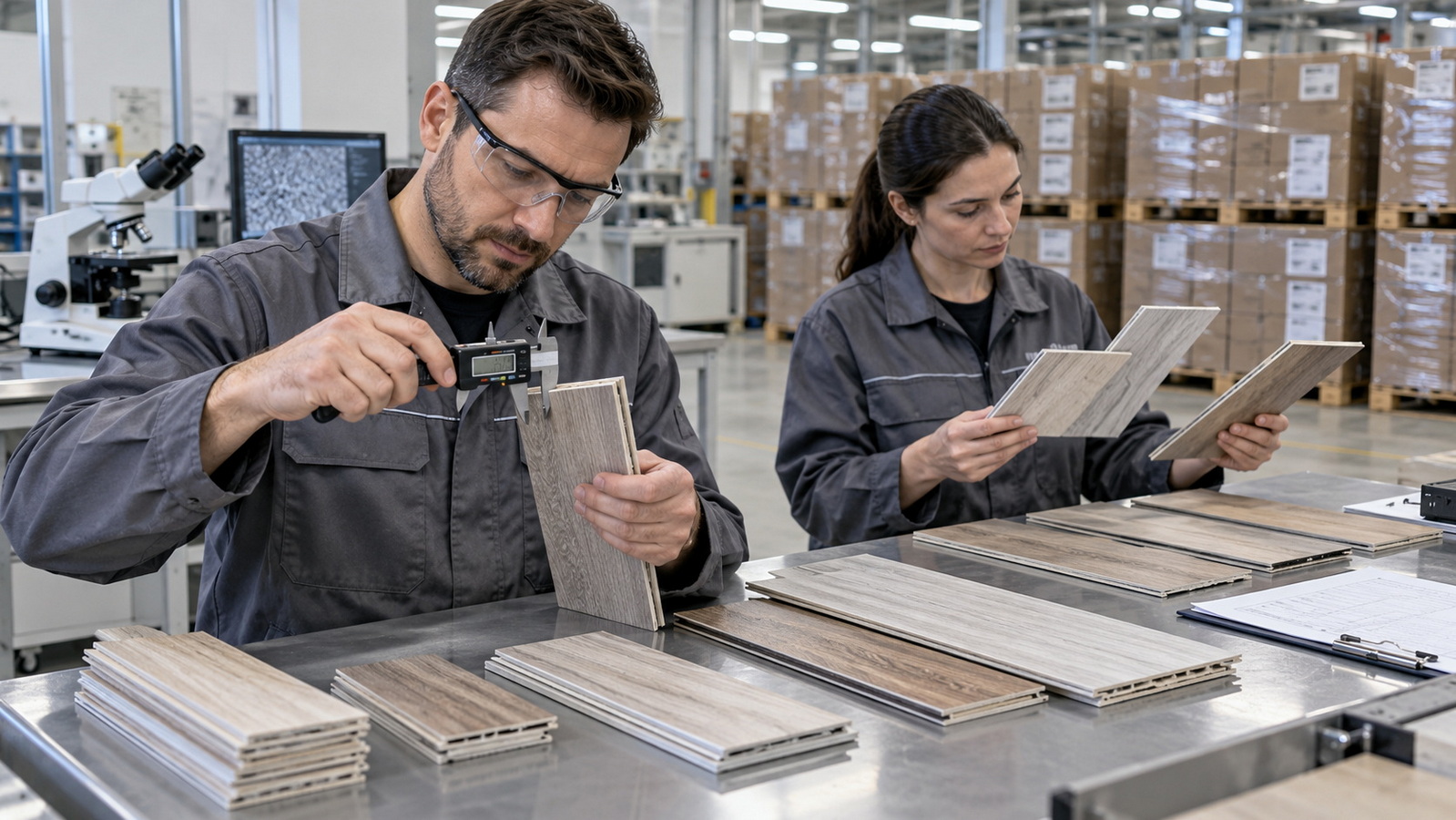
A visually similar surface can conceal a different core, backing, coating, or wear layer. Protect the order with an approved bill of materials, measurable acceptance criteria, retained samples, and a written change-control clause.
Use independent batch sampling where the commercial risk justifies it. Wear-layer microscopy is one example of turning a marketing statement into an inspectable requirement.
Ask exactly what the water-resistance claim covers: the board, its surface, joints, backing, or the installed system.
For wet-area projects, require written confirmation of installation suitability, perimeter detailing, substrate conditions, and warranty exclusions. Do not allow a decorative-panel water-resistance claim to substitute for a flooring-system assessment.
The supplier name, manufacturing address, product scope, and issuer must match the actual production arrangement.
A certificate for a group company or unrelated plant should trigger further investigation, not automatic approval. IAF CertSearch allows buyers to review management-certificate status, scope, issuing body, and accreditation information.
Build a landed-and-installed comparison that includes:
- Freight and insurance.
- Conformity assessment and testing.
- Customs clearance and applicable charges.
- Adhesives, underlays, trims, and transitions.
- Installation labour.
- Cutting waste.
- Spare material.
- Expected maintenance and replacement costs.
This prevents a lower unit price from disguising a more expensive procurement package.
A practical procurement safeguard is to preserve the manufacturing identity of the approved material—not only its décor name.
For modular flooring, ask the supplier to record the locking-profile version, backing construction, production batch, and relevant dimensional tolerances. For tiles and carpets, preserve the corresponding shade, calibre, dye-lot, or construction identifiers.
Then require notification before changes affecting replacement compatibility.
This is a recommended control rather than a claim about any listed supplier. Its purpose is straightforward: a future carton carrying the same collection name should not be assumed to be an interchangeable replacement without verification.
Include maintenance stock from the approved production run where appropriate, and determine the quantity from the project's damage risk, layout, and anticipated replacement needs rather than a universal percentage.
Use three approval stages:
1. Design sample: Confirm appearance, texture, and finish.
2. Technical sample: Verify construction, dimensions, installation details, and supporting reports.
3. Pilot installation: Assess the proposed product-and-installation system under representative project conditions.
Keep signed retained samples with both parties. Link approval records to product codes and the purchase specification.
For imported orders, confirm the destination port, inland delivery arrangements, pallet dimensions, carton identification, and unloading requirements with the logistics team. Require a packing list identifying quantities and production batches.
Before dispatch, reconcile the approved specification, inspection findings, labels, and compliance documents. SASO's published regulation requires truthful, verifiable labeling and identifies country of origin and storage information among relevant labeling requirements.
The strongest shortlist depends on the flooring category and the buyer's operating model.
Saudi Ceramics is relevant to domestic ceramic and porcelain sourcing. ARTIC offers terrazzo and concrete-product expertise. ARTEX represents integrated textile-flooring manufacturing. Alsorayai Co. for Trading offers broad local product access. Binmao Decor provides an international customization option, particularly for buyers coordinating flooring inquiries with quick-install decorative panels.
For a Binmao Decor enquiry, submit the project location, application, quantities, target construction, finish references, required test evidence, packaging needs, and delivery schedule. Request an itemized proposal separating flooring specifications from wall-panel specifications, together with samples, confirmed MOQ, and a product-specific documentation checklist.
Approve the supplier only when the commercial offer, technical evidence, and pilot installation support the same purchasing decision.
Search the exact certificate number or legal company name in IAF CertSearch. Review its status, scope, location, issuing certification body, and accreditation details. The platform identifies active, suspended, withdrawn, and expired certificates.
Also check directly with the issuing certification body when information is missing or inconsistent. A missing search result warrants verification; it should not alone be treated as proof of fraud.
Do not assume so. Request the full report and classification documentation, then ask the laboratory or project consultant to confirm its permitted application to the proposed construction.
Flooring fire assessment uses specific classification and test methods. Changing a product's layers or installation arrangement requires technical review rather than a salesperson's assurance.
Write the required wear-layer thickness and measurement method into the contract. Select samples from the production batch rather than relying only on a presentation sample.
ASTM F410 uses optical measurement and reports average, minimum, and maximum wear-layer thickness. Agree how these results will be used for acceptance before the supplier starts production.
No. CE marking concerns applicable European requirements. Saudi market access must be assessed separately under the relevant Saudi rules. Ceramic tiles, for example, have specific Saudi Quality Mark provisions in SASO's published building-materials regulation.
Confirm the current product route with the importer and an approved conformity-assessment body before shipment.
Define responsibilities before ordering. The agreement should distinguish manufacturing defects, transport damage, storage conditions, substrate preparation, installation workmanship, and maintenance misuse.
Specify the evidence needed for a claim: retained samples, batch codes, delivery photographs, substrate records, installation records, and relevant test results. Where technical causation is disputed, agree on an independent inspection procedure and how its costs will be allocated.
1- Binmao Decor, About Us — [Company capabilities, materials, finishes, and customization].
2- Saudi Exchange, Saudi Ceramic Company Profile — [Establishment, product scope, markets, and disclosed credentials].
3- ARTIC, About Us — [Plant locations, production lines, markets, and certification statements].
4- ARTEX Industrial Investment Company — [Corporate history and integrated carpet-production portfolio].
5- The Worldfolio, Al Abdullatif Industrial Investment Company — [Historical Saudi Carpet Factory background].
6- Alsorayai Co. for Trading, About — [Flooring categories and Saudi market positioning].
7- IMARC Group — [Saudi Arabia Vinyl Flooring Market, 2025 base year and 2026–2034 forecast].
8- General Authority for Statistics — [International Trade Statistics, Fourth Quarter 2025].
9- SASO — [Technical Regulation for Building Materials, Part IV].
10- IAF CertSearch — [Accredited management-system certificate verification].
11- European Commission — [CE marking guidance] and [RoHS Directive scope].
12- Intertek — [ASTM F410 wear-layer measurement] and [ASTM F970 static-loading recovery testing].
13- OETI — [Floor-covering testing services and applicable methods].


