
Views: 248 Author: Sunny Publish Time: 2026-10-13 Origin: Site


Content Menu
● Why Source SPC Flooring from China?
>> What Recent Industry Data Means for Buyers
● How These Manufacturers Were Selected
>> 1. Manufacturing Identity and Product Relevance
>> 2. Product Development and Customization
>> 3. Quality Control and Batch Consistency
>> 4. Compliance Documentation
● SPC Flooring Manufacturer Comparison
● Top 10 SPC Flooring Manufacturers in China
>> 1. Binmao Decor: A Flexible Option for Coordinated Interior Projects
>>> Core Advantages
>>> OEM/ODM Scope and Market Fit
>> 2. CFL Flooring: Technology Development and Production Traceability
>>> Core Advantages
>>> OEM/ODM Scope and Main Markets
>> 3. Novalis Innovative Flooring: Established Resilient-Flooring Expertise
>>> Core Advantages
>>> OEM/ODM Scope and Main Markets
>> 4. Kingdom Flooring: Broad Resilient-Flooring Manufacturing
>>> Core Advantages
>>> OEM/ODM Scope and Main Markets
>> 5. Huali Floors: Large-Volume Resilient-Flooring Supply
>>> Core Advantages
>>> OEM/ODM Scope and Main Markets
>> 6. Tianzhen: Integrated Flooring Production and Development
>>> Core Advantages
>>> OEM/ODM Scope and Main Markets
>> 7. Power Dekor: Multi-Category Flooring and Documented OEM/ODM Services
>>> Core Advantages
>>> OEM/ODM Scope and Main Markets
>> 8. DECNO: Flooring and Wall-Panel Development
>>> Core Advantages
>>> OEM/ODM Scope and Main Markets
>> 9. Carsem Floor: Customized Formats and Surface Options
>>> Core Advantages
>>> OEM/ODM Scope and Main Markets
>> 10. Yihua: Export-Oriented Production and Retail Supply Experience
>>> Core Advantages
>>> OEM/ODM Scope and Main Markets
● What to Specify Before Requesting Prices
>> Define the Complete Construction
>> Separate Material Claims from Performance Evidence
>> Understand CE, RoHS, and Emissions Certification
● Buyer's Guide: From Factory Verification to Shipment
>> 1: Verify the Manufacturing Arrangement
>> 2: Use a Three-Stage Sample Process
>> 3: Put Critical Requirements in the Purchase Contract
>> 5: Review Installation Conditions Before Launch
● Approving the Plank but Not the System
● FAQ
>> 2. Can One FloorScore Certificate Cover Every SPC Product a Factory Sells?
>> 3. How Can Buyers Detect a Material or Construction Change After Sample Approval?
>> 4. Should Thicker Acoustic Backing Always Be Preferred?
>> 5. How Should a Buyer Protect Against Batch Inconsistency in a Long-Term OEM Program?
China offers a broad selection of SPC flooring manufacturers, from internationally established resilient-flooring groups to flexible decorative-material suppliers serving private-label brands and construction projects. The challenge is not finding a factory willing to quote. It is identifying a manufacturer that can reproduce an approved specification consistently, document compliance, and support your business after delivery.
This guide compares ten suppliers worth evaluating: Binmao Decor, CFL Flooring, Novalis Innovative Flooring, Kingdom Flooring, Huali Floors, Tianzhen, Power Dekor, DECNO, Carsem Floor, and Yihua.
The list is a procurement shortlist—not an independently audited ranking by market share, production volume, or product quality. Binmao Decor appears first as the publisher's company and as an option for buyers seeking coordinated flooring and interior-panel sourcing. Its inclusion should be evaluated using the same technical and commercial checks applied to every other supplier.
The central purchasing principle is traceability: a dependable manufacturer should connect each shipped product to its approved construction, production batch, testing evidence, and contractual specification. CFL, for example, publicly describes plank-level identification that traces production, certification, and supply-chain information. That is the type of operational evidence buyers should investigate rather than relying only on showroom samples.
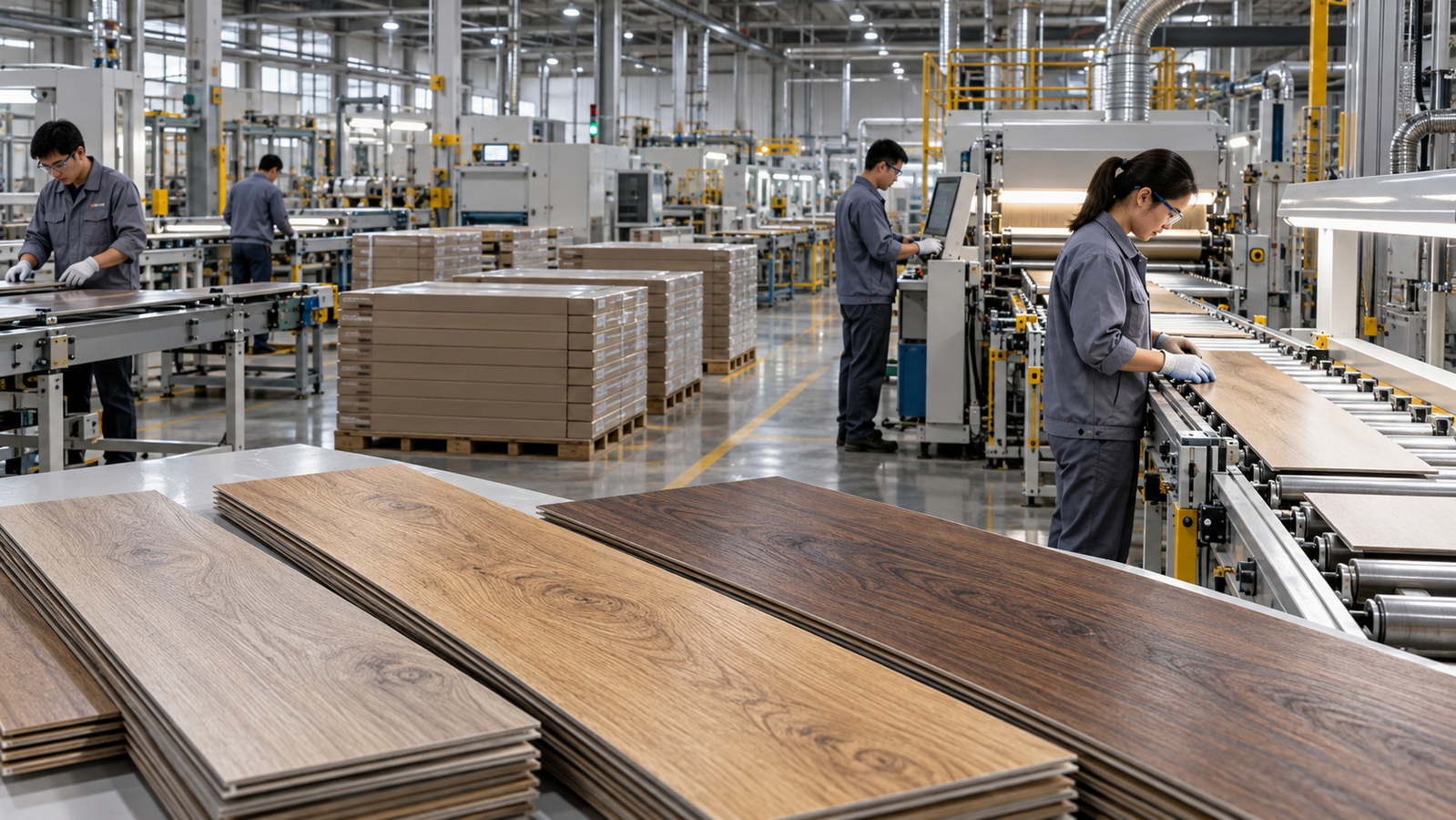
SPC—commonly described as stone plastic composite or stone polymer composite—is a rigid-core flooring construction typically combining PVC resin with mineral fillers, a decorative layer, a protective wear layer, and surface finishing. Some products include an attached acoustic backing. Carsem's product information identifies PVC resin and carbonate additives as components of its SPC construction.
China's supplier base provides access to different manufacturing models within the same category. Buyers can approach large-scale resilient-flooring producers, technology-led international groups, or suppliers offering flooring alongside wall panels and installation accessories.
The company locations in this shortlist illustrate the concentration of relevant manufacturing expertise:
- Jiangsu includes Novalis's established China manufacturing presence in Zhenjiang, Huali in Taizhou, and Yihua in Zhangjiagang.
- Zhejiang includes Kingdom's vinyl-flooring operations and Tianzhen's headquarters in Anji. CFL also identifies manufacturing facilities in Zhejiang and Hunan.
- Foshan, Guangdong, provides access to decorative-interior suppliers such as Binmao Decor, whose published portfolio emphasizes integrated wall panels and customized finishes.
For buyers, these concentrations create opportunities to compare materials, finishing capabilities, production processes, and complementary products. However, proximity to a manufacturing cluster does not establish the quality of an individual factory.
The Multilayer Modular Flooring Association publishes annual sales statistics for its ordinary members and provides a 2025 statistics report. Its dataset covers member-reported product categories, not the entire Chinese SPC industry or global market. Buyers should preserve that distinction when using association figures in business planning.
A separate 2026 industry report from Floor Covering Weekly, citing Catalina estimates, states that rigid-core products represented 77.9% of U.S. LVT dollar sales and 79.6% of LVT square-foot sales in 2025. These figures describe rigid-core products within U.S. LVT sales; they are not China-specific SPC production figures.
The procurement implication is straightforward: rigid-core flooring remains commercially important, but a large category does not make every product interchangeable. The supplier's construction, testing, installation requirements, and warranty conditions still determine whether a product fits your market.
The shortlist uses five practical evaluation dimensions.
A supplier should identify its legal entity, production location, and relevant product range. Buyers should distinguish between an owned factory, a group manufacturing network, and an export business coordinating production elsewhere.
An established wall-panel operation, for example, does not automatically prove in-house SPC extrusion capability.
Useful development capabilities include:
- Decorative-film selection and color matching.
- Embossing and surface-texture development.
- Plank and tile formats.
- Wear-layer and backing options.
- Packaging and private-label support.
- Coordinated moldings and wall-panel finishes.
OEM usually involves manufacturing to an agreed customer specification. ODM adds supplier-led product development. Buyers should ask which activities happen internally and which depend on outside material or tooling partners.
The assessment should cover incoming materials, extrusion control, finishing, locking-profile machining, dimensional inspection, and finished-product testing.
A supplier's ability to explain how it controls production variation is more valuable than a general promise that every product is "premium."
Factory management certification, product emissions certification, chemical testing, and market-access documentation serve different purposes.
FloorScore, for example, evaluates indoor-air emissions for eligible flooring materials, adhesives, and underlayments. It is not a substitute for mechanical-performance testing. SCS provides a searchable directory of certified products.
The final evaluation should consider:
- MOQ by design, size, and construction.
- Repeat-order lead times.
- Production allocation during peak demand.
- Payment and inspection arrangements.
- Technical communication.
- Complaint handling and replacement procedures.
Public capacity figures are useful screening information, but they do not prove available capacity for your specific order.
The table distinguishes disclosed information from details requiring a quotation or document check. Capacity figures are manufacturer-reported unless otherwise indicated; they are not directly comparable because some cover multiple products, multiple countries, or container shipments rather than square-meter output.
| Manufacturer | Established | Primary sourcing fit | Public capacity or manufacturing indicator | MOQ | Certification and documentation position |
|---|---|---|---|---|---|
| Binmao Decor | 14 years’ experience, according to company-provided information; legal founding date requires confirmation | Flexible interior-material sourcing and coordinated project customization | SPC-specific capacity not established on the reviewed About page | Request by SKU and customization level | Request current SPC-specific reports; reviewed page does not establish certification scope. binmaomaterials |
| CFL Flooring | 2004 | Technology-led rigid-core programs and international partnerships | Website reports 70 million m² output; product, period, and facility allocation require clarification | Request quotation | Publishes batch-tracing and external-testing practices; verify certificates for the proposed SKU. cflflooring |
| Novalis Innovative Flooring | 1984 | Established resilient-flooring sourcing with environmental documentation | China manufacturing presence documented; current SPC-specific capacity not confirmed in reviewed sources | Request quotation | Publishes ISO 9001 and ISO 14001 information; verify current certificates and product listings. |
| Kingdom Flooring | 1992 | Private-label resilient flooring and broader product development | Reports 45 million m² annual production capacity across its portfolio | Request quotation | Request current factory and product-specific compliance documents. kingdomflooring |
| Huali Floors | 2002 | Large-volume LVT, SPC, and WPC sourcing | Website reports approximately 1,500 containers monthly across production | Request quotation | Request certificates and test reports tied to the supplying factory and construction. |
| Tianzhen | 2003 | Integrated resilient-flooring manufacturing and development | Official profile identifies two major production bases; current SPC capacity requires confirmation | Request quotation | Request current documents for the quoted product and production site. tzflooring |
| Power Dekor | 1995 | Multi-category flooring and OEM/ODM programs | Current SPC-only capacity not confirmed in reviewed official material | Request quotation | Request product-specific documentation rather than group-level claims. |
| DECNO | 1997; SPC factory established in 2017 | Flooring-and-wall-panel private-label development | Current SPC-only capacity not confirmed in reviewed material | Request quotation | Request current factory certificates and SKU-specific reports. |
| Carsem Floor | 2002 | Customized SPC formats, textures, and complementary materials | SPC page reports 15 extrusion lines and over 1 million m² monthly capacity | Request quotation | Advertises several certifications; independently verify validity and product scope. |
| Yihua | 1989 | Large-scale export and retail-oriented resilient flooring | Reports 20 SPC click-flooring lines and approximately 2,000 containers monthly across products | Request quotation | Reports ISO systems, CE-related compliance, and FloorScore testing; current scope requires verification. yihuaplastic |
No standardized MOQ has been assigned where the reviewed sources do not establish one. A single factory-wide MOQ can be misleading: stock designs, exclusive films, custom packaging, and new tooling may each have different thresholds.
Binmao Decor is a Foshan-based decorative-material manufacturer serving residential, commercial, and hospitality applications. Its published About page emphasizes integrated quick-install wall panels, wood-grain and stone-look finishes, customizable dimensions, and installation support.
According to the company information supplied for this article, Binmao Decor has 14 years of experience and also produces SPC flooring, UV panels, and waterproof, fire-retardant composite wall panels. The reviewed public page provides stronger detail about wall panels than SPC flooring, so buyers should request a separate SPC technical and manufacturing dossier before placing an order.
Binmao Decor's sourcing proposition is particularly relevant to smaller and mid-sized brands seeking flexibility rather than a standardized large-volume program. Its published service information describes custom-order acceptance, one-to-one support, and material options including MDF, wood veneers, PVC/WPC, PU, and acoustic-backed structures.
That breadth can help buyers coordinate floor-and-wall finishes for hotels, villas, restaurants, and commercial interiors.
Potential cooperation areas include private-label flooring, coordinated wall-panel finishes, packaging customization, and project-specific material selection. Buyers should confirm which SPC customization processes are performed in-house.
Its stated application markets include residential interiors, hotels, retail spaces, restaurants, and corporate offices. A verified geographic export breakdown was not available on the reviewed page.
Request:
- The SPC production-site address and equipment list.
- Product construction sheets and batch-testing procedures.
- MOQ by décor and packaging specification.
- Current emissions, fire-performance, and mechanical test reports.
- A written response schedule for sample development and technical questions.
The public page contains inconsistent experience statements and a history presented under another business name. Buyers should therefore confirm the contracting legal entity and founding date rather than treating the page's timeline as independently verified.

Founded in Shanghai in 2004, CFL has developed an international manufacturing network. Its official history records the start of SPC manufacturing in July 2016, and its company page identifies facilities in China, Vietnam, and the United States.
CFL's strongest publicly documented differentiators are product development, patented technologies, internal testing, and production traceability. The company states that individual planks carry identification allowing the production cycle, certification, and supply chain to be traced.
CFL is worth evaluating for differentiated rigid-core collections, technical product-development partnerships, and multi-market distribution programs. Its international operating network supports engagement with buyers beyond China, although private-label availability and territorial arrangements require direct confirmation.
Confirm the actual production country, factory allocation, licensing arrangements, and warranty support for the proposed collection. A group's global footprint does not mean every product can be supplied from every facility.
Novalis was established in 1984 and identifies sales offices and distribution partners across North America, Europe, Asia Pacific, and Africa. Its history includes early exports of luxury vinyl flooring from China to the United States.
Its China manufacturing presence in Zhenjiang, Jiangsu, is documented in reporting on the company's international expansion.
Novalis is relevant to buyers prioritizing established resilient-flooring experience and environmental documentation. Its sustainability information describes ISO 9001 quality-management and ISO 14001 environmental-management certification.
Potential sourcing discussions can include rigid-core collections, design coordination, environmental documentation, and private-label supply where commercially available. Its own brands and existing distribution relationships mean buyers should clarify the terms of any proposed OEM program.
Verify the exact manufacturing site, product family, certificate validity, and emissions listing. Historical certification achievements do not automatically establish current coverage for a newly quoted SPC construction.
Kingdom states that it has manufactured and exported vinyl flooring since 1992. Its official website reports approximately 170,000 m² of land area and 45 million m² of annual production capacity. These are portfolio-level figures, not independently verified SPC-only output.
Kingdom offers a broad resilient-flooring development platform. Its published business information describes LVT, SPC, WPC, PET flooring, digitally printed SPC, wall panels, and flooring accessories.
The company is a relevant candidate for private-label collections combining conventional SPC with alternative materials or coordinated accessories. Its published profile describes relationships with retailers, distributors, and construction companies in more than 50 countries.
Confirm which factory will produce the order, how much capacity is allocated to the specified construction, and whether the quoted technology is commercially established or requires additional development.
Taizhou Huali New Materials was founded on April 15, 2002. Its official profile identifies LVT, SPC, and WPC as core product categories.
The company website reports four production bases and approximately 1,500 containers of monthly production capacity. Because container output depends on product thickness, packaging, and loading configuration, this figure should not be compared directly with another supplier's square-meter capacity.
Huali is worth evaluating for large-volume purchasing programs and buyers seeking multiple resilient-flooring constructions from an established manufacturer.
Relevant discussions include private-label collections, repeat container programs, packaging, and coordinated LVT/SPC/WPC sourcing. Its published brochure describes Europe and North America as major export destinations.
Ask for a current factory-specific production schedule and clarify which published capacity figure applies. Different company materials report different container totals, so the order quotation should establish the relevant basis.
Zhejiang Tianzhen Technology was founded in 2003 and is headquartered in Anji, Zhejiang. Its official profile describes an enterprise integrating production, research and development, and sales, with two major production bases.
Tianzhen's product range includes SPC, WPC, and LVT flooring. That makes it relevant to buyers comparing several resilient-flooring constructions rather than sourcing SPC in isolation.
Potential programs include coordinated product collections, buyer-specified construction, and manufacturing support for established distribution businesses. The reviewed official profile does not establish a reliable geographic sales breakdown; buyers should request current export references.
Confirm the supplying legal entity, production location, product-development responsibilities, and current compliance dossier. Do not substitute group reputation for evidence covering the exact flooring specification.
Power Dekor was established in 1995. Its published portfolio includes SPC flooring, laminate, solid wood, engineered wood, wall panels, and related accessories.
The company is relevant to distributors seeking a broader flooring portfolio under one supplier relationship. Its manufacturing website explicitly describes OEM and ODM services and identifies branches in North America, South Korea, and New Zealand.
Power Dekor can be considered for private-label flooring, coordinated product ranges, and market-specific development. Existing international branches provide identifiable overseas business touchpoints, although buyers should confirm which entity manages their particular program.
Establish the responsible factory, contracting entity, SPC construction, and product-specific test coverage. Group-wide production statistics should not be presented as SPC capacity without clarification.
DECNO traces its business history to 1997 and states that its SPC factory was established in Shandong in 2017. Its current website presents flooring and wall panels as principal product categories.
DECNO is worth considering for buyers seeking flooring-and-wall-material coordination and a supplier with experience across more than one flooring technology.
Potential programs include private-label SPC collections, complementary wall panels, surface-design development, and packaging. Its company history reports cooperation with partners in 75 countries, although that figure should not be treated as a verified current sales distribution.
Separate historical sales claims from current manufacturing capability. Request present-day SPC capacity, factory-specific certification, sample-development responsibilities, and written change-control procedures.
Jiangsu Carsem New Materials was established in 2002. Its official profile lists SPC, MSPC, waterproof laminate, mineral-fiberboard flooring, herringbone products, wall panels, and accessories.
Carsem publishes relatively detailed equipment information, including extrusion machinery, registered-embossing lines, UV coating, profiling equipment, bevel-treatment lines, and backing-attachment lines. Its SPC page reports more than 1 million m² of monthly production capacity.
Carsem is relevant to buyers evaluating herringbone layouts, embossed surfaces, grout-look effects, and broader flooring customization. Its published information describes production and export experience, but a verified current geographic sales breakdown requires confirmation.
Clarify the technical differences between SPC, MSPC, and other quoted constructions. Verify advertised certifications against the exact product, manufacturing location, and certificate validity period.
Zhangjiagang Yihua Rundong New Material was founded in 1989. Its official profile reports seven manufacturing areas, more than 2,000 employees, and 20 SPC click-flooring production lines.
Yihua's profile emphasizes manufacturing scale, export experience, patents, and involvement in Chinese PVC-flooring standard development. It also identifies relationships with major international building-material retailers. These are manufacturer-published statements rather than independently audited findings.
Yihua is a candidate for retail-oriented private-label collections, repeated large orders, and packaging programs. The company's published retailer references indicate experience serving U.S. and European channels.
Verify that historical retail relationships remain relevant to the proposed program. Request current certification records: an older website reference to OHSAS 18001, for example, should not be accepted as proof of current occupational-health-and-safety certification.
A quotation should identify more than "5 mm SPC flooring."
Specify:
- Core thickness separately from attached backing.
- Wear-layer thickness.
- Finished plank dimensions and tolerances.
- Decorative-film reference.
- Surface coating and embossing.
- Edge treatment.
- Locking-system design.
- Backing material, thickness, and performance.
- Packaging and batch identification.
This prevents superficially similar quotations from being mistaken for technically equivalent products.

"Virgin material" can be a useful sourcing requirement, but it does not replace finished-product testing. Likewise, recycled content should be evaluated through its source, control procedures, chemical compliance, and documented performance—not merely accepted or rejected by label.
Ask the supplier to disclose the agreed formulation category and obtain written approval requirements for material substitutions.
For mechanical suitability, request testing appropriate to the construction and intended use, including dimensional stability, residual indentation, locking integrity, and other relevant performance characteristics.
Avoid treating all compliance logos as interchangeable.
- For EU supply, request applicable construction-product documentation, declared performance, and supporting testing. Confirm the relevant standard and current legal requirements with the importer or compliance specialist.
- RoHS primarily addresses electrical and electronic equipment. Ordinary non-electrical SPC flooring should not be evaluated as though a RoHS report were its main market-access credential.
- FloorScore evaluates indoor-air emissions. It does not establish wear resistance, locking strength, fire classification, or complete chemical compliance.
- ISO 9001 concerns a quality-management system; buyers still need evidence covering the actual product.
For hospitality projects, fire-performance documentation must match the specified flooring construction and installation conditions. A generic "fireproof" statement is not sufficient.
Request the business license, contracting entity, factory address, and proposed production site.
During a factory visit or independent audit, examine the actual production flow—not only finished-product storage. Where the supplier coordinates external manufacturing, establish who controls specifications, inspection, and corrective action.
A practical sequence is:
1. Design samples for color, texture, and initial selection.
2. Pre-production samples matching the complete commercial specification.
3. Random production samples selected for shipment inspection.
Retain signed reference samples and a written specification. Appearance approval alone should not authorize changes in construction.

Include the product specification, approved material category, inspection criteria, packaging, batch marking, delivery terms, and required documents.
Also define:
- What happens if inspection fails.
- Who pays for retesting.
- Whether unapproved substitution permits rejection.
- How claims must be documented.
- The agreed corrective-action and replacement process.
Compare goods cost, packaging, inspection, testing, freight, insurance, destination handling, duties, and any applicable trade measures.
Have the customs broker confirm classification, origin, and destination requirements for the actual product and shipping route. Do not assume another buyer's tariff treatment applies to your shipment.
A flooring warranty is only useful if the installation requirements are workable for the target market.
Obtain instructions covering subfloor preparation, moisture management, expansion requirements, underfloor heating, heavy furniture, and permitted backing or underlay.
MMFA's guidance emphasizes that underlay selection affects the flooring system and that appropriate performance requirements help reduce damage, including damage to joining systems. Installation should follow the manufacturer's instructions.
A common blind spot is evaluating a plank in isolation while overlooking the backing, locking profile, and installation system.
A visually attractive sample may not establish whether the supplied construction will perform under repeated loading. MMFA specifically connects underlay suitability with protection against joining-system damage. Adding a softer or thicker underlay is therefore not automatically an improvement.
The practical safeguard is to approve the complete assembly:
- Flooring construction.
- Attached backing.
- Any additional underlay.
- Locking geometry.
- Installation instructions.
- Intended loading conditions.
Then require written authorization before changes to backing, core construction, or locking-profile processing.
CFL's published plank-tracing approach illustrates another useful safeguard: production identification that connects the finished product to its manufacturing and certification history. Buyers can ask every shortlisted supplier how it achieves comparable batch accountability.
The right SPC flooring manufacturer depends on your purchasing model. Technology-led collections, high-volume retail programs, coordinated floor-and-wall projects, and smaller private-label launches require different capabilities.
Start with this shortlist, then narrow it through factory verification, product-specific documentation, production sampling, and a written supply agreement. Treat published capacity and certification claims as starting points for verification—not substitutes for it.
For buyers considering Binmao Decor, send an RFQ containing the destination market, intended application, annual volume, plank dimensions, core and wear-layer requirements, backing preference, finish references, packaging needs, and required test standards.
Request a proposed specification, sample-development plan, SPC manufacturing details, MOQ breakdown, and relevant reports. That creates a measurable basis for evaluating its flexibility, technical communication, and value alongside the other manufacturers.
Search using the legal company name and certificate number in IAF CertSearch, and review the status, standard, certified scope, site information, issuing certification body, and update details. The service provides certificate-status verification rather than simply reproducing a supplier's uploaded document.
Also contact the issuing certification body directly. Confirm that the named site actually manufactures the product you intend to buy. A certificate covering trading activity or another group facility may not cover the proposed manufacturing operation. The accreditation guidance recommends approaching the certification body first when confirming validity.
Do not assume so. Check the certified product listing and certificate scope against the proposed manufacturer, product family, and construction.
Use the SCS Certified Green Products Guide and obtain clarification where the quoted private-label name differs from the listed product. FloorScore is an emissions certification; separate mechanical and fire-performance evidence may still be required.
Use a contractually controlled specification and compare random production samples with the approved construction.
Check thickness, weight, backing, appearance, dimensions, and relevant laboratory performance. Require supplier approval records for any changes and retain batch identification.
A discrepancy does not automatically establish misconduct, but it should trigger investigation before shipment approval. Manufacturer-level production tracing can make that investigation more effective.
No. Evaluate backing as part of the complete flooring system rather than by thickness alone.
Ask for the specified underlay group, relevant performance evidence, and written confirmation of whether extra underlay is permitted. MMFA states that the flooring supplier should specify the required underlay group and explains that appropriate underlay performance helps reduce flooring and joining-system damage.
Establish a controlled specification, signed reference samples, batch identification, inspection criteria, and a formal material-change approval process.
For repeat orders, require the supplier to identify the production site and disclose approved construction changes before manufacturing. Where alternative factories are proposed, qualify them separately rather than assuming equivalent output.
The goal is to make repeat-order approval depend on reproducible evidence, not just the same collection name or packaging.
For further verification, consult MMFA's 2025 member-sales statistics and installation guidance, SCS's FloorScore program and certified-product directory, the European Commission's RoHS scope information, and IAF CertSearch's certificate-verification service. These sources address different questions and should be used together rather than treated as interchangeable credentials.
1. Multilayer Modular Flooring Association. *MMFA Market Statistics*. Industry association statistics covering annual member sales by multilayer flooring category, including 2025 data. [mmfa]
2. SCS Global Services. *FloorScore Certification*. Official information on indoor-air-quality certification for hard-surface flooring, adhesives, and underlayments. [scsglobalservices]
3. SCS Global Services. *Certified Green Products Guide*. Searchable directory for verifying certified products and the scope of their listings. [scsglobalservices]
4. European Commission. *RoHS Directive*. Official guidance on restrictions affecting hazardous substances in electrical and electronic equipment, clarifying why RoHS should not be treated as the primary compliance credential for ordinary SPC flooring. [environment.ec.europa]
5. IAF CertSearch. *Certificate Search*. Verification service for checking accredited management-system certification status by company name or certificate number. [iafcertsearch]
6. Multilayer Modular Flooring Association. *Underlays: Performance Requirements*. Technical guidance on underlay testing and performance requirements for multilayer modular flooring systems. [mmfa]
7. Multilayer Modular Flooring Association. *Installation of Multilayer Modular Floor Coverings*. Technical guidance addressing installation requirements and the importance of following manufacturer instructions. [mmfa]
8. Floor Covering Weekly. *2025 Sales Slide Further Down*. Published October 7, 2026. Industry reporting on U.S. flooring sales, including rigid-core flooring's share of the LVT category. [floorcoveringweekly]
9. Binmao Decor. *About Us*. Manufacturer-published information on integrated decorative wall panels, customization options, and project applications; SPC-specific manufacturing and certification claims require separate verification. [binmaomaterials]
Manufacturer websites and company profiles cited in the article provide supplier-reported information. Buyers should independently verify current capacity, manufacturing locations, certificate validity, and product-specific test coverage before placing orders.


