
Views: 255 Author: Sunny Publish Time: 2026-09-09 Origin: Site


Content Menu
● Why the "Better" Material Depends on the Project
● What Is PU Stone Wall Cladding?
>> Binmao Decor's Integrated Wall-Panel Approach
● PU Stone vs. Natural Stone: Side-by-Side Comparison
● The Most Important Decision Factors
>> 1. Weight and Structural Load
>> 2. Installation Speed and Renovation Downtime
>> 3. Waterproof and Moisture-Management Requirements
>> 4. Fire Performance: Ask for the Actual Test Report
>> 5. Indoor Air Quality and Panel Core Choices
● Where PU Stone Performs Best
>> Hotels and Hospitality Projects
>> Villas and Residential Interiors
>> Retail and Commercial Spaces
● When Natural Stone Is the Better Choice
● How to Specify PU Stone Panels Correctly
● Final Verdict: PU Stone or Natural Stone?
>> 1. Is PU stone cheaper than natural stone?
>> 2. Can PU stone be used in bathrooms or humid spaces?
>> 3. Is PU stone suitable for exterior walls?
>> 5. What is the difference between PU stone and PVC/WPC wall panels?
>> 6. Can Binmao Decor customize PU stone wall panels?
>> 7. Are E1/E0 MDF wall panels appropriate for hotel interiors?
Choosing between PU stone and natural stone is not simply a question of appearance. It is a decision about project load, installation speed, fire-performance documentation, moisture exposure, maintenance expectations, budget, and the desired guest or customer experience. For many renovation-led hotel, villa, retail, and hospitality projects, PU stone wall panels can deliver a realistic stone aesthetic with much lower handling complexity; for landmark, high-wear, or long-life architectural applications, natural stone remains the premium benchmark.
At Binmao Decor, we have spent 14 years manufacturing integrated wall-panel systems for modern interiors and commercial environments. Our experience with PU stone, UV wall panels, waterproof and fire-resistant composite wall panels, MDF-based decorative panels, wood veneers, PVC/WPC systems, and acoustic-backed structures has led to one practical conclusion: the best wall material is the one that matches the whole project system—not merely the visual sample.
Choose PU stone when you need a lightweight, fast-install decorative stone finish for interior feature walls, renovation projects, hotels, villas, and commercial spaces. Choose natural stone when the project requires authentic geological variation, superior long-term exterior durability, high impact resistance, or a premium architectural material statement.

The original PU stone versus natural stone comparison provides a useful high-level overview of weight, installation, cost, customization, and maintenance. However, it leaves several important questions unanswered:
- What should a hotel owner check before specifying a stone-look wall panel?
- Can a "fire-resistant" claim be used without a project-specific test report?
- Is waterproofing a material property, an installation-system property, or both?
- When is PU stone appropriate for exterior use?
- How should designers compare total installed cost rather than material price alone?
- What specifications should procurement teams request from a Chinese wall-panel manufacturer?
These details matter because a visually attractive wall system can still fail if the substrate is unprepared, the adhesive is incompatible, joints are untreated, moisture is trapped behind the cladding, or the product documentation does not match the local project requirement.
A responsible selection process should assess the panel as part of a complete wall assembly: panel + substrate + fixing method + joints + edge details + moisture management + verified performance documents.
PU stone, also called polyurethane stone or polyurethane faux stone, is a lightweight decorative wall-cladding material engineered to reproduce the texture, color, relief, and visual character of natural stone. It is commonly produced by molding polyurethane-based material into stone-like profiles, often with a protective decorative surface finish.
Unlike a slab of granite, marble, limestone, or slate cut from a quarry, PU stone is a manufactured architectural finish. This gives manufacturers more control over panel dimensions, texture consistency, color development, repeatability, and customized design options.
For commercial interiors, the benefits are practical. A project team can create a stone-look feature wall without introducing the weight, cutting complexity, dust, structural demands, and slow installation cycle often associated with natural stone.
At Binmao Decor, PU stone is part of a broader quick-install wall-panel solution rather than a standalone visual material. Depending on the application, our team can support customers with:
- PU stone panels for stone-texture decorative walls
- UV decorative wall boards for modern, easy-clean interiors
- Waterproof composite wall panels for wet or high-humidity spaces
- Fire-performance-oriented panel solutions supported by applicable test documentation
- E1/E0-grade MDF-based decorative panel options
- Oak, walnut, and other wood-veneer finishes
- PVC and WPC decorative systems
- Acoustic-backed wall-panel constructions
- Customized width, depth, surface texture, color, finish, and packaging
- Installation guidance and technical support for global projects
This combination is particularly valuable for hotel developers, contractors, distributors, architects, and villa designers who need coordinated visual finishes across multiple spaces.
| Selection Factor | PU Stone Wall Panels | Natural Stone |
|---|---|---|
| Visual character | Consistent molded stone texture; color and pattern can be customized | Authentic mineral formation, unique veining, variation, and geological character |
| Weight | Lightweight and easier to move, cut, and install | Heavy; may require structural review, skilled handling, and stronger support |
| Installation speed | Typically suitable for faster dry-install or adhesive-based wall finishing systems | Often requires professional stone fabrication, cutting, setting, grouting, and anchoring |
| Customization | Flexible panel dimensions, molded profiles, color options, and finish control | Limited by quarry supply, slab dimensions, stone type, and fabrication constraints |
| Maintenance | Usually easy to dust and clean when installed in appropriate interior conditions | Care depends on stone type; some surfaces benefit from stain protection and specific cleaners |
| Water exposure | Can be suitable for moisture-prone interior applications when the panel and installation system are properly specified | Varies widely by stone type, porosity, sealing method, grout, and installation design |
| Exterior use | Requires project-specific review of UV stability, fixing method, joints, climate, and substrate | Often preferred for demanding, long-term exterior architectural applications |
| Fire documentation | Must be confirmed through applicable product or assembly test reports | Natural stone is inherently noncombustible, but the full wall assembly still matters |
| Installed cost | Often lower and more predictable for renovation and lightweight decorative work | Frequently higher due to material, transport, skilled labor, structural handling, and waste |
| Best-fit projects | Hotel corridors, reception walls, villa feature walls, retail, restaurants, showrooms, renovation projects | Luxury façades, monumental architecture, high-impact areas, premium long-life stonework |
The key point is simple: PU stone competes with natural stone on visual efficiency and installation convenience—not on geological authenticity. A premium natural-stone installation communicates material rarity and permanence. A well-designed PU stone installation communicates design flexibility, speed, cleanliness, and commercial practicality.
Natural stone can create a substantial dead load on the wall or façade system. This affects transportation, lifting, worker safety, substrate requirements, anchors, and in some cases structural engineering review.
PU stone is significantly lighter in concept and therefore attractive for retrofit projects. A hotel refurbishment, for example, may need to transform public corridors, reception zones, breakfast areas, or guest-room feature walls while minimizing demolition and operational disruption.
For these projects, lightweight panels can help reduce:
- Handling effort during installation
- Installation time on upper floors
- Dependence on heavy stone-cutting equipment
- Dust and wet trades on site
- Risk of overloading existing decorative substrates
Expert recommendation: Do not treat "lightweight" as permission to skip substrate inspection. The supporting wall must still be dry, clean, reasonably flat, and capable of accepting the approved fixing or adhesive system.
Fast installation is often the strongest commercial reason to choose PU stone. In hospitality and retail, every additional day of construction can affect room availability, customer flow, operating schedules, and labor coordination.
A panelized PU stone system can simplify project sequencing. Instead of cutting and setting individual heavy stone units, installers can work with modular decorative panels, planned layouts, pre-checked corners, and coordinated trim details.
For a hotel-lobby renovation, the workflow may look like this:
1. Confirm wall dimensions, electrical points, access panels, and finished-floor levels
2. Approve the PU stone color, texture, sample, and panel layout
3. Check substrate flatness, dryness, and surface strength
4. Prepare corners, junctions, and trimming details
5. Install panels according to the approved technical method
6. Seal or finish joints where required by the system
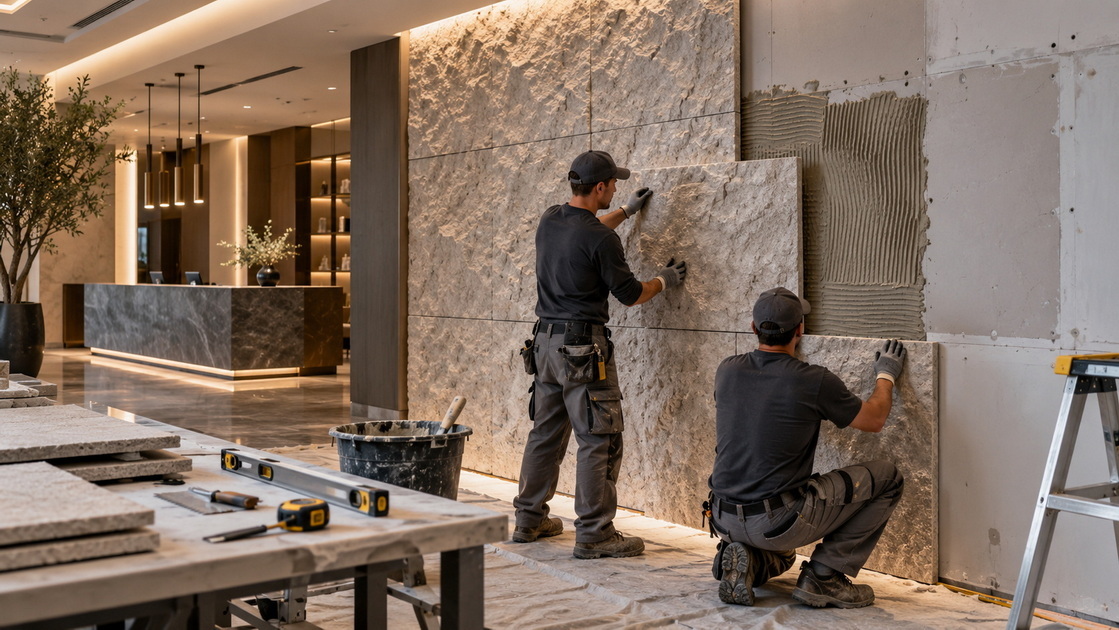
7. Inspect alignment, color consistency, edges, and cleanability before handover
This process is not "just glue panels to a wall." Good results come from layout planning, compatible materials, careful edge treatment, and quality inspection.
"Waterproof" is one of the most misunderstood terms in decorative wall-cladding marketing. A panel may resist water absorption, but a complete wall installation can still fail if water enters through unsealed joints, penetrations, damaged edges, or an unprotected substrate.
For bathrooms, spa corridors, wash areas, kitchens, humid villas, and coastal projects, ask the supplier and installer:
- Is the panel itself water-resistant or waterproof?
- Are joints, corners, and penetrations part of the approved waterproofing detail?
- What adhesive or mechanical fixing is compatible with humid conditions?
- What is behind the panel: cement board, moisture-resistant board, masonry, or another substrate?
- Can trapped moisture drain or dry?
- Is the system intended for splash zones, high-humidity spaces, or direct water exposure?
Building-science guidance emphasizes that effective wall moisture control is a system issue. Drained wall assemblies typically use a cladding layer, drainage plane, drainage gap or cavity, flashing, and drainage exits to manage incidental water. This is particularly important for exterior cladding and façade applications.
For interior decorative walls, the practical lesson is equally relevant: do not rely on surface appearance alone. Coordinate the panel specification with the moisture exposure level and substrate design.
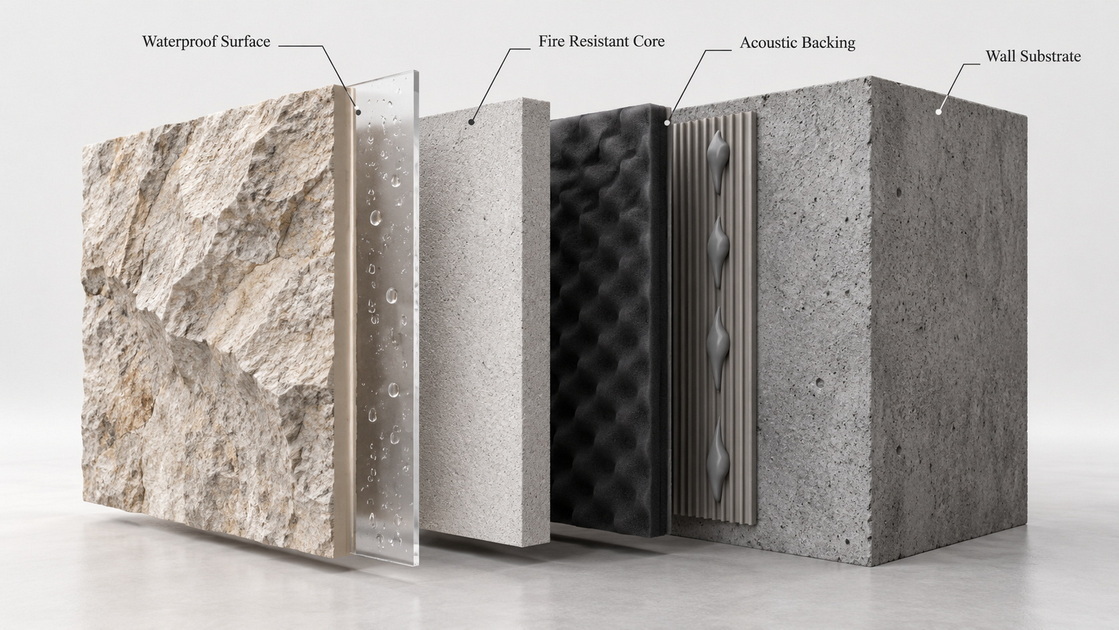
Terms such as "fireproof," "fire-resistant," and "flame-retardant" should not be used casually. Fire performance depends on the specific product construction, thickness, facing, backing, adhesive, fixing method, and the local building code.
ASTM E84 is a recognized test method that measures comparative surface-burning characteristics, including flame-spread and smoke-developed values, for exposed building-material surfaces such as walls and ceilings. It is a 10-minute test method and should not be interpreted as a complete assessment of how an entire wall system performs in a real building fire.
For certain applications, a flame-spread index of 0–25 and smoke-developed index of 0–50 is commonly referenced in U.S. code contexts, including some plenum or air-handling spaces; however, the applicable requirement depends on the project, occupancy type, code, location, and exact installation.
Procurement checklist: Before approving PU stone or any composite wall panel, request the test report—not merely a marketing statement—and verify:
- Test standard and edition
- Testing laboratory
- Product name and exact construction
- Thickness and surface finish tested
- Test date and report number
- Whether the report applies to the intended installation
- Relevant local code or project specification
At Binmao Decor, we can provide product test documentation for applicable product configurations and work with customers to identify the documentation needed for their project. Final compliance decisions should always be confirmed with the project architect, fire consultant, contractor, and local authority.
For MDF-based decorative systems, indoor air quality is an important selection criterion. In the United States, EPA formaldehyde standards under TSCA Title VI regulate hardwood plywood, medium-density fiberboard, including thin MDF, and particleboard. The EPA lists the MDF emission limit at 0.11 ppm and thin MDF at 0.13 ppm.
For projects specifying MDF decorative panels, buyers should clearly distinguish between:
- Decorative appearance
- Board grade
- Emission classification
- Certification or test documentation
- Intended indoor application
- Installation environment
Binmao Decor can supply E1/E0-grade MDF-based options depending on the requested construction and project requirements. However, purchasing teams should always verify the applicable regulatory and certification requirements in their destination market before placing a final order.
PU stone is especially effective where visual impact is important but construction efficiency is essential.
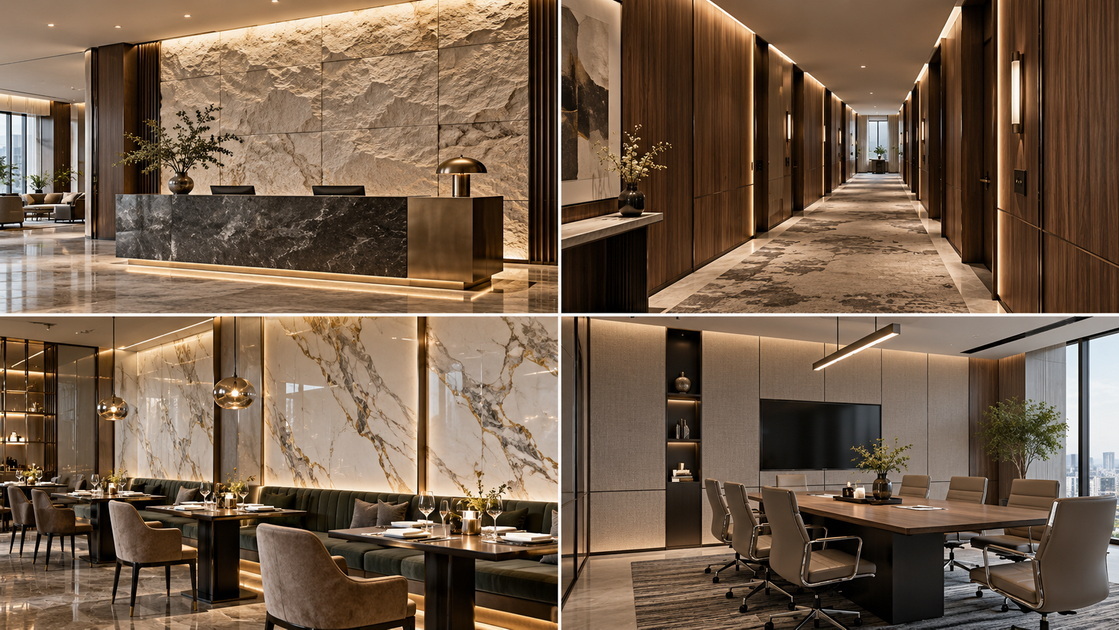
Hotels benefit from materials that create atmosphere while keeping renovation schedules manageable. PU stone can be used for:
- Reception backdrops
- Lobby feature walls
- Restaurant and café walls
- Corridor focal points
- Guest-room TV walls
- Spa reception zones
- Boutique hotel themed interiors
A warm gray stacked-stone PU finish, for example, can create a premium lobby statement when paired with walnut veneer panels, concealed lighting, and acoustic-backed wall sections. The result can feel layered and high-end without requiring a heavy full-depth natural-stone construction.
For villas, PU stone is useful where owners want stone character with more design freedom. It can support rustic, Mediterranean, contemporary, industrial, and luxury-modern interiors.
Use it for:
- Living-room feature walls
- Fireplace surrounds, subject to heat and clearance requirements
- Stairwell walls
- Entrance foyers
- Dining-room statement walls
- Covered terraces, if the product and installation are approved for the environment
Retailers and commercial designers often need a distinct brand environment delivered within a short fit-out period. PU stone can provide a recognizable material identity for cafés, showrooms, salons, restaurants, offices, and display environments.
The panel format also helps designers combine stone visuals with other materials such as UV marble-look boards, wood veneer, metal trims, mirrors, and acoustic panels.
Natural stone is still the right choice when the project values authenticity over efficiency or when performance demands exceed the intended use of PU stone.
Choose natural stone when you need:
- Genuine and non-repeatable geological veining
- A premium luxury-material story
- High-impact resistance in demanding locations
- Long-term exterior durability in a properly engineered façade
- Heavy-duty floor, countertop, or monumental applications
- A material that can be restored, refinished, or repolished over time
Natural stone also requires informed care. The Natural Stone Institute recommends neutral cleaners, stone soap, or mild liquid dishwashing detergent with warm water for cleaning. It notes that some stones may benefit from impregnating sealers, but sealing improves stain resistance rather than making stone stain-proof.
This does not make natural stone inconvenient; it makes it a material that should be specified and maintained with expertise.
A detailed request for quotation leads to better sampling, fewer installation problems, and more accurate pricing. Instead of asking only for "PU stone price," provide a clear project brief.
Include the following information:
- Project type: hotel, villa, restaurant, retail store, apartment, office, or showroom
- Installation location: interior dry area, humid area, covered exterior, or exposed exterior
- Required panel dimensions and total square meters
- Preferred stone style: stacked stone, ledgestone, travertine look, slate look, limestone look, or custom texture
- Required color, gloss level, and texture depth
- Substrate type and expected fixing method
- Fire-performance and indoor-air documentation requirements
- Packing, labeling, pallet, and shipping-port requirements
- Need for installation drawings, cutting guidance, corner pieces, trims, or accessories
- Destination country and applicable project standards
This is where a specialist manufacturer can add value. Binmao Decor can customize panel width, depth, finish, and structure around residential, commercial, and hospitality requirements, while providing installation support and relevant product reports for the selected configuration.
PU stone is not a universal replacement for natural stone. It is a strategic alternative for projects where lightweight construction, fast installation, controlled aesthetics, easy maintenance, and flexible customization matter most.
Natural stone is still the strongest choice for projects that demand authentic mineral beauty, long-term architectural permanence, and premium material prestige.
For most hotel renovations, villa feature walls, commercial interiors, and fast-track decorative upgrades, PU stone can offer the more efficient balance of design impact and installation practicality. For exterior façades, high-heat zones, fire-sensitive spaces, and code-regulated applications, always evaluate the full assembly and confirm suitability through project-specific technical review.
Planning a PU stone, UV panel, waterproof wall panel, wood veneer, PVC/WPC, or acoustic wall-panel project? Contact Binmao Decor with your drawings, finish references, quantities, and target market. Our team can help you select a custom fast-install wall solution, prepare samples, provide applicable test documentation, and support your installation planning.
In many projects, PU stone is more cost-effective than natural stone because it is lighter, simpler to handle, often faster to install, and can reduce labor, cutting, transport, and structural-support requirements. The final installed cost still depends on the panel design, wall condition, installation method, quantity, destination, and technical requirements.
PU stone may be suitable for humid interior spaces when the selected product, joints, substrate, adhesive, and waterproofing details are designed for that environment. Do not assume a water-resistant panel alone makes the entire wall system waterproof. Confirm the intended exposure level with the manufacturer and installer.
Some PU stone products may be used in covered or exterior applications, but exterior use requires specific review of UV exposure, temperature movement, moisture management, wind load, substrate, mechanical fixing, joint design, and local code requirements. For exposed façades, a rainscreen and drainage strategy may be necessary.
Do not describe PU stone as "fireproof" without verified, applicable test evidence. Fire performance must be evaluated based on the actual product construction and installed assembly. ASTM E84 provides surface-burning measurements, including flame-spread and smoke-developed indices, but it is not a complete building-fire-performance assessment.
PU stone is primarily selected for its three-dimensional, stone-like decorative relief. PVC and WPC panels are often used for flat, grooved, wood-look, marble-look, or contemporary decorative surfaces. The best choice depends on the desired design, moisture exposure, installation method, fire-performance requirements, budget, and maintenance expectations.
Yes. Binmao Decor can support custom panel width, depth, finish, texture, color, structure, packaging, and project-oriented wall-panel combinations. Customers should provide drawings, reference images, quantities, application conditions, and destination-market requirements for an accurate recommendation.
E1/E0-grade MDF options can be considered for hotel interiors when the board construction, finish, emission documentation, intended location, fire requirements, and local regulations align with the project specification. In the U.S., applicable composite-wood products are regulated under EPA TSCA Title VI formaldehyde-emission standards.
1. George Panel. "[PU Stone vs. Natural Stone: A Comprehensive Comparison]." Original article reviewed as the baseline source for this enhanced comparison. [georgepanel]
2. ASTM International. "[ASTM E84: Standard Test Method for Surface Burning Characteristics of Building Materials]." Describes comparative measurement of flame spread and smoke density for exposed wall and ceiling surfaces. [store.astm]
3. ASTM International. "[Surface Burning Characteristics]." Clarifies the difference between ASTM E84's 10-minute test duration and extended-duration testing. [astm]
4. U.S. Environmental Protection Agency. "[Frequent Questions for Regulated Stakeholders About Implementing Formaldehyde Standards]." Provides TSCA Title VI composite-wood product categories and emission limits. [epa]
5. Natural Stone Institute. "[Learn About Cleaning Products for Natural Stone]." Provides natural-stone care and sealing guidance. [naturalstoneinstitute]
6. Building Science Corporation. "[Modeled and Measured Drainage, Storage and Drying Behind Cladding Systems]." Explains key components of drained wall assemblies and moisture management. [buildingscience]
7. Building Science Corporation. "[Rain Control in Buildings]." Explains drainage gaps, flashing, weep holes, and drying principles for wall assemblies. [buildingscience]
8. UL Solutions. "[Products Used in Air Handling Spaces]." Discusses ASTM E84/UL 723 flame-spread and smoke-developed criteria referenced in certain code applications. [code-authorities.ul]


