
Views: 278 Author: Sunny Publish Time: 2026-09-19 Origin: Site


Content Menu
● What Is the Difference Between Wall Panel Material and Wall Panel Style?
● MDF Wall Panels: Best for Dry, Painted and Custom Interior Features
>> Why designers choose MDF wall panels
>> The moisture limitation of MDF
>> Best applications for MDF wall panels
● WPC Wall Panels: A Durable Choice for Humidity-Prone Interiors
>> Why WPC panels are popular for hotels and villas
>> Important questions before buying WPC panels
>> Best applications for WPC wall panels
● PVC Wall Panels and UV Boards: Practical Fast-Install Solutions
>> When PVC wall panels make sense
>> Do not confuse "waterproof" with "fire-rated"
● Solid Wood and Wood Veneer Panels: Premium Warmth With Greater Care Requirements
>> Advantages of solid wood and wood veneer
● MDF vs WPC vs PVC vs Solid Wood
● How to Choose Wall Panels for Hotels, Villas and Commercial Projects
>> 1: Classify the installation environment
>> 2: Define the non-negotiable performance requirements
>> 3: Select the visual system
>> 4: Approve a full sample package
● Fire Safety and Indoor-Air Documentation
>> Indoor-air and formaldehyde checklist
● Installation Mistakes That Can Ruin Good Wall Panels
● Why Customization Matters in Large Wall Panel Projects
● Choose Performance First, Design Second
>> Request a Project-Specific Wall Panel Solution
>> 1. Are WPC wall panels completely waterproof?
>> 2. Can MDF wall panels be used in bathrooms?
>> 3. Is VJ panel a material or a design style?
>> 4. Are PVC wall panels suitable for hotel projects?
>> 5. What documents should I request from a wall panel manufacturer?
>> 6. Which wall panel is best for a luxury villa living room?
>> 7. Can acoustic wall panels improve office or hotel-room comfort?
Choosing the right wall panel is not simply a matter of choosing a wood grain, a color, or a fluted profile. For hotel developers, villa designers, contractors, and commercial buyers, the best wall panel material must balance moisture resistance, fire-test documentation, indoor-air considerations, installation speed, maintenance needs, and visual consistency.
In our experience working with fast-install decorative wall panel solutions for hospitality, residential, and commercial interiors, the biggest purchasing mistake is comparing panels only by unit price. A low-cost panel can become an expensive decision when it requires repeated painting, difficult site finishing, early replacement, or fails to match the project's moisture and fire-performance requirements.
This guide compares MDF wall panels, WPC wall panels, PVC wall panels, UV boards, solid wood panels, and VJ/fluted wall panel profiles. It also explains how to specify the right panel system for bathrooms, hotel corridors, villa living rooms, lobbies, retail spaces, offices, and other demanding interiors.

Before comparing products, it is important to separate material from profile.
A wall panel material is the structural base or core used to make the product. Common options include MDF, PVC, WPC, PU, plywood, and solid wood. A panel profile is the visible design format, such as fluted, slatted, VJ, flat, marble-look, stone-look, or fabric-look.
For example, a vertical-groove VJ wall can be made from:
- MDF with a painted finish
- PVC or WPC with a wood-grain film
- Solid oak or walnut veneer
- UV-coated decorative board
- A composite core with an acoustic felt backing
This distinction matters because a stylish fluted appearance does not automatically mean a panel is waterproof, fire-rated, low-emission, or appropriate for a hotel corridor.
Medium-density fiberboard, commonly called MDF, is an engineered wood panel made from wood fibers and resin binders compressed under heat and pressure. It is widely used for decorative wall moulding, painted VJ panels, cabinetry components, and custom millwork.
MDF provides a smooth, uniform surface. It cuts cleanly and can be machined into detailed grooves, curved elements, geometric patterns, and decorative trim.
It is a strong option when your project requires:
- A seamless painted feature wall
- Custom colors matched to an interior palette
- Precision-cut VJ or shaker-style profiles
- Decorative wall mouldings in dry rooms
- A cost-conscious alternative to solid timber millwork
For dry residential spaces, such as bedrooms, living rooms, dining rooms, and executive offices, MDF can offer a polished architectural finish at a lower material cost than natural hardwood.
Standard MDF is not a wet-area product. When exposed to water or persistent humidity, it can absorb moisture, swell at the edges, lose structural integrity, and create conditions that make maintenance difficult.
That does not mean every MDF product is unsuitable for every interior project. Moisture-resistant MDF grades may be appropriate in controlled environments. However, they should not be treated as equivalent to a truly waterproof PVC or WPC wall panel system.
MDF also deserves closer attention for indoor-air documentation. Composite wood products, including MDF, may contain resins associated with formaldehyde emissions. The U.S. Environmental Protection Agency identifies composite wood products such as MDF, particleboard, and hardwood plywood as potential sources of formaldehyde exposure indoors.
For projects in California or projects following North American procurement standards, buyers should request compliant documentation. California's composite wood regulation specifically applies to MDF, particleboard, hardwood plywood, and finished goods containing these materials, with formaldehyde-emission compliance requirements and labeling obligations.
- Dry bedrooms and living rooms
- Painted wainscoting and decorative moulding
- Boutique retail displays
- Office reception features
- Custom VJ wall treatments
- Interior areas with stable temperature and humidity
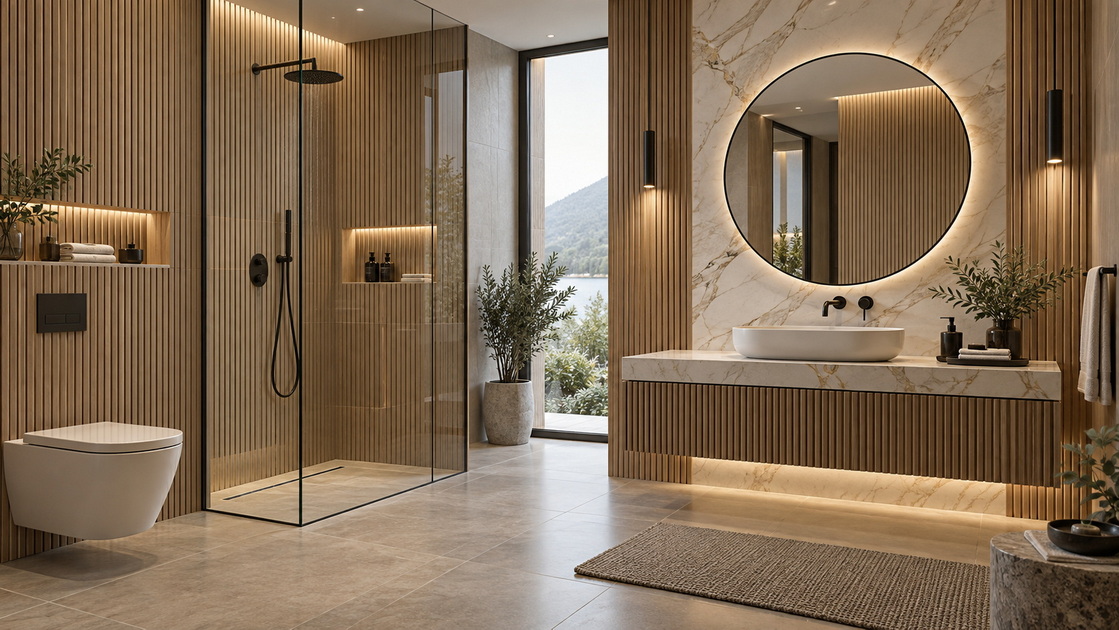
WPC stands for wood-plastic composite. In wall-panel applications, it commonly combines wood fibers or bamboo fibers with thermoplastic materials and additives. Depending on the product design, WPC can be supplied as fluted panels, flat wall cladding, decorative slats, ceiling panels, or composite architectural finishes.
WPC wall panels are often selected because they provide a practical balance between decorative appearance and moisture resistance. They are particularly useful in projects where designers want a warm wood-look surface without the maintenance demands of natural timber.
A quality WPC panel system may offer:
- Strong moisture resistance
- Mold-resistant surface performance
- Fast-install interlocking or clip-based systems
- Pre-finished wood, stone, fabric, or solid-color appearances
- Reduced need for on-site painting
- Easier cleaning than painted MDF
- Stable visual consistency across large wall areas
For bathrooms, laundry rooms, basement areas, hotel service zones, and high-turnover rental properties, WPC can reduce the risk associated with unfinished wood-based panels.
However, buyers should avoid assuming that every WPC panel has identical performance. Waterproof claims, fire performance, impact resistance, thermal movement, surface-film durability, and emission characteristics vary by formulation and construction.
Ask the supplier for:
1. The complete panel cross-section and core composition
2. Water-absorption or moisture-resistance test information
3. Fire-test report and the exact standard used
4. Recommended installation method and expansion-gap requirement
5. Surface-film, UV-coating, or laminate specification
6. Warranty terms for color change, warping, cracking, and delamination
7. Batch samples from the actual production finish
- Hotel bathrooms and changing areas
- Villa kitchens and laundry spaces
- Basement renovations
- Moisture-prone corridors
- Rental apartments
- Commercial interiors needing fast installation
- Decorative fluted feature walls with low maintenance requirements
PVC wall panels are lightweight decorative panels made primarily from polyvinyl chloride. Depending on the system, they may be hollow, foam-core, laminated, grooved, or combined with a decorative surface film. PVC wall panels are commonly used where ease of cleaning, moisture resistance, and installation speed matter.
UV boards are decorative panels finished with UV-cured coatings. They are frequently used to create marble-look, stone-look, glossy, matte, fabric-look, or printed decorative surfaces. The actual performance of a UV board depends on the substrate, coating system, thickness, installation method, and edge treatment.
PVC wall panel systems can be a practical option for projects that need:
- Waterproof decorative surfaces
- Easy cleaning and routine maintenance
- Lightweight handling
- Quick installation
- Consistent factory-produced finishes
- Cost-efficient upgrades for hospitality and commercial interiors
In hotel projects, PVC and UV boards may be useful for selected feature areas, corridors, washroom-adjacent walls, reception backdrops, or refurbishment work where construction time must be minimized.
Binmao Decor supplies quick-install interior wall panel series for hotels, villas, and commercial spaces, including decorative wood, stone, and fabric-effect options. Its listed product range includes PVC wall panels, UV marble wall panels, bamboo wood-fiber panels, acoustic wall panels, PU stone panels, and fluted wall panel solutions.
A waterproof panel is not automatically fire-rated. Likewise, a decorative fire-retardant claim should not be accepted without the relevant test report.
For North American projects, ASTM E84 is a commonly referenced test method for evaluating the comparative surface-burning characteristics of exposed building materials such as walls and ceilings. The test reports flame-spread and smoke-developed indices under defined laboratory conditions; it does not, by itself, describe every real-world fire risk or prove that a complete installation will meet local code requirements.
Solid wood panels offer a depth, grain variation, texture, and natural character that printed or embossed finishes cannot fully reproduce. Oak, walnut, teak, ash, and other species can create a premium architectural impression in villas, executive suites, boutique hotels, private clubs, and luxury retail interiors.
Wood veneer panels provide a more material-efficient route to a natural timber appearance. They use a thin layer of real wood over a stable engineered core, often allowing designers to achieve a high-end surface while reducing the cost and movement associated with thick solid timber.
- Authentic natural grain and tactile value
- Premium visual differentiation
- Suitable for luxury and biophilic interiors
- Repairable or refinishable in some applications
- Strong storytelling value for high-end brands
Natural wood responds to changes in humidity. It can expand, contract, crack, cup, or change color over time. It also requires attention to sealing, finish maintenance, installation acclimatization, and expansion gaps.
Solid wood is generally best suited to climate-controlled, lower-moisture environments where the design budget allows for skilled installation and long-term maintenance.
| Feature | MDF Wall Panel | WPC Wall Panel | PVC / UV Wall Panel | Solid Wood / Veneer Panel |
|---|---|---|---|---|
| Moisture resistance | Low for standard MDF | High, depending on construction | High for suitable PVC systems | Moderate; requires sealing and climate control |
| Suitable for bathrooms | Usually no | Often yes, subject to system approval | Often yes, subject to installation details | Not normally preferred |
| Painted custom colors | Excellent | Limited after factory finishing | Limited after factory finishing | Possible, but often not desired |
| Wood-look realism | Depends on finish | Good to very good | Good, especially with premium decorative films | Excellent and naturally unique |
| Maintenance level | Moderate | Low | Low | Moderate to high |
| Fire documentation needed | Yes for regulated projects | Yes | Yes | Yes |
| Indoor-air documentation | Important | Important | Important | Important |
| Installation speed | Medium | Fast to medium | Fast | Medium to slow |
| Repairability | Moderate | Usually panel replacement | Usually panel replacement | High in some refinishing systems |
| Best use case | Dry painted features | Humidity-prone interiors | Fast-install waterproof decorative projects | Luxury dry interiors |
The correct choice begins with the location of the panel, not the visual design alone.
Use the room condition as your first filter:
- Dry areas: Bedrooms, meeting rooms, hotel suites, lobbies, living rooms, offices
- Moderate-humidity areas: Corridors, kitchens, changing rooms, entry areas
- High-humidity areas: Bathrooms, laundry rooms, basements, spa-adjacent spaces
- High-traffic areas: Hotel corridors, retail stores, public reception areas, restaurants
- Acoustic-sensitive areas: Conference rooms, cinemas, offices, hospitality lounges
A panel suitable for a dry guest-room headboard may not be suitable for a shower-adjacent wall or a busy hotel corridor.
Before requesting a quotation, list the requirements that cannot be compromised:
- Moisture and mold resistance
- Fire-test documentation
- Emission or indoor-air documentation
- Acoustic performance
- Impact and scratch resistance
- Cleaning-chemical compatibility
- Installation time
- Color and finish consistency
- Custom size, depth, width, and edge detail
- Local building-code or project-specification compliance
Once performance requirements are clear, specify the appearance:
- Fluted or slatted wood grain
- Flat marble-look UV board
- Fabric-effect integrated panel
- Oak, walnut, or other wood veneer
- Stone-look PU panel
- Painted MDF VJ profile
- Acoustic slat panel with sound-absorbing backing
A small color chip is not enough for a large project. Request a complete sample package that includes the finished face, core material, joint system, edge profile, accessories, and installation guidance.
For hospitality and commercial projects, the sample approval should also confirm:
- Color consistency under project lighting
- Joint appearance at panel-to-panel connections
- Corner and termination details
- Cleaning response
- Scratch resistance
- Adhesive and mechanical-fixing compatibility
- Fire and emission documentation matching the ordered construction
Fire and emission claims should be treated as documentation questions, not marketing adjectives.
For projects requiring fire-retardant wall panels, request:
- Test standard and report number
- Laboratory name and accreditation information
- Product name, thickness, and decorative finish tested
- Flame-spread and smoke-developed results where applicable
- Installation or substrate conditions used during testing
- Test-report validity and product-batch traceability
- Confirmation that the supplied product matches the tested specimen
ASTM E84 evaluates comparative surface burning performance and reports flame-spread and smoke-developed indices. It applies to exposed wall and ceiling surfaces, but it should be interpreted alongside local code requirements, assembly design, and the full project specification.
For MDF, veneer-core panels, and other composite wood structures, request:
- Board grade and resin system
- E0 or E1 documentation where relevant to the project market
- CARB or TSCA Title VI documentation if required
- Third-party test reports where specified
- Batch identification and finished-product declarations
The EPA notes that formaldehyde can off-gas from composite wood products and that exposure commonly occurs through indoor air. Proper ventilation and verified compliant materials are especially important in enclosed, newly renovated, or high-occupancy environments.
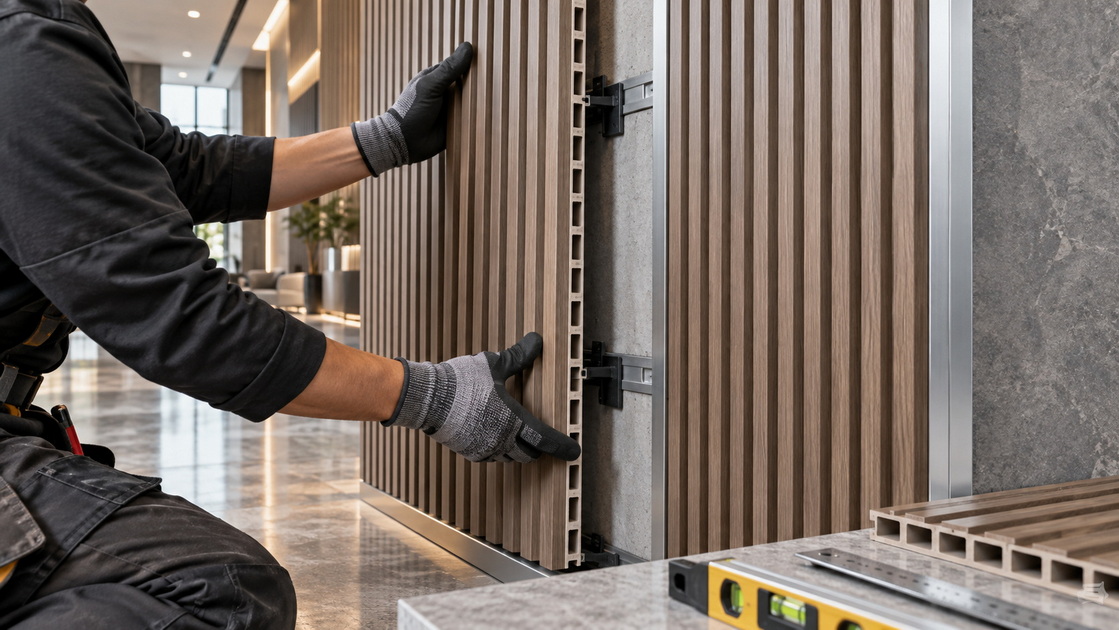
Even a high-quality panel can fail if it is installed incorrectly. In our experience, installation planning is one of the most overlooked parts of wall-panel procurement.
1. Using standard MDF in wet zones.
A painted MDF panel may look excellent at handover, but standard MDF is vulnerable to water exposure and ongoing humidity.
2. Ignoring wall flatness.
Uneven substrates can create visible gaps, weak adhesive bonding, panel distortion, and poor joint alignment.
3. Skipping expansion allowances.
Wood, WPC, PVC, and composite panels may move differently with temperature and humidity. Follow the manufacturer's required clearances.
4. Using unapproved adhesive.
Adhesive compatibility affects bond strength, surface staining, VOC considerations, and future maintenance.
5. Approving samples without accessories.
Corners, trims, end caps, shadow gaps, and transition profiles determine whether a finished installation looks premium.
6. Treating all fire reports as interchangeable.
A report for one thickness, finish, or assembly may not apply to another product configuration.
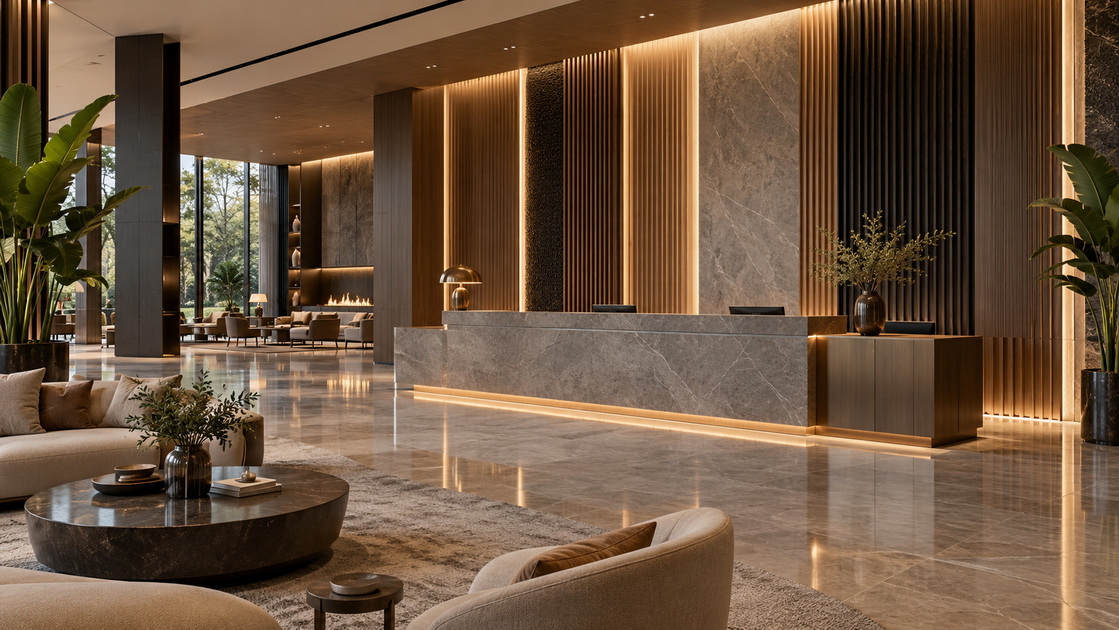
For a hotel, villa, or commercial fit-out, standard panel dimensions do not always create the best outcome. Custom wall panel design can reduce cutting waste, improve alignment with doors and windows, simplify installation, and deliver a more intentional visual rhythm.
Binmao Decor supports customized specifications for wall panel width, depth, finishes, and project requirements, together with professional installation technical support and relevant product test documentation. Its integrated wall panel range is positioned for modern hotels, villas, and commercial interiors requiring waterproof, mold-resistant, fast-install decorative solutions.
Customization can include:
- Panel width and height
- Flute spacing and depth
- Core material selection
- Oak, walnut, marble, stone, fabric, or custom decorative finishes
- Acoustic backing structures
- PVC, WPC, PU, MDF, wood veneer, or UV-board configurations
- Edge details and accessory systems
- Project-specific packaging and labeling
- Sample development and color matching
There is no single "best" wall panel for every project.
Choose MDF wall panels when you need a smooth, painted, custom architectural look in a dry and controlled interior environment.
Choose WPC wall panels when you need a durable, moisture-resistant decorative system for bathrooms, kitchens, basements, rental properties, or fast-install hospitality projects.
Choose PVC wall panels or UV boards when waterproof decorative surfaces, easy cleaning, consistent finishes, and installation efficiency are priorities.
Choose solid wood or wood veneer panels when authentic natural material, premium grain, and luxury visual impact outweigh the higher maintenance and budget requirements.
Choose acoustic-backed wall panels when visual design must also support sound absorption in offices, hospitality lounges, meeting rooms, and entertainment spaces.
For hotels, villas, and commercial interiors, the strongest specification is usually not simply "wood-look wall panel." It is a complete performance brief: material, finish, dimensions, moisture conditions, fire documentation, indoor-air requirements, installation method, accessories, and maintenance expectations.
Planning a hotel, villa, retail, office, or commercial wall-cladding project?
Contact Binmao Decor to request:
- Material and finish samples
- Custom wall panel dimensions
- PVC, WPC, MDF, UV, PU, wood veneer, and acoustic panel options
- Product test-report support
- Installation guidance
- Factory-direct quotation for wholesale or project orders
A well-specified panel system helps protect your design intent, installation schedule, and long-term maintenance budget.
Many WPC wall panels are designed for high moisture resistance, but buyers should confirm the exact product construction, joint system, edge treatment, and installation instructions. "Waterproof" performance can be affected by unsealed joints, wall penetrations, poor substrate preparation, and incorrect accessory installation.
Standard MDF is generally not recommended for bathrooms or directly wet environments because it can absorb moisture and swell. For bathroom projects, consider a suitable WPC, PVC, or other waterproof composite panel system, while confirming project-specific fire and installation requirements.
VJ is a decorative panel profile characterized by vertical grooves or joints. It can be made from MDF, WPC, PVC, solid wood, veneer, or other panel materials. Select the base material according to the room's moisture, maintenance, and performance needs.
PVC wall panels can be suitable for selected hotel applications because they are lightweight, easy to clean, and often moisture-resistant. However, hotel buyers should verify fire-test documentation, surface durability, cleaning compatibility, appearance quality, and local project requirements before specifying them.
At minimum, request product specifications, panel cross-sections, finish details, installation instructions, warranty terms, fire-test reports where required, and emission documentation for composite wood products. For large projects, request pre-production samples and batch traceability.
It depends on the design objective. Solid wood or premium wood veneer is often best for a natural luxury appearance. Painted MDF works well for refined architectural moulding. WPC or PVC-based panels may be more practical where maintenance resistance, speed, and humidity control are important.
Acoustic wall panels with an appropriate sound-absorbing backing can help reduce reflected sound and improve perceived comfort. Actual acoustic performance depends on the panel structure, backing material, installation method, room size, and surrounding surfaces. Ask for performance data rather than assuming all slatted panels provide the same acoustic benefit.
1. George Panel. "Wall Panel Comparison Guide: MDF vs. WPC vs. Solid Wood." Discusses the distinction between VJ profile design and panel substrate materials, as well as basic use cases for MDF, WPC, and solid wood. [Read the source]. [georgepanel]
2. Binmao Decor. "China Wall Panels & SPC Flooring Manufacturer." Product-range and company information covering waterproof, fire-retardant integrated wall panels, PVC panels, UV marble panels, acoustic panels, PU stone panels, fluted panels, customization, and technical support. [Read the source]. [binmaomaterials]
3. U.S. Environmental Protection Agency. "Facts About Formaldehyde." Explains formaldehyde sources, including composite wood products such as MDF, and describes potential indoor exposure considerations. [Read the source]. [epa]
4. California Air Resources Board. "Frequently Asked Questions: Regulated Community." Explains California requirements for formaldehyde emissions from composite wood products, including MDF, particleboard, hardwood plywood, and finished goods. [Read the source]. [ww2.arb.ca]
5. California Air Resources Board. "Composite Wood Enforcement." Provides information on compliance responsibilities for composite wood product manufacturers, importers, distributors, retailers, and finished goods. [Read the source]. [ww2.arb.ca]
6. ASTM International. "ASTM E84: Standard Test Method for Surface Burning Characteristics of Building Materials." Explains the ASTM E84 test method, including surface flame-spread and smoke-developed index reporting for wall and ceiling materials. [Read the source]. [store.astm]


