
Views: 260 Author: Sunny Publish Time: 2026-09-21 Origin: Site


Content Menu
● What Is Carbon Crystal Board?
● Why Carbon Crystal Wall Panels Are Popular
>> Main Advantages for Interior Projects
>> "Waterproof" Is Not the Same as a Waterproof Wall System
● Carbon Crystal Board Structure and Material Options
● Fire Performance: What Project Buyers Must Verify
>> A Practical Fire-Report Checklist
● How to Choose Carbon Crystal Board for Hotels, Villas, and Commercial Spaces
>> 1: Define the Application Zone
>> 2: Match the Surface to the Maintenance Plan
>> 3: Specify the Complete Installation Method
>> 4: Request a Project Sample Board
● Installation Guidance from a Manufacturer's Perspective
>> Basic Installation Preparation
● Request a Carbon Crystal Board Solution
>> 1. Is carbon crystal board the same as UV board?
>> 2. Is carbon crystal board suitable for bathrooms?
>> 3. What fire rating should a commercial wall panel have?
>> 4. Can Binmao Decor make custom sizes and finishes?
>> 5. What documents should I request before placing an order?
>> 6. Are E0 and E1 MDF panels appropriate for international projects?
Carbon crystal board is a fast-install interior decorative wall panel commonly used in hotels, villas, apartments, retail spaces, offices, and renovation projects. Buyers value it because it can combine a finished decorative surface with moisture resistance, easy cleaning, and project-specific sizing—but its actual performance depends on the core formula, surface finish, joint design, substrate, installation method, and verified test reports.
At Binmao Decor, we have spent 14 years manufacturing UV panels and integrated wall-panel systems for modern residential, hospitality, and commercial interiors. From our production and project-support experience, the most important purchasing lesson is simple: do not select a carbon crystal wall panel based only on a sample's appearance. Specify the complete system—panel, decorative film, backing, edge treatment, substrate, adhesive or framing, and compliance documents—before production begins.

Carbon crystal board, also called carbon crystal wall panel or carbon crystal plate, is a decorative composite sheet used mainly for interior walls, ceilings, and feature-wall applications. The term is widely used in the wall-panel market, but it is not one globally standardized material definition. Different manufacturers may use different core ingredients, production processes, decorative films, thicknesses, and fire-performance claims.
In many market specifications, the board is described as a composite that may include polymer resin, mineral fillers such as calcium powder, bamboo-charcoal-related additives, and other modifiers. The surface is often laminated or finished with PVC, PET, PP, UV-coated, or other decorative films. Common decorative effects include:
- Marble and stone patterns
- Oak, walnut, teak, and other wood-grain finishes
- Fabric and leather textures
- Concrete, metallic, or industrial finishes
- High-gloss mirror-like decorative surfaces
- Matte solid colors for minimalist interiors
Typical panel dimensions seen in the market include approximately 1,220 mm widths, lengths from 2,440 mm to 3,000 mm or more, and thickness options from about 5 mm to 15 mm. However, these figures should be treated as a starting point rather than a final procurement specification. A buyer should confirm actual tolerance, thickness, density, flatness, surface film, packaging, and allowable installation conditions with the manufacturer.
For international hotel, villa, and commercial projects, a carbon crystal board should be evaluated as part of a broader decorative wall system—not as an isolated panel.
The popularity of carbon crystal wall panels comes from their ability to shorten finishing work. Traditional wall decoration may require several on-site stages, such as leveling, plastering, painting, tiling, veneering, drying, and cleanup. A finished wall panel can reduce the number of visible finishing steps because its decorative face is produced before it reaches the job site.
For property developers, contractors, and interior designers, this can improve schedule control and visual consistency. For distributors and project buyers, it also creates an opportunity to source a flexible product range for several interior styles.
A properly selected wall-panel system can offer the following benefits:
- Fast installation: Large-format panels can cover more wall area than small tiles or individually installed decorative elements.
- Decorative flexibility: Surface films and UV finishes can reproduce stone, wood, fabric, metal, or solid-color looks.
- Easy daily maintenance: Smooth, finished surfaces are generally easier to wipe than porous painted or textured walls.
- Moisture-management potential: Waterproof or moisture-resistant panel faces can be useful in suitable interior locations when joints, edges, penetrations, and backing conditions are correctly designed.
- Reduced wet work: Dry-installation methods can reduce dust, curing time, and some on-site finishing steps.
- Customization potential: Width, depth, length, finish, profile, and backing structures can be adapted to a project's requirements.
At Binmao Decor, we provide quick-install decorative panel solutions for modern hotels, villas, and commercial environments. Our production capabilities can support custom dimensions, finishes, and functional structures, including E1/E0 MDF, oak or walnut wood veneer, PVC/WPC, PU components, UV-finished surfaces, and acoustic backing options.
This distinction matters in bathrooms, wet rooms, kitchens, basement spaces, and hospitality projects. A panel face may resist water exposure, but the complete installation can still fail if water reaches unsealed joints, cut edges, screw holes, electrical openings, weak adhesive areas, or a moisture-sensitive substrate.
A project should therefore evaluate:
1. The panel face's water resistance
2. Cut-edge protection
3. Joint profiles and sealants
4. The wall substrate's moisture condition
5. Adhesive compatibility
6. Expansion gaps and movement allowance
7. Accessory performance at corners, ceilings, and floor transitions
Manufacturers in the category also advise confirming exposure conditions, joint treatment, edge sealing, and exact product reports, because panel-level performance alone does not make an entire wall assembly waterproof.
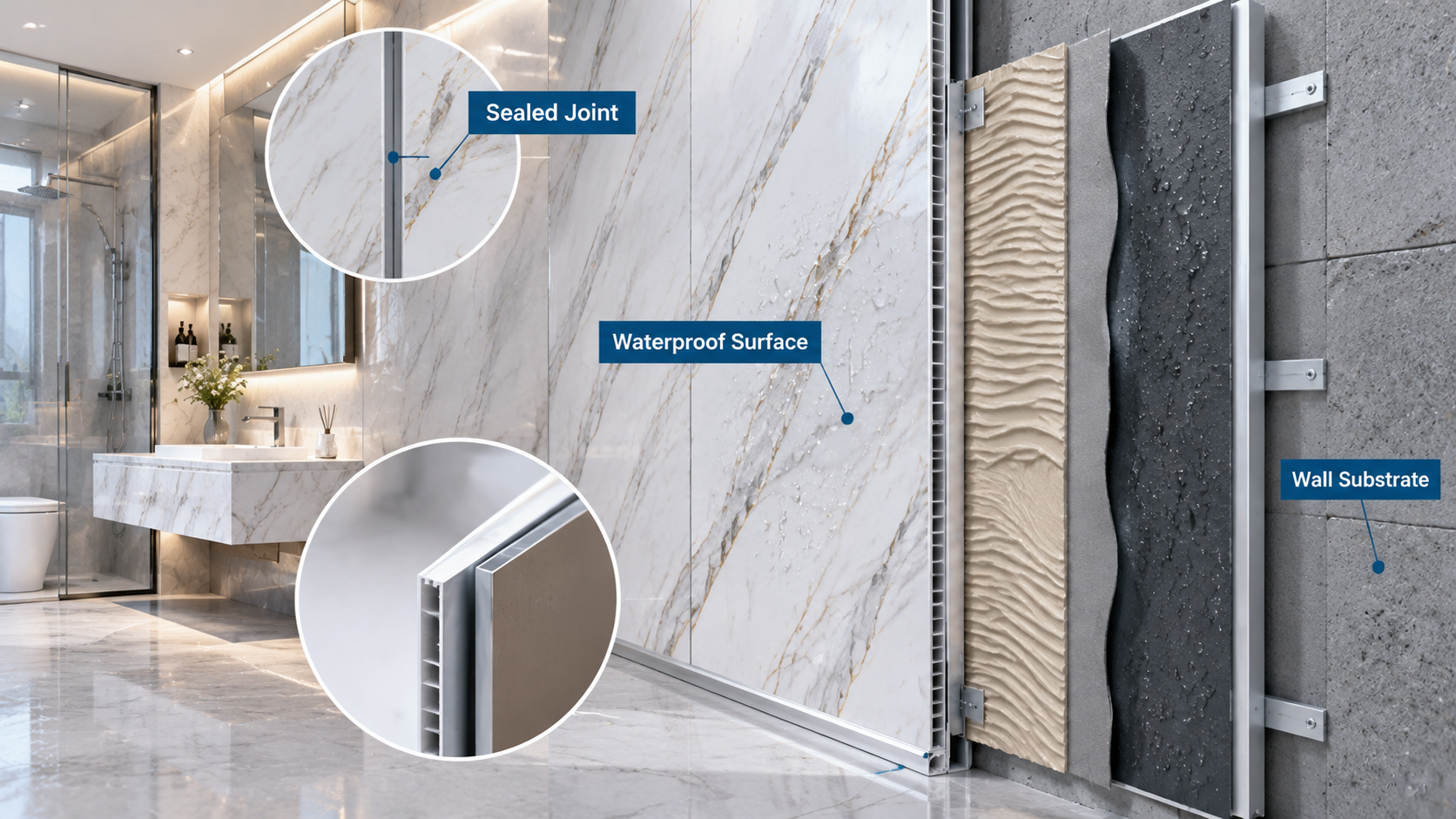
The structure of a wall panel affects its appearance, durability, fire performance, moisture behavior, weight, machining response, and installation requirements. It is not enough to ask, "Is this board waterproof?" A professional buyer should ask, "What exactly is inside the board, and how will it perform in our specified wall assembly?"
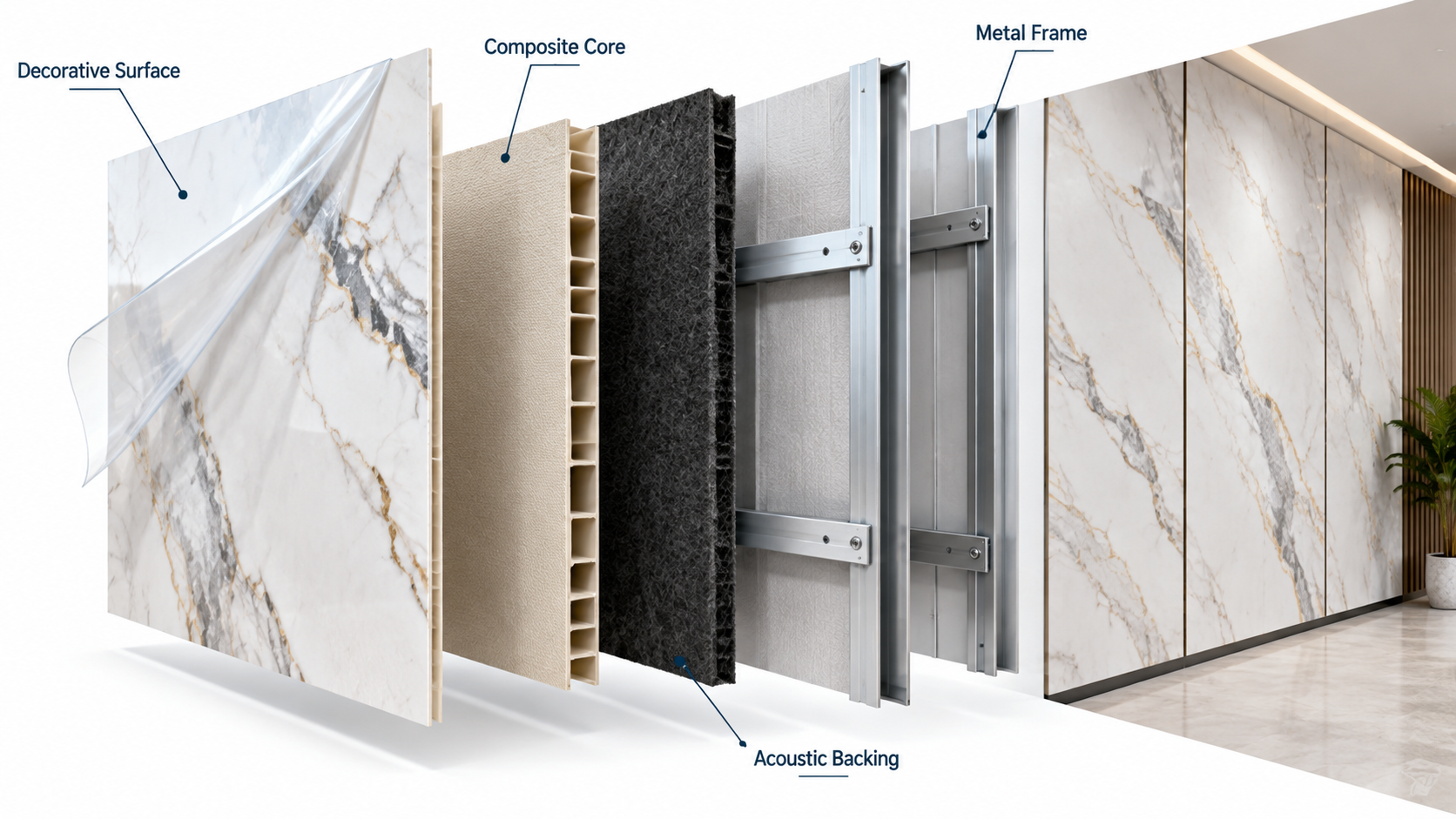
The surface determines much of the visual effect and day-to-day cleaning performance. Common options may include PVC film, PET film, PP film, UV-coated layers, hot-stamping foil, wood veneer, or other decorative laminates.
For commercial and hospitality interiors, buyers should clarify:
- Matte, satin, high-gloss, or textured finish
- Scratch-resistance expectation
- Color and pattern consistency between batches
- UV stability for areas exposed to daylight
- Fingerprint visibility on dark or glossy finishes
- Cleaning-agent compatibility
- Protective-film removal instructions
- Replacement availability for future maintenance
A hotel corridor, for example, may need a low-gloss, scratch-resistant wood-grain finish that hides fingerprints and withstands luggage traffic better than a mirror-gloss decorative surface.
Binmao Decor can tailor panel structures to project needs. Possible construction choices may include:
| Component | Common role in a wall-panel system | Buyer’s verification question |
|---|---|---|
| E1/E0 MDF | Smooth, machinable structural core for decorative applications | Which formaldehyde-emission test standard and report apply? |
| Natural wood veneer | Premium visual layer, such as oak or walnut | Is it real veneer, engineered veneer, or printed film? |
| PVC/WPC composite | Moisture-tolerant decorative panel construction | What are the density, thermal movement, and installation requirements? |
| PU components | Lightweight profile or decorative molding applications | Is the specified product suitable for the intended fire and impact conditions? |
| Acoustic backing | Sound-absorption or sound-control support | What acoustic test data applies to the complete installed system? |
| UV decorative surface | Enhanced visual finish and cleanable face | What abrasion, stain, and gloss-retention data is available? |
For formaldehyde-sensitive projects, do not rely only on sales language such as "eco-friendly" or "zero formaldehyde." Request the exact emissions classification, laboratory report, test method, report date, product configuration, and batch or model identification. E0 and E1 labels are not interchangeable across every market unless the relevant standard and test basis are clearly documented.
Fire safety is one of the most misunderstood areas of decorative wall-panel procurement. Terms such as "fireproof," "fire-resistant," "flame-retardant," "B1," and "Class A" are often used in marketing, but they do not automatically mean the same thing across countries or test systems.
For projects in the United States or markets using ASTM-based requirements, ASTM E84 is widely used to assess the surface-burning characteristics of building materials. The test reports a Flame Spread Index (FSI) and a Smoke Developed Index (SDI) under specified test conditions. ASTM explains that the method provides comparative measurements of flame-spread and smoke-density characteristics.
In common U.S. building-code terminology, ASTM E84 classifications are generally expressed as follows:
| ASTM E84 classification | Flame Spread Index | Smoke Developed Index |
|---|---|---|
| Class A | 0–25 | 0–450 |
| Class B | 26–75 | 0–450 |
| Class C | 76–200 | 0–450 |
These categories are often used by code officials and design teams when evaluating interior finish materials.
However, a test report must match the actual product configuration. A report for a 5 mm panel with one film, one substrate, and one mounting method should not automatically be assumed to apply to a thicker panel, a different decorative film, an acoustic backing, a wood keel system, or a different adhesive.
Before approving a carbon crystal board for a hotel, apartment, office, retail, or public-space project, request:
1. The complete test report, not only a certificate image
2. The testing laboratory's name and accreditation details
3. The applicable standard, such as ASTM E84 where relevant
4. The panel thickness, face finish, core, and backing tested
5. The installation or mounting condition tested
6. Flame Spread Index and Smoke Developed Index values
7. Report issue date and product identification
8. Confirmation that the production specification matches the tested sample
ASTM E84 is valuable, but it is a surface-burning test—not a complete prediction of total building fire behavior. It evaluates flame spread and smoke development under specific controlled conditions.
The best product is not simply the thickest board or the cheapest panel. It is the panel system that fits the real project environment, regulatory obligations, design target, maintenance capacity, and installation method.
Start by identifying where the panels will be installed:
- Hotel guestroom headboard walls
- Hotel corridors and elevator lobbies
- Restaurant dining rooms
- Retail stores and showrooms
- Office reception walls
- Villa living rooms and bedrooms
- Kitchen-adjacent decorative walls
- Bathroom dry zones or moisture-prone areas
- Basement renovation spaces
- Ceiling or feature-wall applications
A luxury villa feature wall may prioritize real oak veneer and acoustic comfort. A hotel corridor may prioritize consistent batch color, fire documentation, impact resistance, rapid replacement, and easy-clean surfaces.
A beautiful finish that is difficult to clean can become a maintenance problem. For high-touch public interiors, ask how the surface performs with routine cleaning, disinfectants, fingerprints, wheeled-luggage scuffing, and possible stain exposure.
For example, a restaurant entry wall may look impressive in high-gloss black marble. But a low-gloss stone texture may hide fingerprints and reduce daily maintenance time.
A wall panel is only as reliable as its installation. Confirm whether the project will use:
- Direct adhesive installation
- Metal framing or keel systems
- Mechanical fasteners
- Tongue-and-groove or profile connections
- Corner trims and end caps
- Silicone or sealant joints
- Ventilated cavity construction
- Acoustic backing or insulation layers
Where high fire performance is required, the framing material matters. Some suppliers specifically advise using metal keels rather than wood keels in higher fire-performance applications, because the supporting structure itself must be considered in the final assembly.
A small swatch is useful for color selection, but it is not enough for a large project. Request a full-size or near-full-size sample with the exact finish, thickness, profile, and backing.
Review the sample under the project's actual lighting conditions:
- Daylight
- Warm hotel lighting
- Cool office lighting
- Wall-washer lighting
- Downlights
- Nighttime artificial lighting
This is especially important for marble patterns, metallic finishes, dark wood grains, and high-gloss panels.
At Binmao Decor, we recommend treating installation support as part of product selection—not as an afterthought. Our technical-support process can help customers confirm panel dimensions, surface selection, substrate requirements, installation accessories, packing plans, and application-specific recommendations before shipment.
Before installation, the wall should be clean, dry, structurally sound, and reasonably flat. The installer should inspect for moisture intrusion, loose paint, hollow plaster, mold, unevenness, and unprotected electrical penetrations.
A reliable pre-installation checklist includes:
- Confirm the wall is dry and stable
- Measure and mark panel layout before cutting
- Confirm expansion and contraction allowances
- Test adhesive compatibility on a sample area
- Protect exposed cut edges where required
- Check alignment at corners, doors, windows, and outlets
- Use appropriate trim profiles
- Follow the approved installation drawing
- Remove protective films only at the correct stage
- Inspect color, pattern direction, and surface condition before fixing
For panels installed in moisture-prone locations, do not assume that a water-resistant face eliminates the need for edge sealing and joint control.
Binmao Decor is a China-based integrated wall-panel manufacturer with 14 years of experience in UV panels, UV boards, waterproof wall panels, fire-retardant composite wall panels, and customized decorative panel solutions.
We serve customers who need more than a generic catalog product. Our value lies in combining manufacturing capability with practical project support for modern hospitality, residential, and commercial interiors.
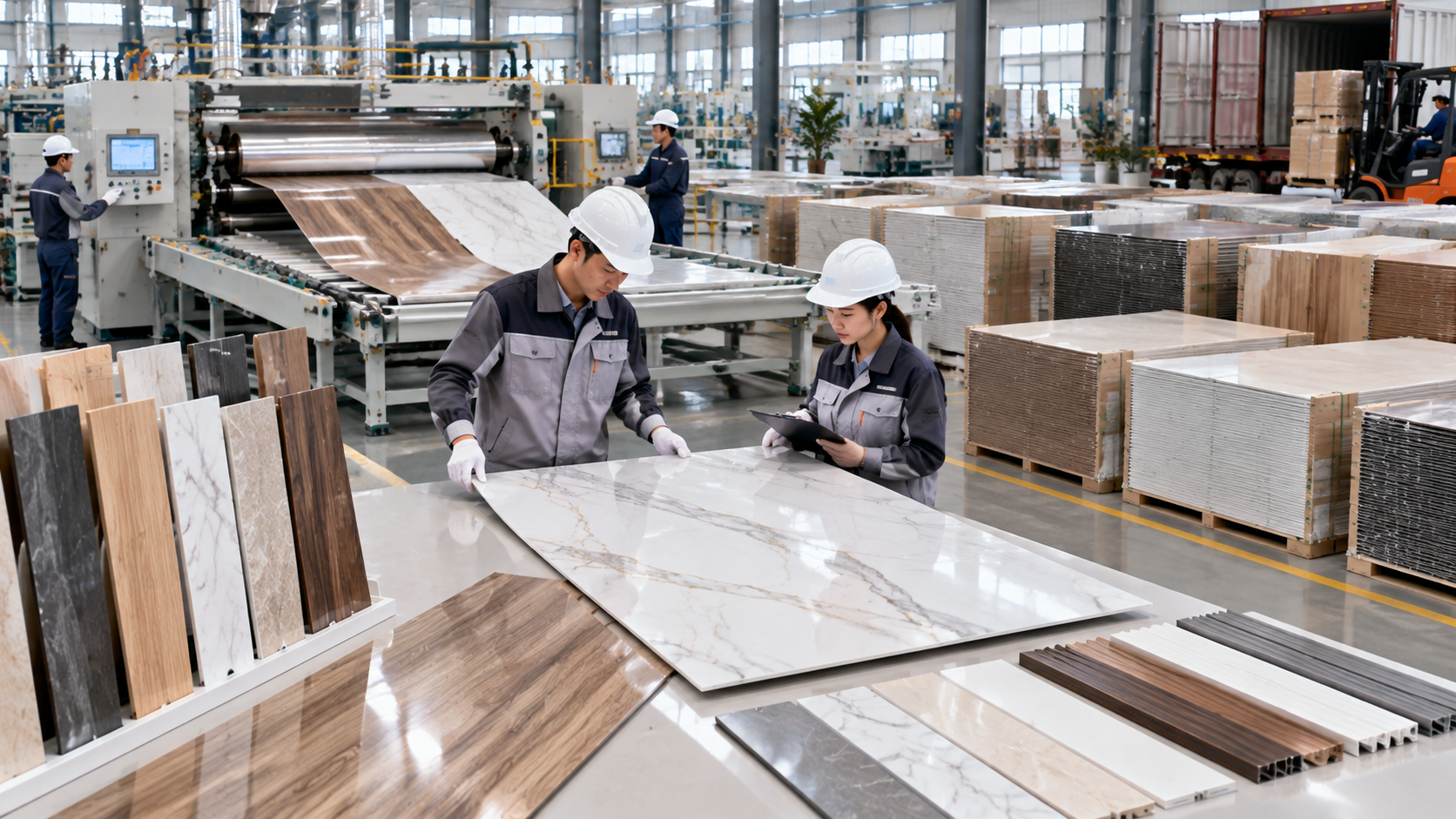
- Panel width, length, thickness, and profile
- Marble, wood-grain, fabric, metallic, solid-color, and custom decorative finishes
- E1/E0 MDF structures
- Oak, walnut, and other wood-veneer options
- PVC/WPC panel systems
- PU decorative components
- UV-finished surfaces
- Acoustic backing structures
- Packaging and loading plans for export projects
- Product test reports and technical documentation where applicable
- Installation guidance and technical support
Our goal is to help global buyers source fast-install decorative panels with clear specifications, stable quality, and a system-level understanding of project performance.
Choosing a wall panel is a design, engineering, compliance, and supply-chain decision. If you are sourcing carbon crystal boards, UV panels, waterproof wall panels, fire-retardant decorative boards, acoustic wall systems, or customized interior panels for a hotel, villa, apartment, office, or retail project, contact Binmao Decor with your drawings, target market, application area, required dimensions, preferred finish, and compliance requirements.
We can help you develop a customized fast-install wall-panel solution with professional manufacturing support, technical installation guidance, and project-relevant product documentation.
Not always. Both are decorative panel categories, but the name "carbon crystal board" often refers to a specific market category of composite decorative sheet, while "UV board" usually emphasizes a UV-cured decorative surface. Their core materials, surface films, thicknesses, and performance characteristics can differ. Always confirm the complete product structure.
It can be suitable for selected bathroom walls or other moisture-prone interior areas when the panel, joints, cut edges, wall substrate, adhesive, and sealing system are designed for that environment. A waterproof surface does not automatically make the entire installation waterproof.
The required rating depends on local building codes, occupancy type, location within the building, and authority-having-jurisdiction requirements. For ASTM E84-based projects, request the complete report and confirm both the Flame Spread Index and Smoke Developed Index for the exact product configuration.
Yes. We can customize panel dimensions, thickness, decorative finishes, core structures, veneer options, and functional backing configurations according to residential, hotel, and commercial project requirements.
Request the product specification sheet, detailed quotation, confirmed finish sample, panel drawing, packing details, installation guidance, applicable test reports, emissions documentation where relevant, and production lead time. For regulated projects, verify that every report corresponds to the final product specification.
They may be appropriate depending on the project's emissions requirements and governing standards. Buyers should request test reports and clarify the exact standard, laboratory, date, product composition, and applicable market requirement rather than relying only on an E0 or E1 label.
1. ASTM International. "ASTM E84-21a: Standard Test Method for Surface Burning Characteristics of Building Materials." Explains that the method measures comparative flame-spread and smoke-density behavior under specified conditions. [ASTM E84 standard]. [store.astm]
2. Capital Testing. "ASTM E84 Surface Burning Characteristics." Explains the role of Flame Spread Index and Smoke Developed Index in evaluating surface-burning characteristics. [Capital Testing ASTM E84 overview]. [capitaltesting]
3. Atlas Roofing. "The Ins and Outs of ASTM E84 Fire Testing." Provides commonly cited ASTM E84 Class A, B, and C index ranges and explains the tunnel-test framework. [Atlas Roofing ASTM E84 guide]. [atlasroofing]
4. CNWALL. "Carbon Crystal Wall Panels Manufacturer." Provides representative market descriptions of carbon crystal board composition, standard dimensions, decorative finishes, and the need to confirm exact product test reports and installation details. [CNWALL carbon crystal wall panels]. [chinawallpanel]
5. EAZART. "China Carbon Crystal Wall Panels Suppliers Support Customized." Provides representative market specifications, including size ranges, materials, surface-film options, and an installation consideration regarding fire-performance requirements. [EAZART carbon crystal wall panels]. [eazart]
6. WPCSPC. "What Is Carbon Crystal Board? Complete Guide to Modern Decorative Wall Materials." The original article provided as the basis for topic expansion and SEO-focused restructuring. [Original carbon crystal board guide]. [wpcspc]


