
Views: 259 Author: Sunny Publish Time: 2026-10-01 Origin: Site


Content Menu
● Why Black Acoustic Wall Panels Need a More Complete Evaluation
● The Real Advantages of Black Acoustic Wall Panels
>> Reduced Glare for Screen, Stage, and Lighting Environments
>> A High-End Architectural Look
>> More Forgiving Appearance in High-Traffic Areas
>> Strong Compatibility With Integrated Technology
● Black vs. White, Gray, Wood Tone, and Other Colors
● How to Specify Black Fluted Acoustic Wall Panels Correctly
>> 1. Define the Acoustic Goal First
>> 2. Confirm the Panel Construction
>> 3. Request Fire Documentation for the Exact Product
>> 4. Evaluate Moisture Exposure Honestly
>> 5. Plan Lighting Before Installation
● Common Buying Mistakes to Avoid
>> 1: Assuming Black Means Better Acoustics
>> 2: Confusing Sound Absorption With Soundproofing
>> 3: Choosing a Finish Without Reviewing Samples
>> 4: Ignoring Installation Details
● Request a Customized Black Acoustic Wall Panel Solution
● FAQ About Black Acoustic Wall Panels
>> 1. Do black acoustic wall panels absorb more sound than white panels?
>> 2. Can black fluted wall panels be used in hotels?
>> 3. Will black wall panels make a room look smaller?
>> 4. Are black acoustic wall panels waterproof?
>> 5. What NRC rating should I look for?
>> 6. Are black acoustic panels difficult to clean?
Black acoustic wall panels can create a premium, low-glare interior while helping control echo and reverberation—but color alone does not determine acoustic performance. For a successful hotel, villa, office, cinema, or retail project, specifiers should evaluate the complete wall-panel system: acoustic backing, panel thickness, mounting method, fire-test documentation, moisture resistance, lighting plan, and installation detail.
At Binmao Decor, we have spent 14 years manufacturing fast-install decorative wall panel systems for international residential, hospitality, and commercial projects. From black fluted wall panels and UV decorative boards to waterproof, fire-resistant composite panels with acoustic backings, our practical experience leads to one core recommendation: select black for its visual and operational advantages, then engineer the structure for the acoustic and safety results the project actually requires.

Black acoustic wall panels are increasingly specified in home theaters, hotel corridors, meeting rooms, restaurants, boutique retail stores, studios, and premium villas. The appeal is easy to understand: black conveys restraint, depth, technology, and sophistication. It can also reduce visually distracting reflections in screen-focused or stage-focused spaces.
However, many articles overstate the role of color. A black finish does not automatically provide better sound absorption than a white, gray, beige, or wood-tone version of the same acoustic product. In most panel systems, acoustic performance depends primarily on:
- The sound-absorbing core or backing material
- Panel thickness and density
- Perforation or slat geometry
- The air cavity behind the panel
- The amount and distribution of acoustic coverage
- Installation method and wall condition
- Independent acoustic test data
The industry commonly uses the Noise Reduction Coefficient, or NRC, to compare mid-frequency sound absorption. NRC is derived from tested sound-absorption coefficients at 250, 500, 1,000, and 2,000 Hz. A higher NRC generally indicates that a material absorbs more sound energy in the tested setup. Importantly, the same decorative surface can perform differently when installed directly against a wall versus mounted over an air gap or acoustic backing.
For buyers, architects, and contractors, this distinction prevents a costly specification error: purchasing a visually attractive black panel expecting it to "soundproof" a room. Sound absorption reduces reflections and reverberation inside a room; sound insulation or sound blocking is a different requirement.
A matte black surface absorbs more visible light than a light-colored surface. This makes black fluted wall panels particularly useful where reflected light can interfere with visual comfort, content viewing, or the intended atmosphere.
Black acoustic wall panels are especially appropriate for:
- Home theaters and private cinemas
- Hotel screening rooms
- Recording, podcast, and editing studios
- Conference rooms with projection screens
- Gaming rooms and entertainment lounges
- Event spaces with LED walls or stage lighting
- Luxury retail displays where merchandise should remain the visual focus
The U.S. Department of Energy notes that dark-toned interior materials absorb light and can create a dimmer, higher-contrast setting. That is often a strength in cinema and presentation environments, but it must be balanced with a well-designed lighting scheme in workplaces or small rooms.
Choose a low-sheen or matte black finish rather than a glossy black surface. Matte finishes better control glare and reduce visible reflections from downlights, LEDs, windows, and display screens.
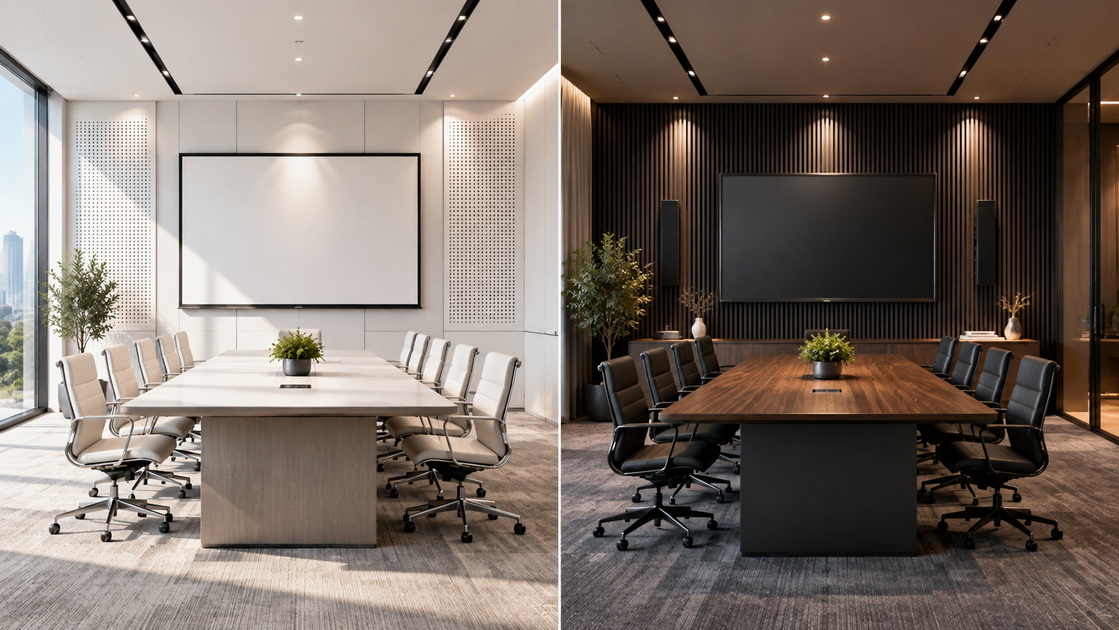
Black functions as a versatile neutral in contemporary interior design. It works effectively with warm woods, brushed brass, natural stone, concrete, smoked glass, stainless steel, and lighter wall finishes. In fluted wall panel systems, black also enhances the shadow lines between slats or grooves, making the wall texture appear more dimensional.
For hotels and villas, black panels can create a refined backdrop without competing with furniture, art, signage, or lighting. Typical design combinations include:
| Design Direction | Recommended Combination | Best Applications |
|---|---|---|
| Modern luxury | Black fluted wall panels + walnut veneer + brass lighting | Hotel lobby, executive lounge, villa entrance |
| Minimalist technology | Black acoustic panels + charcoal metal + concealed LED strips | Meeting room, showroom, media room |
| Soft contemporary | Black acoustic backing + natural oak slats + warm white lighting | Restaurant, office lounge, reception area |
| Industrial commercial | Matte black panels + concrete-look surfaces + black steel details | Retail store, café, creative office |
| Cinematic entertainment | Black panels + dark carpet + acoustic ceiling + controlled lighting | Theater, music room, gaming lounge |
A black surface can visually recede, allowing a screen, artwork, illuminated display, or branded feature wall to become the focal point. This creates a stronger hierarchy than a highly reflective white wall or a bold saturated color.
Compared with white, ivory, or pale beige surfaces, black and charcoal panels may make minor dust marks, fingerprints, and small everyday scuffs less visually noticeable. That can be helpful in corridors, hospitality spaces, commercial lounges, entertainment rooms, and offices.
But this advantage has limits. Black panels may still show:
- Light-colored construction dust
- White paint transfer
- Grease marks
- Scratches on glossy surfaces
- Uneven fading when exposed to strong direct sunlight
For this reason, project teams should request a maintenance guide and sample board before confirming the final finish. In busy areas, a textured, embossed, wood-grain, or matte UV-coated finish may be more practical than a smooth high-gloss black finish.
Black acoustic wall panels integrate naturally with black speakers, recessed outlets, LED displays, monitors, projector screens, security devices, and AV equipment. This is valuable in commercial interiors where visual coordination matters as much as technical performance.
For example, in a hotel conference room, black acoustic slat wall panels can conceal or visually minimize speaker grilles, cable pathways, control panels, and display framing. The result is a cleaner room that supports professional presentations without making the technology the dominant visual element.
Color selection should be based on the project's light level, room size, brand identity, cleaning demands, and architectural objective—not only on current design trends.
| Panel Color | Main Benefits | Potential Limitations | Best-Fit Projects |
|---|---|---|---|
| Black | Premium appearance, lower visual glare, strong contrast, blends with AV equipment | Can make compact or poorly lit rooms feel enclosed; may absorb more heat near strong sun exposure | Cinemas, studios, hospitality lounges, retail, feature walls |
| White | Brightens interiors, creates an open visual effect, supports high daylight reflection | Shows stains, dust, and wear more easily; can create screen glare | Clinics, classrooms, small offices, light residential interiors |
| Gray | Balanced, contemporary, and forgiving for commercial use | May appear flat if finishes and lighting lack contrast | Offices, corridors, co-working spaces, retail |
| Beige or cream | Warm, soft, and easy to coordinate with traditional interiors | Can feel less distinctive in luxury or technology-led designs | Villas, hospitality guest rooms, residential common areas |
| Wood tone | Natural appearance and strong biophilic appeal | Grain and batch matching require careful quality control | Hotels, restaurants, villas, wellness spaces |
| Bold colors | Supports branding and wayfinding | Can limit future renovation flexibility | Schools, branded stores, creative spaces |
A visually impressive panel is not enough. A reliable project specification should define the full system rather than simply stating "black acoustic wall panel."
Ask what problem the room needs to solve:
- Is the room too echoey?
- Are conversations unclear?
- Does the space need speech privacy?
- Is external noise entering the room?
- Is the project trying to improve cinema, music, or recording quality?
- Is the goal decorative wall coverage with moderate acoustic improvement?
For echo control, ask for NRC test data for the specific assembly. NRC is not a universal property of a color or decorative pattern. Mounting conditions matter. For example, tested acoustic panel data show that thickness, airspace, and backing can materially change measured NRC results.
At Binmao Decor, customers can discuss customized structures according to their application and project requirements. Depending on the panel system, options may include:
- E1 or E0-grade MDF substrates
- Oak, walnut, and other wood veneer finishes
- PVC or WPC decorative wall-panel structures
- PU panels for lightweight decorative applications
- Acoustic felt or sound-absorbing backing layers
- UV-coated surfaces for decorative and cleaning performance
- Custom widths, depths, slat spacing, and black finish options
For a black slatted wall, the decorative slat face is only one component. The acoustic benefit often comes from the combination of slat spacing, porous acoustic felt, cavity depth, and wall installation method.
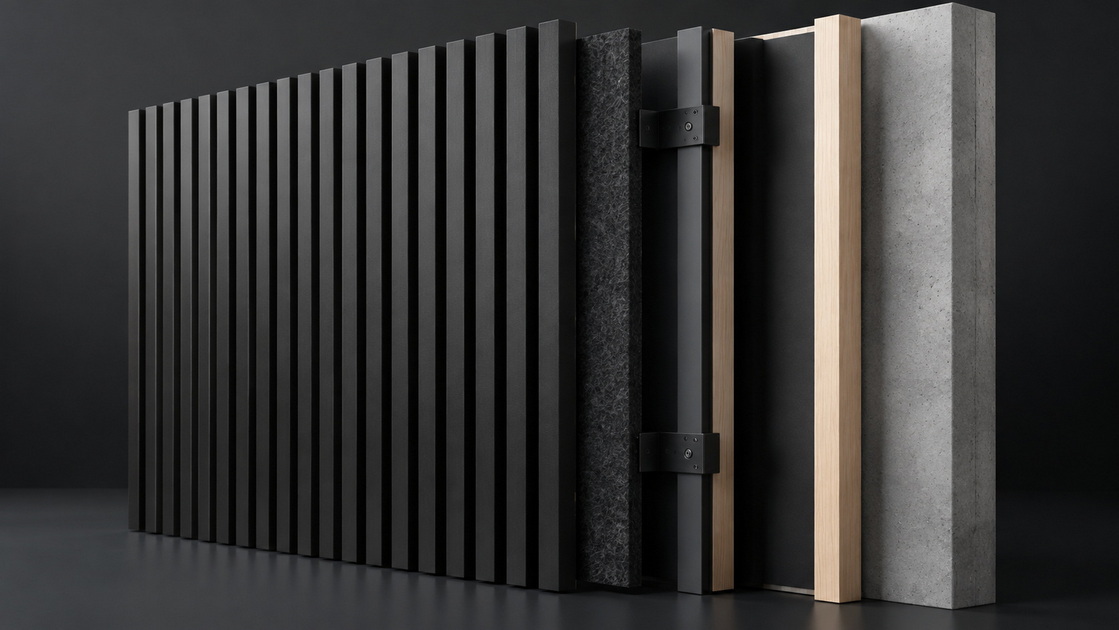
"Fireproof" is a broad commercial term and should never replace project-specific documentation. For projects requiring a fire-performance rating, request the test report for the actual panel construction, finish, thickness, backing, and mounting system being purchased.
ASTM E84 is a widely used U.S. test method for evaluating surface-burning characteristics of building materials, including flame-spread and smoke-developed indices under specified test conditions. ASTM also makes clear that this is a comparative surface-burning test and is not, by itself, a complete fire-risk assessment for every real-world installation.
Before approving a black acoustic panel for a hotel, commercial project, or public venue, verify:
- Applicable local code requirements
- Required fire classification
- Test standard and report issuer
- Exact tested product composition
- Test report validity and scope
- Installation configuration covered by the test
- Whether the wall assembly requires additional approvals
For bathrooms, spas, kitchens, coastal projects, and humid hotel areas, waterproof and mold-resistant performance is essential. But moisture suitability depends on the product composition and installation detail.
A WPC, PVC, or other waterproof composite decorative panel may be more appropriate than standard MDF in direct-humidity environments. MDF with E1/E0 formaldehyde-emission classification may be suitable for dry interior applications, but it should not be treated as interchangeable with a waterproof composite wall panel.
Practical recommendation: Divide the project by exposure zone. Use moisture-appropriate wall systems in wet or humid areas, and select decorative acoustic systems for dry feature walls, lobby spaces, meeting rooms, guest rooms, and entertainment areas.
Black panels can look elegant under warm, indirect lighting yet feel heavy under inadequate lighting. Coordinate the panel color with lighting temperature, lighting direction, ceiling height, and nearby finishes.
For a hospitality feature wall, consider:
1. Warm LED grazing light to highlight fluted texture
2. A matte black or black wood-grain finish to avoid sharp reflections
3. Natural wood, stone, or metallic accents to add warmth
4. Enough ambient lighting to preserve wayfinding and comfort
5. A physical sample viewed under the project's real lighting conditions
Black can improve visual glare control, but it does not independently improve NRC. Compare tested acoustic data for the whole wall-panel assembly, not just the finish color.
Acoustic wall panels can reduce echo and improve sound clarity inside a space. They do not automatically stop noise from moving through walls, doors, floors, ceilings, or mechanical openings. Sound isolation often requires a complete assembly with mass, decoupling, sealing, insulation, and professionally designed details.
A screen image cannot reliably show texture, gloss level, color depth, or wood-grain variation. Request samples and examine them under the intended lighting. Check black finishes for scratch resistance, fingerprint visibility, UV stability, and consistency across batches.
Even premium panels can disappoint if the wall is uneven, moisture-damaged, poorly prepared, or installed without the specified acoustic backing or cavity. Professional installation support should include panel layout, corner treatment, adhesive or mechanical-fixing recommendations, cutout planning, and maintenance guidance.
Binmao Decor is a Chinese integrated wall panel manufacturer with 14 years of production experience, specializing in fluted wall panels, UV decorative boards, waterproof and fire-resistant composite wall panels, and customized fast-install interior wall solutions.
For hotel, villa, and commercial projects, we support customization in:
- Panel width, depth, profile, and fluted pattern
- Black, wood veneer, UV, matte, textured, and other finishes
- E1/E0 MDF, wood veneer, PVC, WPC, PU, and acoustic-backed structures
- Waterproof and mold-resistant panel options
- Fire-performance documentation based on product requirements
- Technical installation guidance for global customers
- Product samples and test-report support for project evaluation
Our role is not simply to supply a black decorative panel. We help customers choose a wall-panel construction that matches their design intent, site conditions, maintenance expectations, acoustic needs, and compliance requirements.
If you are sourcing black fluted wall panels for a hotel, villa, office, restaurant, cinema, or retail project, do not choose based on appearance alone. Send Binmao Decor your drawings, wall dimensions, project application, target finish, required fire standard, and acoustic expectations.
Our technical team can help you evaluate suitable material structures, custom sizes, decorative finishes, acoustic backing options, installation methods, samples, and available product test reports—so your wall-panel system looks premium and performs reliably.
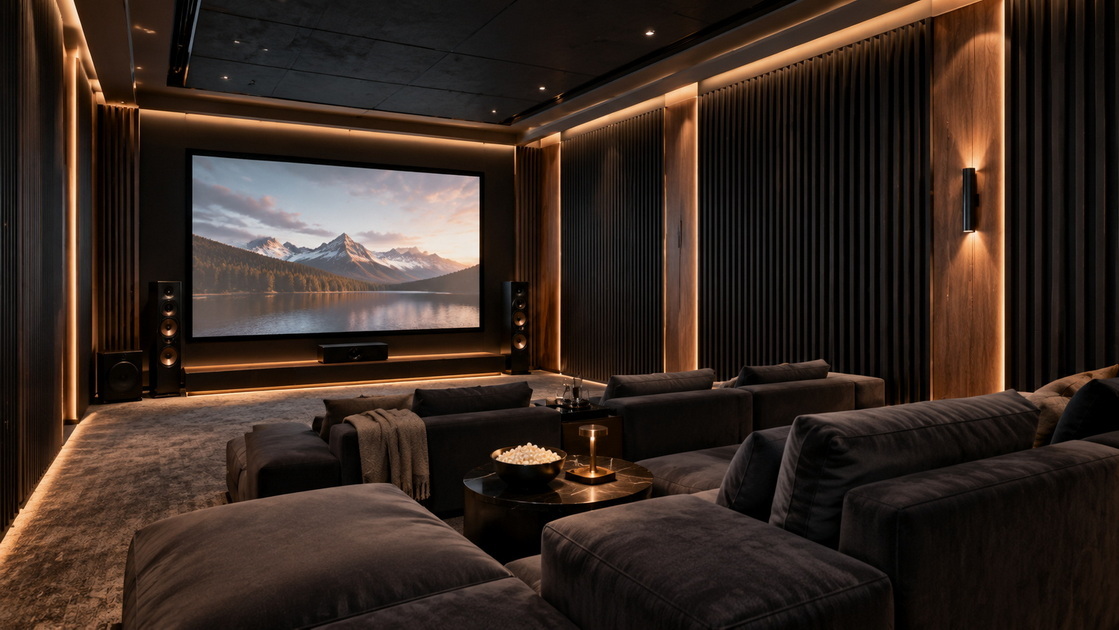
Not necessarily. Color alone does not determine sound absorption. If two panels have the same core, thickness, perforation, backing, and installation method, the black and white versions may have similar acoustic performance. Review NRC data for the tested assembly.
Yes. Black fluted wall panels can work well in hotel lobbies, corridors, lounges, conference rooms, restaurants, bars, media rooms, and feature walls. For hotel use, verify fire-test documentation, cleaning requirements, substrate suitability, and local building-code compliance before final specification.
They can make a small room feel more enclosed if lighting is insufficient or if black is used across every surface. Use black strategically on a feature wall, add warm lighting, combine it with wood or light finishes, and avoid glossy surfaces to maintain balance.
It depends on the product construction. PVC, WPC, and other waterproof composite systems may be suitable for moisture-prone settings, while standard MDF-based panels are generally better suited to dry interiors unless specifically engineered and documented for the intended exposure conditions.
The right NRC depends on the room purpose, size, existing finishes, ceiling height, and acoustic target. In general, a higher NRC indicates greater tested sound absorption, but the amount of coverage and installation method are also critical. Ask for the test report, the mounting method, and project-specific coverage recommendations.
A matte or textured black panel can hide minor day-to-day marks better than a white panel, but light dust, paint transfer, grease, and scratches can still be visible. Follow the manufacturer's cleaning instructions and test any cleaner on a sample first.
1. Acoustical Surfaces. "[NRC Rating: Understanding the Noise Reduction Coefficient]." Explains NRC as an average of absorption coefficients at 250, 500, 1,000, and 2,000 Hz. [acousticalsurfaces]
2. Association of the Wall and Ceiling Industry. "[Acoustics in Suspended Acoustical Ceilings]." Describes NRC and ASTM C423 reverberation-room testing for sound absorption. [awci]
3. ASTM International. "[ASTM E84: Standard Test Method for Surface Burning Characteristics of Building Materials]." Explains the test's use for exposed wall and ceiling surfaces and the reporting of flame-spread and smoke-developed indices. [store.astm]
4. U.S. Department of Energy. "[Indoor Environmental Quality Assessment Guide]." Discusses how dark interior materials absorb light and may create higher-contrast, dimmer visual environments. [energy]
5. Acoustical Surfaces. "[Sound Silencer Ceiling and Wall Panels]." Demonstrates that panel thickness, backing, and mounting conditions can alter measured NRC results. [acousticalsurfaces]
6. Acoustical Surfaces. "[How to Effectively Distribute Acoustical Material]." Illustrates how acoustic-material spacing and layout can affect performance. [acousticalsurfaces]
7. ArchDaily. "[Poly Max PET Felt Acoustic Panels]." Provides an example of acoustic panel performance data, available colors, and fire-rating information for a specific product system. [archdaily]


