
Views: 289 Author: Sunny Publish Time: 2026-11-07 Origin: Site


Content Menu
● Understanding Guinea's Wall Panel Supply Opportunity
>> Where the Manufacturing Capabilities Are Located
● How the Suppliers Were Assessed
● Understanding Bamboo Wood Fiber Wall Panels Before Comparing Suppliers
>> Specify the Core, Not Just the Product Name
>> Treat Environmental Labels Carefully
● Five Wall Panel Manufacturers and Suppliers to Evaluate for Guinea Projects
>> 1. Binmao Decor — Flexible Integrated Wall Panel Sourcing for Customized Interiors
>>> Company Background and Establishment
>>> Core Strengths
>>> What to Verify
>> 2. Tangshan Linkworld — A Candidate with Published Bamboo Wood Fiber Panel Specifications
>>> Core Strengths
>>> OEM/ODM Scope
>>> What to Verify
>> 3. Jiangxi Rongke New Building Materials — Broad Decorative Supply and Coordinated Accessories
>>> Company Background and Establishment
>>> Core Strengths
>>> Main Markets and OEM/ODM Scope
>>> What to Verify
>> 4. OOK New Material — Formulation, Mold Development, and Private-Label Potential
>>> Company Background and Establishment
>>> Core Strengths
>>> OEM/ODM Scope
>>> What to Verify
>> 5. Qingdao Barefoot Construction Material — Composite Product Breadth for Multi-Category Procurement
>>> Company Background and Establishment
>>> Core Strengths
>>> Main Markets and OEM/ODM Scope
>>> What to Verify
● Capacity, MOQ, and Certification Transparency
● Buyer's Guide: How to Qualify a Supplier for Guinea
>> 1. Verify the Contracting Entity and Factory
>> 2. Use a Three-Stage Sample Process
>> 3. Define Performance Before Asking for a Price
>> 4. Compare Landed Installed Cost
>> 5. Make Delivery Dates Conditional on Clear Milestones
● Common Procurement Pitfalls and How to Avoid Them
>> Material Substitution Behind an Identical Surface
>> Confusing Water Resistance with a Waterproof Installation
>> Accepting an Unrelated Test Report
>> Comparing Nominal Area Instead of Coverage Area
>> Assuming "Acoustic" Means Soundproof
● An Overlooked Buyer Check: Freeze the Construction Behind the Approved Finish
● FAQ
>> 1. How can I verify whether a supplier's ISO certificate has expired or been suspended?
>> 2. Can a supplier use one fire report for different decorative films and thicknesses?
>> 3. Are CE and RoHS certificates sufficient for a hotel project in Guinea?
>> 4. How can I prevent the approved sample from differing from mass production?
>> 5. Can I place a mixed order below the normal MOQ without compromising consistency?
For buyers sourcing bamboo wood fiber wall panels for Guinea, the most useful supplier shortlist combines export-capable manufacturers with a reliable local importing and installation arrangement. The available evidence does not establish Guinea as a major manufacturing center for this specific panel category, nor does it support presenting five to ten verified domestic factories.
This guide therefore examines five manufacturers and suppliers that buyers in Guinea can evaluate for direct-import projects. Their inclusion does not establish that they maintain Guinean warehouses, appointed distributors, or completed projects in the country.
The central purchasing principle is traceability: the quoted panel, approved sample, laboratory report, production batch, and installation specification should describe the same product.

Guinea's economic development provides relevant context for building-material procurement. The World Bank's October 2026 Guinea Economic Update reports economic growth of 7.3% in 2025 and projects average growth of approximately 9% during 2026–2028, supported by the expansion of the Simandou project. These are national economic figures, not measurements of bamboo wood fiber wall panel demand. They should not be converted into an unsupported panel-market growth forecast.
For hotel developers, villa contractors, commercial fit-out companies, and building-material distributors, the procurement question is practical: which supplier can deliver the required finish, documented performance, repeat-order consistency, and installation support at an acceptable landed cost?
Local purchasing can simplify sample inspection, communication, replacement orders, and site coordination. Direct importing can provide access to wider decorative collections and more extensive customization. However, a local seller's inventory should not be confused with local manufacturing, and an overseas factory's export capability should not be confused with proven delivery experience in Guinea.
The companies reviewed here illustrate several Chinese supply locations relevant to this category:
- Foshan, Guangdong: Binmao Decor and OOK New Material offer integrated decorative wall-panel ranges.
- Tangshan, Hebei: Linkworld lists bamboo wood fiber integrated panels alongside other interior and exterior products.
- Ganzhou, Jiangxi: Rongke offers WPC panels, decorative sheets, acoustic products, and matching accessories.
- Qingdao, Shandong: Barefoot supplies composite wall products associated with the COOWIN brand.
These locations provide access to different manufacturers and product portfolios. They are not evidence of an equivalent manufacturing cluster in Guinea.
A credible supplier assessment starts with evidence rather than catalogue size.
The following criteria guide this shortlist and should also guide buyers' requests for quotation.
| Assessment area | Evidence buyers should request | Why it matters |
|---|---|---|
| Business identity | Business license, registered address, contracting entity, bank beneficiary | Establishes who manufactures, invoices, and accepts liability |
| Manufacturing capability | Live production walkthrough, equipment list, product-specific output | Separates actual production capability from trading claims |
| Product development | Profile drawings, tooling proposals, finish samples, revision procedures | Demonstrates the depth of customization support |
| Quality control | Incoming-material checks, in-process records, batch inspection reports | Helps prevent substitution and inconsistent repeat orders |
| Technical compliance | Complete reports identifying the tested panel and installation configuration | Connects performance claims to the purchased product |
| Delivery reliability | Production-slot confirmation, material availability, packing plan | Makes lead-time commitments more meaningful |
| Commercial flexibility | MOQ by profile and finish, mixed-order policy, tooling ownership | Determines suitability for distributors and smaller brands |
| After-sales support | Installation instructions, defect procedure, replacement terms | Reduces unresolved site problems |
"Bamboo wood fiber wall panel" is a commercial product description, not a universal formulation.
For example, Linkworld describes one grille profile as bamboo wood fiber combined with PVC. Its wider catalogue separately identifies bamboo-charcoal substrates, SPC panels, and UV decorative boards. These categories should not be treated as interchangeable simply because they offer similar wood-grain finishes.
Ask each supplier to identify:
1. Polymer type and declared plant-fiber content.
2. Whether the formulation contains mineral filler.
3. Virgin or recycled material policy.
4. Solid, hollow, foamed, or multilayer construction.
5. Overall thickness and minimum structural wall thickness.
6. Decorative film, coating, and adhesive system.
7. Intended exposure conditions and installation method.
8. The exact product covered by each test report.
An MDF-backed decorative panel, PVC-based bamboo fiber profile, and mineral-filled SPC sheet can require different moisture precautions, fixing methods, and performance documentation.
Binmao's published material options include E1/E0-grade MDF, wood veneers, PVC/WPC, PU, and acoustic backing structures. These are different material systems, not one product with identical performance. Buyers should request the applicable standard, test method, result, and tested construction for the selected panel.
Likewise, CE marking is not a general-purpose quality award. European Commission guidance states that it applies only where relevant harmonized rules require it. Construction-product assessment depends on the applicable technical route and intended use. A CE logo alone does not establish suitability for a Guinean hotel or commercial project.
RoHS primarily concerns electrical and electronic equipment. A RoHS-related substance report should not be presented as comprehensive proof of an ordinary decorative panel's environmental performance, indoor emissions, or construction compliance.
Binmao Decor is a Foshan-based integrated wall panel manufacturer offering quick-install decorative products for hotels, villas, commercial interiors, and residential applications. Its published range includes wood-grain, stone-look, and fabric-textured finishes, with customizable widths, depths, and surface treatments.
Binmao describes its experience as 14 years in the company information supplied for this article. Its public About Us page includes a timeline beginning in 2012, but also contains a separate "over 20 years" statement and references to "Harmony Furniture." Buyers should confirm the legal entity's registration date and request a consistent corporate history before supplier approval.
This distinction matters: a brand history, a founder's experience, and the incorporation date of the contracting company are not necessarily the same.
Binmao's strongest documented fit is project-specific decorative coordination. Its published options include:
- MDF in stated E1/E0 grades.
- Oak, walnut, and other wood veneers.
- PVC/WPC and PU materials.
- Acoustic backing structures.
- Painted, stained, lacquered, and textured finishes.
- Custom dimensions and installation technical support.
For smaller brands and project distributors, this breadth can support a value-focused sourcing strategy: coordinating several finishes and panel structures with one supplier may reduce fragmented purchasing. However, price competitiveness, minimum order flexibility, and response efficiency should be demonstrated through an actual quotation and sample-development exercise—not assumed.
The company describes overseas cooperation and applications across residential, hospitality, commercial, and office interiors, but does not publish a reliable country-by-country sales breakdown on the reviewed page.
Its stated customization capabilities make it a reasonable candidate for buyers seeking tailored dimensions and finishes. Procurement teams should additionally confirm private-label packaging, profile development, sample revision limits, tooling costs, and ownership of custom designs.
Binmao publishes water-resistance, mold-resistance, and fire-retardancy claims. These should be checked against the exact selected construction rather than extended across every MDF, veneer, PVC/WPC, PU, and acoustic-backed product.
For a bamboo wood fiber wall panel order, request a dedicated specification sheet confirming that the proposed core actually matches that description.
Linkworld provides some of the most detailed publicly described specifications within this shortlist.
A company-issued October 2026 release states that its first production line began operating in 2004. This is a production-history claim, not independently verified evidence of the current legal entity's incorporation date.
Its listed bamboo wood fiber integrated wall panel is 9 mm thick, with widths of 300, 400, and 600 mm and a stated standard length of 2,900 mm. Published joint options include small V-seams, butt joints, and seamless locking systems.
The company also describes a 155 × 18 mm grille panel with approximately 150 mm installed coverage width and a bamboo wood fiber/PVC composition. That distinction between nominal width and installed coverage is commercially important when comparing prices per square meter.
Linkworld reports:
- A 20,000-square-meter factory.
- Annual output of 1,560,000 square meters.
- Approximately 70% of output exported.
- Shipments to more than 60 countries, including the United States, Canada, Spain, Russia, Singapore, India, Malaysia, and Middle Eastern markets.
These figures come from company-issued promotional material and should be treated as supplier declarations.
The published service description includes specification customization, sample orders, mixed batches, export documentation, and shipment support.
This makes Linkworld worth evaluating where a buyer needs defined panel dimensions and several decorative categories. Confirm whether stated annual capacity covers the entire portfolio or the precise bamboo wood fiber line being quoted.
Request original reports for any fire, emissions, or heavy-metal claims. Do not transfer a classification from an exterior profile, carbon-crystal board, or different surface finish to the selected integrated panel.
Jiangxi Rongke, operating through the AMER website, offers WPC 3D wall panels, acoustic panels, PS panels, skirting, PU products, UV marble sheets, SPC flooring, and bamboo-charcoal wood veneer products.
The reviewed website states more than 15 years of manufacturing and sales experience, but does not establish a precise incorporation year. Buyers should obtain the business license rather than calculate a founding date from an experience claim.
Rongke's main appeal is assortment coordination. A distributor or fit-out contractor can evaluate feature-wall panels alongside skirting, decorative sheets, and acoustic products.
Its website reports three production bases, 30 PS production lines, and 32 WPC/PVC production lines. These are company-reported equipment figures, not independently verified annual output measurements.
A public supplier profile identifies North America, Southeast Asia, Africa, and the Middle East among its markets. Africa-wide activity does not prove an established distribution arrangement in Guinea.
Rongke advertises product development, customization, free samples, inspection images, production videos, and catalogue/display-board design support.
Confirm which production base manufactures the selected panel and whether its legal identity matches the relevant inspection and certification documents. Ask for product-specific output, current capacity utilization, and a written finish-control procedure.
OOK New Material's public profile places it in Foshan's Shunde district and lists WPC panels, acoustic panels, bamboo-charcoal panels, flexible stone, UV marble sheets, and SPC wall panels.
One public profile describes the company as established in 2018. Its fuller listing also records an export start date in March 2018. Buyers should verify the registered incorporation date separately, since export history and establishment are different facts.
OOK describes an integrated process covering:
- Raw-material formulation.
- Mold development.
- Extrusion.
- Surface finishing.
- Finished-product inspection.
This is relevant to buyers who need more than a standard catalogue finish, particularly when profile geometry and decorative matching form part of the purchasing brief.
The company reports seven production lines and monthly capacity of 100,000 square meters. Its stated markets include North and South America, Europe, Southeast Asia, Africa, Oceania, and the Middle East.
OOK explicitly advertises OEM/ODM support from sampling and design through packaging and shipment.
Its profile mentions ISO 9001 and SGS, but buyers should distinguish a management-system certificate from a laboratory report or inspection service. Request certificate numbers and complete documents rather than accepting organization names as proof.
Confirm whether the reported capacity applies to the proposed material family, and ensure any bamboo-charcoal or WPC description matches the actual substrate supplied.
Qingdao Barefoot, associated in public material with the COOWIN brand, supplies composite products covering interior wall panels, ceilings, decorative trims, exterior cladding, decking, and fencing.
A third-party directory lists an establishment year of 2000 and worldwide markets. Because this is directory information, buyers should verify the legal company's registration and its relationship with the brand before relying on that date.
Barefoot is most relevant where procurement combines interior decorative panels with exterior composite products. Its broader range may simplify supplier coordination, but interior and exterior products must still be specified separately.
The reviewed directory describes worldwide market coverage, without a sufficiently detailed regional breakdown to establish its principal markets or Guinea-specific sales.
For OEM/ODM work, request written confirmation of available profile modifications, custom colors, branding, tooling, and packaging. The reviewed evidence does not establish the full commercial scope of those services.
Obtain a dedicated technical sheet for the proposed bamboo wood fiber interior panel. Do not substitute decking or exterior cladding documentation for interior product evidence.
The following table compares disclosed information, not audited performance. "Not established" means the reviewed evidence does not substantiate the item.
| Supplier | Most relevant purchasing focus | Public capacity information | MOQ for selected bamboo wood fiber panel | Certification and report position |
|---|---|---|---|---|
| Binmao Decor | Custom dimensions, coordinated finishes, integrated interior solutions | Numerical output not established | Request by profile, finish, and packaging | Obtain current product-specific reports; reviewed page does not establish certificate numbers binmaomaterials |
| Linkworld | Published integrated panel dimensions and multiple joint options | Claims 1,560,000 m² annually across its offering | Request written product-specific MOQ | Several performance claims published; original reports and scope require verification natlawreview |
| Jiangxi Rongke | Broad decorative assortment and matching accessories | Claims 30 PS and 32 WPC/PVC lines; product-specific output not stated | Request by material family and finish | Verify factory identity and selected-product documentation amerdecor |
| OOK New Material | Formulation, mold development, OEM/ODM | Claims 100,000 m² monthly and seven lines | Request by profile, film, and customization | Mentions ISO 9001 and SGS; document identity, validity, and scope need checking ooknewmaterial.made-in-china |
| Qingdao Barefoot | Interior/exterior composite purchasing | Comparable numerical output not established | Request for the exact interior panel | Reviewed evidence insufficient to establish current certificate scope natlawreview |
MOQ should be broken down into separate thresholds: extrusion profile, decorative film, color, custom tooling, printed packaging, and total shipment. A supplier may accept a mixed order while still requiring a substantial minimum for each custom finish.
Request the business license, factory address, invoice entity, and bank beneficiary.
Where these differ, ask for a written explanation. A trading company can provide valuable coordination, but buyers should know which organization controls manufacturing and which accepts warranty obligations.
During a live video inspection, ask to see the quoted profile, production line, raw-material storage, finishing process, QC station, and packed goods.
A practical approval sequence is:
1. Appearance sample: review color, texture, gloss, and surface feel.
2. Production-representative panel: inspect dimensions, core structure, joint fit, and edge condition.
3. Installation mock-up: evaluate the complete panel, trim, adhesive or fixing system, substrate, and workmanship.
Retain signed reference samples with both parties. For important projects, send a production-representative sample to an appropriately accredited laboratory.
Avoid specifications such as "high quality, waterproof, fireproof."
Instead, identify:
- Intended room and exposure.
- Required fire classification and accepted test standard.
- Panel dimensions and tolerances.
- Structural wall thickness for hollow profiles.
- Surface finish and adhesive system.
- Joint and trim details.
- Indoor-emissions requirements.
- Cleaning and maintenance conditions.
Fire classifications under different systems should not be treated as automatic equivalents. The report must identify the tested product, including its finish and relevant construction details.
Use a purchasing worksheet that includes:
- Panels + trims + fixings/adhesive + packaging + origin charges + freight + insurance + destination charges + duties/taxes + inland delivery + installation + agreed spares.
Ask a Guinean customs broker to confirm classification and current import requirements from the actual product composition and documentation. Do not assume that all products described as bamboo panels share one customs classification.
For shipment planning, obtain written confirmation of container loading dimensions, carton protection, moisture-control measures, destination charges, free-time conditions, and responsibility for unloading and inland delivery.
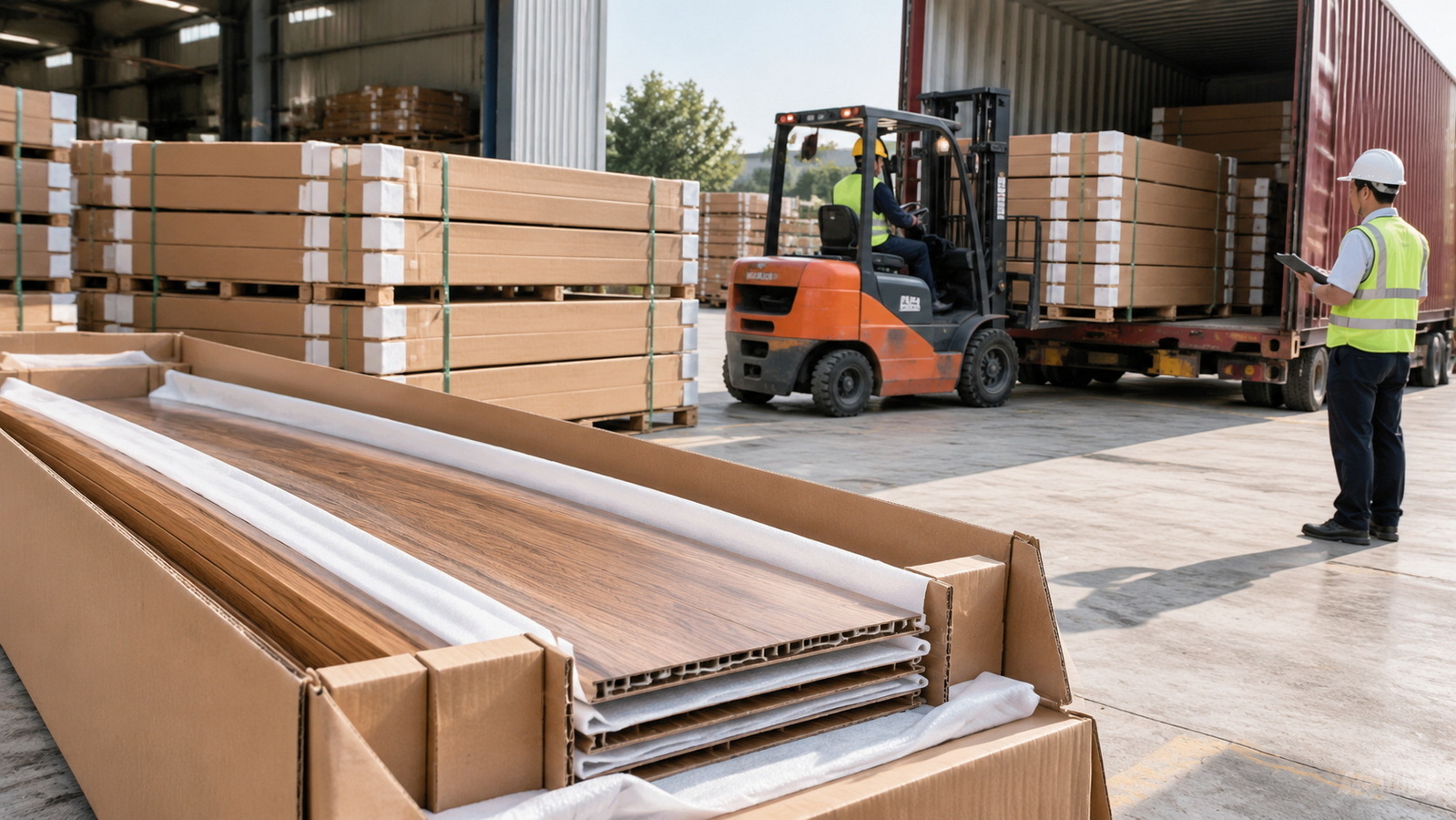
A useful delivery commitment should identify:
- When specifications become frozen.
- When the deposit is received.
- When decorative film and other materials are available.
- The reserved production slot.
- Inspection and corrective-action time.
- Packing completion and shipment readiness.
Ask for evidence of the schedule rather than relying only on an advertised standard lead time.
A decorative film can make different cores look similar. Require an approved material declaration, profile drawing, dimensional tolerances, and a contract clause prohibiting unapproved formulation or structural changes.
A panel's moisture resistance does not independently establish that its joints, adhesive, substrate, or service penetrations form a waterproof wall system. Require a complete installation detail for wet or condensation-prone areas.
Check the report holder, manufacturer, product code, thickness, surface finish, substrate, and installation method. A report for a different panel construction is not automatically transferable.
Confirm whether quotations use nominal width or installed coverage width. Linkworld's published 155 mm profile with approximately 150 mm installed coverage illustrates why the distinction matters.
Ask what was tested and whether the result describes sound absorption or transmission through a complete partition. Decorative slats, backing, air cavities, and the supporting wall should be assessed as part of the intended assembly.
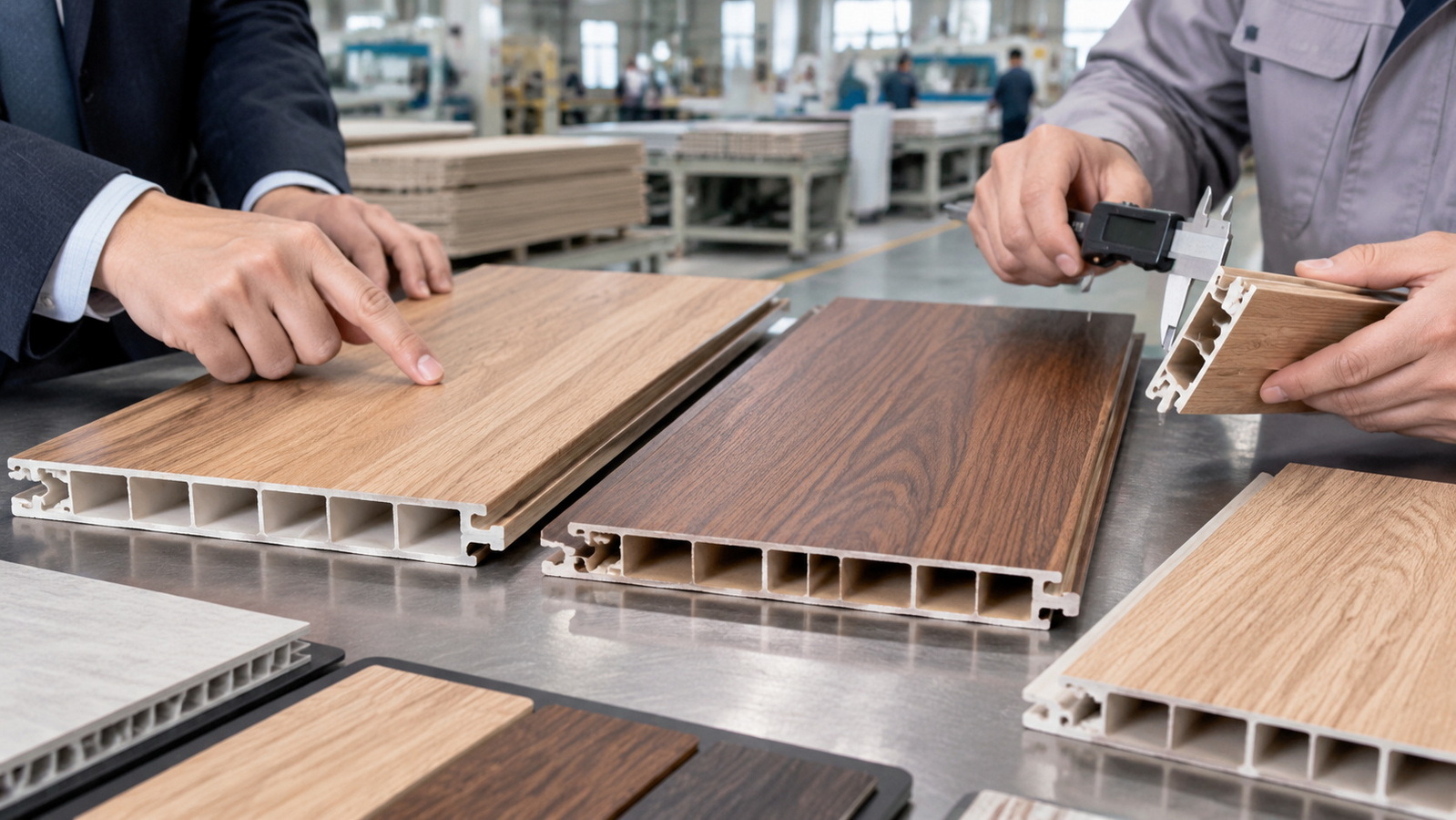
A useful anti-substitution control is to approve the panel's hidden construction as carefully as its visible surface.
Record the approved:
- Cross-section and rib geometry.
- Minimum structural wall thickness.
- Mass per linear meter.
- Surface film and adhesive identification.
- Joint fit.
- Material declaration.
- Batch identification method.
Mass is a screening measurement, not proof of quality. A heavier panel is not automatically stronger or safer. Its value is that an unexplained change can flag a need to investigate the formulation or geometry.
For repeat orders, compare random production pieces against the retained reference and agreed tolerances. Require written approval before changes to the core, film, adhesive, or profile.
This turns "same quality as the sample" into an enforceable purchasing specification rather than a subjective promise.
Guinea-focused buyers should evaluate this shortlist as a set of overseas sourcing candidates, not as verified local manufacturers.
Binmao Decor is worth considering for customized interior coordination; Linkworld offers comparatively detailed published bamboo wood fiber panel specifications; Rongke provides a broad decorative assortment; OOK describes formulation and mold-development capabilities; and Barefoot offers a wider composite product portfolio. Each requires product-specific qualification before approval.
For a Binmao Decor quotation, submit the project location, application area, panel structure, dimensions, preferred finish, required performance documentation, estimated quantity, and delivery terms. Request a matching specification sheet, production-representative sample, installation guidance, and itemized commercial offer before confirming an order.
Search the certificate number or legal company name through IAF CertSearch, then compare the standard, scope, certified sites, issuing certification body, and status. The system distinguishes active, suspended, withdrawn, and expired certificates.
If you cannot locate a record, contact the issuing certification body directly. Do not rely solely on the expiry date printed on a PDF: verify the current status and ensure the certified site covers the relevant manufacturing activity.
Do not assume so. Ask the issuing laboratory or competent assessment body whether the report or classification explicitly covers the proposed variants.
Changes to surface film, adhesive, core formulation, thickness, backing, or mounting can affect whether the evidence applies. Require written confirmation of coverage rather than a salesperson's statement that the products are similar.
No. CE marking relates to applicable European product rules, while RoHS addresses hazardous substances in electrical and electronic equipment. Neither, by itself, establishes that an ordinary decorative wall panel meets a Guinean hotel project's complete requirements.
Ask the project's responsible designer, fire consultant, and local authorities to identify the accepted performance evidence. Then obtain reports for the actual panel and installation configuration.
Attach a controlled product specification to the contract. Include the profile drawing, material declaration, dimensions, tolerances, finish reference, structural wall thickness, and agreed inspection criteria.
Retain signed samples and arrange random checks during production and before shipment. Independent inspection is particularly useful for a first order or a formulation-sensitive commercial project.
Potentially, but confirm which minimums apply separately. Stock profiles and existing decorative films may offer different flexibility from custom tooling or newly printed finishes.
Ask the supplier to state the MOQ per profile, finish, packaging design, and total shipment. Agree batch identification and retained finish references for future replenishment; otherwise, a small initial order can become difficult to match later.
1. World Bank, "Guinea Economic Update 2026: Beyond Mining—Turning Resource Wealth into Private Sector Growth and Job Creation," October 9, 2026. Used for national economic context, not a panel-market forecast. [worldbank]
2. World Bank, "Imports of Goods and Services—Guinea." Official macroeconomic trade-data resource; not a bamboo wall panel import series. [data.worldbank]
3. European Commission, Your Europe, "CE Marking." Official guidance on applicability and manufacturer responsibilities. [europa]
4. European Commission, "RoHS Directive." Official explanation of its electrical and electronic equipment scope. [environment.ec.europa]
5. IAF CertSearch, "Certificate Verification Guide." Guidance on checking certification status and accredited standards. [support.iafcertsearch]
6. CSTB, "CE Marking." Construction-product technical assessment and marking guidance. [cstb]
7. Binmao Decor, "About Us." Supplier-published materials, customization options, applications, and company-history statements. [binmaomaterials]
8. Linkworld-issued supplier overview, October 29, 2026. Promotional source for declared specifications, production history, capacity, and markets. [natlawreview]
9. Jiangxi Rongke / AMER, official website. Supplier-published product portfolio, equipment, and service information. [amerdecor]
10. OOK New Material, public company profile. Supplier-declared capacity, export markets, customization services, and certification claims. [ooknewmaterial.en.made-in-china]
11. Qingdao Barefoot, public supplier directory profile. Secondary source for the stated establishment year and market coverage. [tradekey]


