
Views: 247 Author: Sunny Publish Time: 2026-10-28 Origin: Site


Content Menu
● Why Source Acoustic Wall Panels from China?
>> Manufacturing Clusters and Their Purchasing Advantages
>> What Recent Industry Data Actually Shows
● How to Evaluate a Reliable Manufacturer
● Top 10 Acoustic Wall Panels Manufacturers in China
>> 2. Guangdong Leeyin Acoustics Technology Co., Ltd.
>> 3. Burgeree New Tech Jiangsu Co., Ltd.
>> 4. Qingdao Boss Flame Retardant Textile Materials Co., Ltd. — QDBOSS
>> 5. Shanghai Kingkus New Material Co., Ltd.
>> 6. Suzhou Acousound New Material Technology Inc.
>> 7. Foshan Tiange Acoustic and Decor Material Co., Ltd.
>> 8. Guangzhou MQ Acoustic Materials Co., Ltd.
>> 9. LEEDINGS
>> 10. Hebei RooAoo New Material Technology Co., Ltd.
● Manufacturer Comparison: Capacity, MOQ, and Compliance
● Technical Buyer's Guide: Specify the Panel Before Comparing Prices
>> Understand Absorption Versus Sound Insulation
>> Compare Equivalent Acoustic Tests
>> Define Materials Beyond "Premium MDF" or "High-Density PET"
>> Treat Fire, Moisture, and Mold Claims Separately
>> Understand What CE and RoHS Actually Mean
● An Overlooked Procurement Trap: Decorative Changes Can Alter the Tested Product
● Factory Verification, Sampling, and Logistics
>> Verify the Actual Production Site
>> Use a Staged Sample Process
>> Compare Landed Cost and Packing Efficiency
● FAQ
>> 1. How Can I Check Whether a Manufacturer's ISO Certificate Has Expired?
>> 2. Can I Use a Supplier's NRC Report for My Private-Label Panel?
>> 3. Is a Flame-Retardant Fabric Certificate Enough for a Fabric-Wrapped Panel?
>> 4. What Documents Should a US Importer Request for MDF-Based Acoustic Panels?
>> 5. How Can I Detect Material Substitution Between Sampling and Bulk Production?
Choosing acoustic wall panels manufacturers in China requires more than comparing finishes and prices. For procurement managers, the stronger long-term partner is the factory that can reproduce an approved sample, explain its test reports, control material changes, and deliver consistent panels across repeat orders.
China offers a broad sourcing base for PET acoustic panels, wood-slat acoustic panels, fabric-wrapped absorbers, and integrated decorative wall systems. However, manufacturers differ considerably in product specialization, customization depth, production transparency, and export documentation.
This guide compares ten manufacturers worth investigating for different purchasing needs, with Binmao Decor presented first as a customization-oriented option for integrated interior projects.

China's main advantage is the combination of upstream materials, decorative processing, acoustic fabrication, and export services available within established manufacturing regions.
For buyers, this makes it possible to source different panel constructions and coordinate finishes, packaging, installation components, and private-label requirements.
The manufacturers reviewed here illustrate three useful sourcing concentrations:
- Foshan and Guangzhou, Guangdong: integrated decorative panels, wood-based acoustic products, architectural finishes, and multi-material project packages.
- Changshu and Suzhou, Jiangsu: PET felt acoustic materials, precision cutting, office-acoustic products, and custom architectural fabrication.
- Qingdao, Shandong, and Nangong, Hebei: additional options for fabric-wrapped panels, flame-retardant textiles, PET panels, and wood-slat products.
These are practical sourcing concentrations rather than a formal ranking of regional output. Their value lies in the availability of related production processes and alternative suppliers.
The USDA Foreign Agricultural Service's *Solid Wood Annual 2025* reports that China exported approximately 13.6 million cubic meters of plywood in 2025, up 3% from 2024. It also reports approximately US$16.3 billion in wood-product exports under HS Chapter 44.
These figures demonstrate the scale of China's wider wood-products supply chain. They do not measure acoustic wall panels specifically.
That distinction matters: acoustic panels span PET, wood, fiberglass, fabric, and composite constructions. A broad wood-products export figure should not be presented as the size of the acoustic-panel market.
Before shortlisting suppliers, buyers should establish a consistent evaluation framework.
| Evaluation area | Evidence to request | Why it matters |
|---|---|---|
| Factory identity | Business license, production address, legal manufacturer details | Distinguishes production capability from a sales-office presentation |
| Product specialization | Current catalog, production samples, comparable applications | Confirms experience with the required construction |
| Development capability | Drawings, prototypes, material alternatives, change-control records | Shows whether customization extends beyond color selection |
| Quality control | Incoming-material checks, inspection records, batch traceability | Helps control repeat-order consistency |
| Acoustic evidence | Complete report matching the supplied assembly | Prevents misleading performance comparisons |
| Compliance | Applicable product reports and current management certificates | Supports destination-market and project requirements |
| Delivery planning | Available capacity, production schedule, material lead times | Separates theoretical capacity from actual order availability |
| Commercial support | Written MOQ, sample process, packaging specification, response responsibilities | Reduces uncertainty during development and reorders |
The profiles below use publicly available manufacturer information and, for Binmao Decor, the company brief supplied for this article. No factory visits, customer interviews, or independent production audits are implied.
Location: Foshan, Guangdong
Experience: 14 years, according to the company brief
Primary positioning: Customized integrated decorative wall systems with acoustic-backing options
Binmao Decor is relevant to buyers sourcing acoustic wall treatments as part of a broader hotel, villa, residential, or commercial interior package.
Its published material options include E1/E0-grade MDF, oak and walnut veneers, PVC/WPC, PU, and acoustic-backing structures. The company also describes customized widths, depths, and finishes, together with installation technical support.
Its potential value for smaller brands lies in development flexibility: buyers can discuss panel dimensions, decorative finishes, substrate selection, and installation details rather than choosing only from a fixed catalog.
For example, a hospitality supplier developing coordinated reception walls and guest-room feature panels could investigate whether Binmao can support a unified finish across different panel constructions.
- Core advantage: integration of decorative materials, customization, and installation support.
- Relevant markets: residential, hospitality, and commercial interiors; geographic sales shares are not publicly established.
- OEM/ODM scope to discuss: custom profiles, dimensions, finishes, acoustic-backing configurations, and installation details.
- Procurement check: confirm acoustic results, moisture suitability, and fire performance for the exact proposed construction.
The company brief states 14 years of experience, corresponding to a 2012 starting point in 2026. However, the public About page contains inconsistent experience wording and legacy furniture-company references. Buyers should confirm the legal entity's registration date rather than treating all website history text as verified corporate history.
Binmao is therefore a practical candidate for customization-led sourcing, but claims about lower cost, faster communication, or superior research capability should be validated through a common RFQ and sample-development exercise.

Location: Guangzhou and Foshan, Guangdong
Established: 2006, according to company information
Primary positioning: Broad architectural-acoustics product sourcing
Leeyin publishes a wide portfolio covering grooved and perforated wood panels, PET panels, fabric-wrapped panels, wood-wool products, diffusers, and related acoustic materials. It reports a 20,000-square-meter production base in Foshan.
This range makes it relevant to distributors and contractors consolidating several acoustic-product categories.
- Core advantage: breadth across materials and acoustic applications.
- Relevant markets: international building-material importers and architectural projects; geographic revenue shares are not verified.
- OEM/ODM scope to discuss: dimensions, decorative finishes, panel constructions, and coordinated project packages.
- Procurement check: establish which products are manufactured at the quoted site and which involve partner factories.
A broad catalog can reduce supplier coordination, but buyers should still verify each product family separately.
Location: Changshu, Jiangsu
Established: 2012, according to its official company profile
Primary positioning: PET-based architectural acoustic products
Burgeree's official profile identifies a 66,000-square-meter site and a focus on research, design, production, and application support for architectural acoustic materials. Its 2026 DOMOTEX exhibitor profile repeats the 2012 establishment date and site area.
The company is relevant to buyers developing coordinated PET wall treatments and related architectural products.
- Core advantage: focused PET-material development and a substantial published production footprint.
- Relevant markets: construction and office applications; verified geographic sales proportions are unavailable.
- OEM/ODM scope to discuss: custom forms, dimensions, colors, and application-specific fabrication.
- Procurement check: obtain usable monthly output for the required thickness and finish, rather than treating factory area as production capacity.
Buyers should also distinguish legal-entity establishment from any earlier brand or predecessor history.
Location: Qingdao, Shandong
Established: 2008
Primary positioning: Fabric-wrapped acoustic panels and flame-retardant textiles
QDBOSS publishes a factory area exceeding 40,000 square meters. Its product range includes polyester-fiber panels, fabric-wrapped absorbers, fiberglass acoustic ceilings, and flame-retardant fabrics.
The combination is relevant to cinemas, auditoriums, meeting rooms, music facilities, and other interiors where absorptive cores and decorative textiles must be coordinated.
- Core advantage: acoustic-panel production combined with flame-retardant textile capability.
- Relevant markets: architectural and industrial applications; the company reports exports to more than 50 countries.
- OEM/ODM scope to discuss: fabric selection, panel sizes, core configurations, and coordinated ceiling products.
- Procurement check: request evidence for the finished panel assembly, not only the facing fabric.
A flame-retardant fabric report does not, by itself, establish the classification of every fabric-and-core combination.
Manufacturing location: Changshu, Jiangsu
Industry entry: 2010 for acoustic panels, according to its company profile
Primary positioning: Design-oriented PET acoustic fabrication
Kingkus describes entry into the acoustic-panel industry in 2010, following earlier activity in construction and decorative materials. This is an industry-entry date, not necessarily the incorporation date of the current legal entity.
Its published positioning emphasizes polyester-fiber materials, decorative design, and production consistency.
- Core advantage: combining functional acoustic materials with architectural and furniture-oriented design.
- Relevant markets: architectural interiors, offices, and design-led projects; geographic sales shares require confirmation.
- OEM/ODM scope to discuss: custom shapes, cut patterns, decorative arrangements, and project-specific fabrication.
- Procurement check: approve physical color standards and edge-quality samples before releasing production.
For design-sensitive installations, repeatable cutting quality and replacement-panel color consistency can be as important commercially as the initial sample appearance.
Location: Suzhou, Jiangsu
Established: August 2018
Primary positioning: PET acoustic panels and custom wall-and-ceiling products
Acousound's official history states that its foreign-trade, design, and development departments were established in 2018, with a second production line introduced in 2020.
Its published range includes PET panels and acoustic wall-slat and ceiling products. Its supplier profile also identifies commercial, educational, industrial, worship, professional-audio, and residential applications.
- Core advantage: a PET-focused offering supported by design and export functions.
- Relevant markets: commercial and residential acoustic applications internationally.
- OEM/ODM scope to discuss: custom panels, decorative fabrication, and coordinated wall-and-ceiling collections.
- Procurement check: obtain the complete fire and acoustic reports for each quoted SKU.
A published supplier profile lists 720,000 PET panels produced in the previous year, but the reporting period and panel dimensions should be confirmed before using that number for capacity planning.
Location: Foshan, Guangdong
Established: 2008
Primary positioning: Project-oriented acoustic materials and systems
Tiange's official company information states that it was established in 2008 and has exported products to 108 countries. This export reach is a company claim rather than an independently audited market breakdown.
Its published portfolio includes wood, fabric, aluminum, and other acoustic products, alongside sound-insulation materials and acoustic doors.
- Core advantage: coordinating multiple acoustic-material categories for building projects.
- Relevant markets: international architectural projects and domestic acoustic-decoration applications.
- OEM/ODM scope to discuss: project dimensions, finish coordination, installation requirements, and mixed-material packages.
- Procurement check: identify the legal manufacturer and production site for every category.
This is particularly important when a single quotation includes decorative absorbers, doors, and insulation products with different manufacturing requirements.
Sales location: Guangzhou, Guangdong
Established: 2017, according to a published supplier profile
Primary positioning: Customized acoustic panels and mixed-material sourcing
MQ's official About page reports four production lines and annual output exceeding 500,000 square meters of acoustic materials. It identifies America, Southeast Asia, and Africa as its main markets.
Its portfolio includes PET felt, wood-wool tiles, fiberglass ceiling products, and fabric-covered panels. The company also publishes an inspection process covering raw materials, processing, finishing, testing, and packaging.
- Core advantage: a broad material range with published production and inspection information.
- Relevant markets: America, Southeast Asia, and Africa.
- OEM/ODM scope to discuss: nonstandard dimensions, decorative processing, project packages, and private-label requirements.
- Procurement check: reconcile factory location, quoted output, and the exact production route for the order.
MQ lists ISO 9001, CE, FSC, and restricted-substance-related documentation. Buyers should request certificate numbers and establish the scope of each claim rather than treating them as interchangeable approvals.
Operating group: Jiangsu SUYIN and Guangdong YUEYIN
Established: Not clearly stated on the reviewed homepage
Primary positioning: Scaled PET and wood-slat acoustic-panel supply
LEEDINGS publishes a product range covering wood-slat panels, PET panels, three-dimensional tiles, and hexagonal acoustic products. It explicitly advertises OEM/ODM services.
The company reports annual production capacity of 11.88 million square meters across its operations, including facilities in China and a Thailand hub. This should not be interpreted as verified capacity at one Chinese factory.
- Core advantage: a published large-scale manufacturing proposition and coordinated product range.
- Relevant markets: international commercial, educational, and residential applications.
- OEM/ODM scope to discuss: private-label ranges, custom forms, finishes, and packaging.
- Procurement check: confirm the producing factory, country of origin, allocated capacity, and product-specific documentation.
Its website lists several compliance and supply-chain schemes. Each requires separate verification for the product and transaction concerned.
Location: Nangong, Xingtai, Hebei
Established: Not clearly stated on the reviewed official homepage
Primary positioning: Export-oriented wood-slat and PET acoustic panels
RooAoo reports a 17,300-square-meter factory, eight equipment lines, and capacity exceeding 60 containers per month. Its website states that Europe is its largest export destination and that it supplies more than 70 countries.
The range includes natural-wood and veneered slat panels, PVC-finished slat products, PET panels, three-dimensional panels, and desk partitions.
- Core advantage: a focused decorative-acoustic range with published export and production indicators.
- Relevant markets: predominantly Europe, according to the company.
- OEM/ODM scope to discuss: veneer options, panel formats, PET colors, and custom decorative products.
- Procurement check: translate container claims into square meters for the exact SKU and packing configuration.
The company lists FSC, GRS, and fire-related credentials, but current scope and transaction eligibility should be checked before making corresponding product claims.
The figures below use different measurement bases. Factory area, annual output, and container volume are not directly comparable.
"Confirm" means a reliable, applicable figure was not established from the reviewed sources—not that the supplier lacks the capability.
| Manufacturer | Published capacity or manufacturing indicator | MOQ | Published compliance information or evidence to request |
|---|---|---|---|
| Binmao Decor | Complete production lines described; numerical output not published | Confirm by construction and finish | Request exact acoustic, fire, moisture, and emissions reports |
| Leeyin | 20,000 m² production base | Confirm by SKU | Request product-specific acoustic, fire, and environmental documents |
| Burgeree | 66,000 m² site | Confirm by thickness, color, and fabrication | Verify reports for the selected PET construction |
| QDBOSS | More than 40,000 m² site | Confirm by core, fabric, and dimensions | Verify finished-assembly fire and acoustic evidence |
| Kingkus | PET-material and fabrication capability; comparable current output not established | Confirm by design and color | Request current product reports and applicable environmental credentials |
| Acousound | Supplier profile lists 720,000 PET panels in a previous year; period requires confirmation | Confirm by product | Supplier claims independent acoustic and flammability testing |
| Tiange | Broad project-oriented manufacturing range; numerical output not established | Confirm by product category | Request reports tied to each actual production source |
| MQ | More than 500,000 m² annual output; four lines, self-reported | Confirm by SKU and processing | Lists ISO 9001, CE, FSC, and restricted-substance-related evidence |
| LEEDINGS | 11.88 million m² annual capacity across operations, self-reported | Confirm by plant and product | Lists FSC, CE, AgBB, ASTM E84 Class A, VOC A+, and social-audit schemes |
| RooAoo | 60+ containers/month and eight equipment lines, self-reported | Confirm by finish and loading mix | Lists FSC, GRS, and fire-related credentials |
Manufacturing figures and listed credentials come from the respective company publications and supplier profiles; they are not independent capacity or certification validations.
MOQ should be requested separately for stock panels, custom colors, special veneers, new tooling, and branded packaging. A single advertised minimum rarely describes every order configuration.
Acoustic wall panels commonly manage reflected sound inside a room. They should not automatically be treated as complete barriers against noise passing between rooms.
Absorption testing and airborne sound-transmission testing assess different functions. A decorative absorber's NRC result does not establish the sound-insulation performance of a complete partition.
For a hotel project, therefore, specify whether the objective is reducing lobby reverberation, improving meeting-room clarity, or limiting sound transmission between guest rooms. These require different evidence.
ASTM C423 measures sound absorption in a reverberation room. Mounting arrangements are addressed through ASTM E795, and installation conditions materially affect the result.
Request the following with every acoustic claim:
- Report number and issuing laboratory.
- Panel construction and thickness.
- Backing material and density.
- Air-cavity depth.
- Mounting arrangement.
- Frequency-by-frequency results.
- Details of any additional insulation behind the panel.
Two panels advertised with the same NRC may have been tested under different conditions.
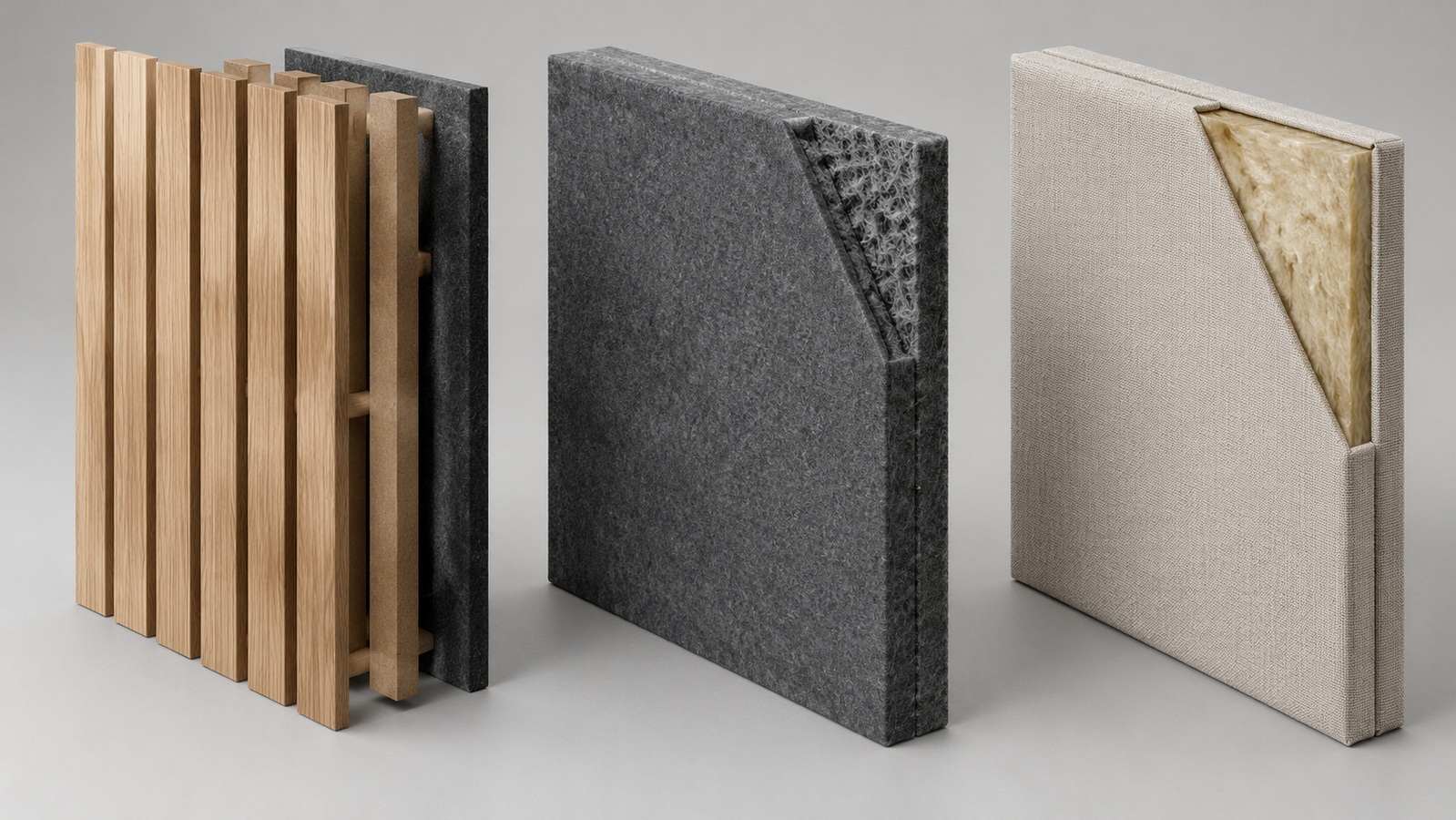
For wood-slat acoustic panels, the purchase specification should identify:
- MDF or alternative substrate.
- Applicable formaldehyde standard and test method.
- Veneer species and whether the finish is natural veneer, engineered veneer, or printed film.
- Slat dimensions and spacing.
- Felt thickness and composition.
- Adhesive and assembly method.
- Dimensional and appearance tolerances.
An E0 or E1 label should not be accepted without the applicable standard and report. For regulated composite-wood products entering the United States, EPA TSCA Title VI requirements apply; a generic emissions label is not a substitute for the required compliance documentation.
A decorative panel family may include both wood-based and polymer-based constructions. Performance claims should follow the exact construction, not the brand name.
For Binmao Decor, the published website describes water resistance, mold resistance, and fire-retardant features. Buyers should establish which individual constructions support those claims and under what conditions. They should not assume that an MDF-backed acoustic panel has the same moisture suitability as a PVC/WPC-based system.
Similarly, a fire classification must identify its test standard and tested assembly. "Class A," "B1," and "fireproof" are not interchangeable descriptions.
CE marking is required only where applicable European legislation mandates it. For construction products, buyers need to establish the relevant assessment route and supporting performance documentation rather than accept a generic certificate.
RoHS primarily concerns electrical and electronic equipment. A restricted-substance test referencing RoHS limits does not establish acoustic performance, fire classification, or general construction-product conformity.
A common sourcing mistake is treating the decorative surface as independent of acoustic performance.
A supplier may offer a tested panel and then change its slat spacing, facing construction, backing, or installation detail to meet a new design request. The revised panel may look similar, but the original report may no longer represent the delivered assembly.
The same issue arises when a laboratory specimen uses an air cavity while the installation team bonds the purchased panels directly to the wall. Mounting conditions affect absorption, so these configurations should not be compared as equivalent.
The practical safeguard is a controlled product schedule containing:
1. Approved drawing and revision number.
2. Material bill and finish code.
3. Slat or perforation geometry.
4. Backing construction.
5. Installation instructions.
6. Applicable report numbers.
7. Written approval requirements for substitutions.
Make this schedule part of the purchase order. If the supplier proposes a material or design change, require a written explanation of whether existing performance evidence remains applicable.
Request the business license, legal company name, factory address, and bank-beneficiary details before paying a deposit.
During an audit or live walkthrough, inspect the production processes relevant to the order—not simply the showroom. Confirm raw-material storage, cutting or forming equipment, finishing, assembly, inspection, and packing.
For mixed-material orders, ask which operations are subcontracted and who controls incoming quality. These checks are especially important when purchasing several categories through one supplier.
A useful approval sequence is:
1. Material samples for veneer, PET, fabric, and finish selection.
2. A finished panel to assess dimensions, workmanship, and assembly.
3. A representative installation mock-up.
4. A signed reference sample retained by both parties.
5. First-production checks against the approved specification.
Agree measurable acceptance limits rather than relying on "same as sample." Include weight, thickness, dimensions, slat alignment, color control, surface defects, packaging, and labeling.
Request carton dimensions, gross weight, pallet dimensions, panel quantity per carton, and a loading plan for the chosen shipment format.
Compare freight on the actual packed order. Long panels, vulnerable veneers, and lightweight products can create handling or space-utilization issues that are invisible in the unit price.
The quotation should also specify the named Incoterm and location, inspection responsibility, insurance arrangements, and treatment of damage claims.
The appropriate manufacturer depends on the purchasing program.
Binmao Decor is relevant to customization-led integrated interiors. Burgeree, Kingkus, and Acousound merit investigation for PET-focused products. QDBOSS offers a textile-and-acoustic combination, while Leeyin, Tiange, and MQ provide broader project-oriented portfolios. LEEDINGS and RooAoo publish scale and export indicators worth examining during capacity verification.
The decisive comparison should use the same specification, installation assumptions, sample requirements, and commercial terms for every candidate.
For a customized interior-wall program, send Binmao Decor your drawings, destination market, intended installation, finish preferences, target quantity, and required performance standards. Request a construction-specific quotation, representative sample, applicable test reports, packaging proposal, and written production schedule before approving bulk manufacture.
Search the legal company name or certificate number in IAF CertSearch. Check the status, certified scope, covered sites, issuing certification body, and accreditation information.
The database distinguishes active, suspended, withdrawn, and expired certificates. If a document cannot be reconciled with the database, contact the issuing certification body directly. Do not rely only on a PDF's printed expiry date.
Also remember that ISO 9001 concerns a quality-management system; it does not replace a product's acoustic or fire-test evidence.
Only when the report accurately represents your supplied construction and intended mounting configuration, and you have the necessary permission to use it.
Check thickness, backing, facing, geometry, and installation. A private-label name change is different from changing the panel itself. If the construction changes, obtain confirmation from the laboratory or a qualified technical adviser about whether additional testing is necessary. Mounting differences alone can materially affect absorption results.
No. It establishes evidence about the tested fabric under the stated conditions, not automatically the finished panel.
Request the applicable report or classification covering the complete construction, including core, adhesive, fabric, substrate, and mounting where relevant. Destination-market and building-use requirements must also be confirmed.
Where the products fall within the regulated scope, request TSCA Title VI compliance documentation, relevant labeling information, supplier and producer identification, and records supporting the regulated composite-wood content.
EPA guidance also addresses importer certification and recordkeeping requirements. The importer should coordinate the document set with its customs broker and compliance adviser before shipment. E0 or E1 descriptions alone do not satisfy these requirements.
Create a signed material schedule and retain an approved sample. Compare bulk panels against agreed dimensions, weight, thickness, surface construction, backing, and finish.
Use incoming-material traceability and production inspections to investigate inconsistencies. Visual checks alone cannot reliably establish emissions, fire behavior, or acoustic performance, so higher-risk changes may require laboratory verification. The contract should prohibit unapproved substitutions and define corrective action.
1. Binmao Decor — About Us: material options, customization, installation support, and published company history. [binmaomaterials]
2. Leeyin Acoustic — 2026 manufacturer guide and published company information. This is a manufacturer-authored source, not an independent ranking. [leeyinacoustic]
3. Burgeree — Official company profile and 2026 DOMOTEX exhibitor listing. [burgeree]
4. QDBOSS — Official company profile, manufacturing footprint, products, and reported export reach. [qdbossacoustics]
5. Kingkus — Company background and acoustic-industry entry history. [gamution]
6. Acousound — Official company history and published supplier profile. [polyacoustic]
7. Tiange Acoustics — Official company introduction. [acousticcn]
8. MQ Acoustic Materials — Official company introduction, production figures, markets, and listed credentials. [mq-acoustics]
9. LEEDINGS — Official product range, operating structure, capacity claims, and listed schemes. [leedings]
10. RooAoo — Official product range, manufacturing indicators, and export information. [raacoustic]
11. USDA Foreign Agricultural Service — *Solid Wood Annual 2025*: China's wood-products production and trade context. [apps.fas.usda]
12. Intertek — ASTM C423 sound-absorption testing overview. [intertek]
13. ASTM E795-23 — Mounting practices for sound-absorption specimens. [standards.iteh]
14. US Environmental Protection Agency — Formaldehyde emission standards for composite-wood products. [epa]
15. US Environmental Protection Agency — Importer, distributor, and retailer compliance guidance. [epa]
16. European Commission — Construction Products Regulation. [single-market-economy.ec.europa]
17. European Union — CE-marking requirements and applicability. [europa]
18. European Commission — RoHS Directive scope. [environment.ec.europa]
19. IAF CertSearch — Certification verification platform and verification guidance. [iafcertsearch]


