
Views: 267 Author: Sunny Publish Time: 2026-09-04 Origin: Site


Content Menu
● MDF vs PVC Wall Panels: Quick Answer
>> Why designers choose MDF panels
>> MDF limitations to address early
>> Why PVC panels work well in wet interiors
>> PVC limitations buyers should understand
● MDF vs PVC Wall Panels: Side-by-Side Comparison
● Expert Selection Guide by Application
>> Hotels and hospitality projects
>> Villas and residential interiors
● The Specification Checklist Most Buyers Miss
● Fire, Moisture, and Emissions: Avoid Overclaiming
● Why Binmao Decor Uses a Project-Based Approach
>> 1. Is MDF better than PVC for wall panels?
>> 2. Can MDF wall panels be used in bathrooms?
>> 3. Are PVC wall panels really waterproof?
>> 4. Are PVC wall panels fireproof?
>> 5. What does E1 or E0 MDF mean?
>> 6. Which wall panels are best for hotels?
>> 7. Can PVC panels be installed over existing tile or uneven walls?
Choosing between MDF wall panels and PVC wall panels is not simply a design decision. For a hotel corridor, villa bedroom, retail space, restaurant, apartment renovation, or moisture-prone bathroom, the chosen wall-cladding system affects appearance, installation speed, maintenance, indoor-air considerations, fire-performance documentation, and long-term replacement costs.
At Binmao Decor, we have spent 14 years manufacturing fast-install decorative wall-panel systems for international projects. From E1/E0 MDF panels with oak or walnut veneer to PVC, WPC, UV board, PU panels, and acoustic-backed composite wall systems, one lesson is clear: the best panel is the one that matches the exact environment, compliance requirement, and design intent of the project.
This expert guide explains the real differences between MDF vs. PVC wall panels, identifies where each material performs well, and gives architects, contractors, wholesalers, and project buyers a clearer specification process.
MDF wall panels are generally better for dry, design-led interiors where a premium painted, veneered, grooved, or carved appearance is the priority. They offer a smooth substrate and excellent machining flexibility but require careful moisture control and documented formaldehyde-emission compliance.
PVC wall panels are generally better for wet, high-humidity, quick-renovation, and easy-clean environments. Their major strengths are water resistance, low maintenance, light weight, and efficient installation. However, buyers should verify the product's specific fire-test results, material formulation, expansion allowance, and compatibility with local building-code requirements.
For many hospitality and commercial projects, the strongest solution is not strictly MDF or PVC. It is often a project-specific composite wall-panel system: for example, an MDF core with a wood veneer for dry public areas, waterproof PVC or WPC panels for washrooms, and acoustic-backed decorative panels for meeting rooms or hotel guestrooms.
MDF stands for medium-density fiberboard. It is an engineered wood panel made by breaking wood into fibers, combining those fibers with resin, and pressing the material into dense, uniform boards under heat and pressure.
For wall-decoration applications, MDF is usually supplied as a plain board, grooved fluted panel, slatted panel, decorative board, or finished product with paint, melamine paper, PVC film, PET film, wood veneer, or other surface treatments.
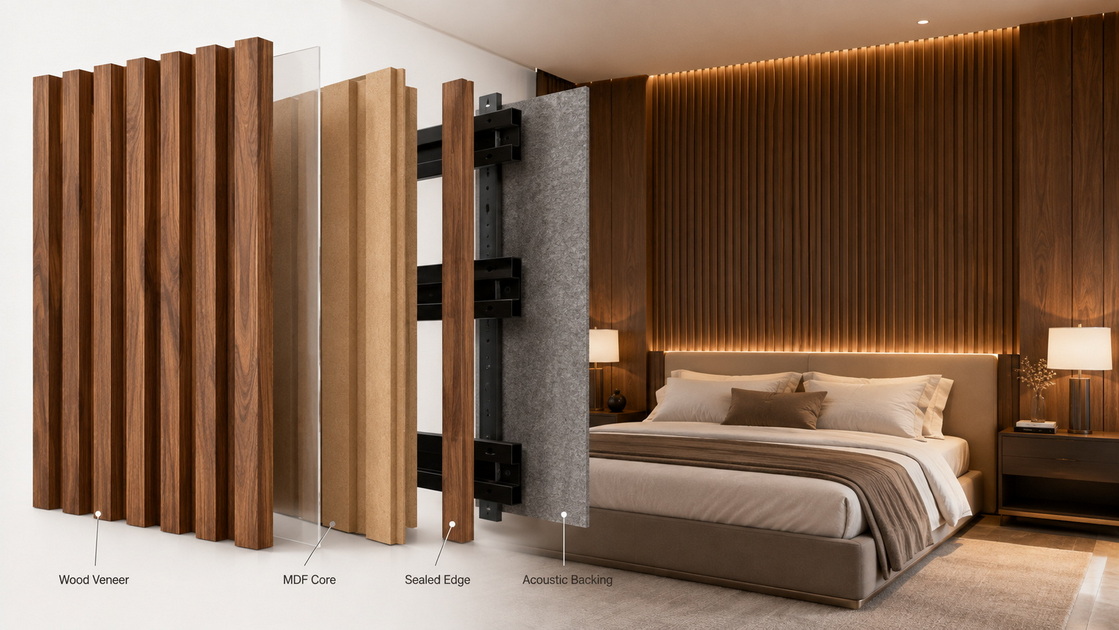
MDF remains popular for premium interior decoration because its smooth, consistent surface gives designers substantial freedom.
Key advantages include:
- Smooth finish: MDF has no natural knots or grain variation, making it suitable for paint, lamination, veneer, and decorative film.
- High customization potential: It can be cut, drilled, routed, carved, grooved, and shaped for fluted walls, geometric panels, hidden doors, cabinetry transitions, and bespoke millwork.
- Premium visual effect: Oak veneer, walnut veneer, smoked wood finishes, painted surfaces, and synchronized wood-grain films can create a more architectural appearance than standard plastic panels.
- Good dimensional consistency in controlled interiors: When specified correctly and kept dry, MDF provides a stable, uniform decorative base.
- Integration with acoustic systems: MDF-faced panels can be combined with sound-absorbing backing, slatted designs, perforation, or insulation layers for hotel rooms, offices, studios, and conference spaces.
MDF is not a universal wall solution. Its performance depends heavily on the panel grade, edge sealing, finish system, installation conditions, and exposure to water.
- Moisture sensitivity: Standard MDF can swell, soften, or lose structural integrity when exposed to water or persistent humidity.
- Higher handling weight: MDF panels are typically heavier than hollow PVC panels, which can affect freight planning, site handling, wall-fixing methods, and labor.
- Emission compliance matters: MDF contains binders. Buyers should request current third-party test reports and compliance labels rather than relying only on broad terms such as "eco-friendly."
- Not a fire-rating substitute: A fire-retardant treatment, fire-resistant substrate, or tested wall assembly must be verified with documentation. A decorative MDF panel should never be assumed to meet a required fire classification without a project-relevant test report.
For products sold in the United States, composite wood products including MDF must be labeled as compliant with TSCA Title VI requirements. California also regulates formaldehyde emissions from MDF and other composite wood products under its Composite Wood Products Regulation.
PVC wall panels are interior decorative cladding products made primarily from polyvinyl chloride resin with additives, pigments, stabilizers, and sometimes reinforcing or foaming components. Depending on the product design, panels may be hollow, solid, laminated, UV-coated, printed, embossed, or assembled with tongue-and-groove edges.
PVC panels are commonly selected when a project requires a cleanable, water-resistant surface and fast installation over an existing wall.
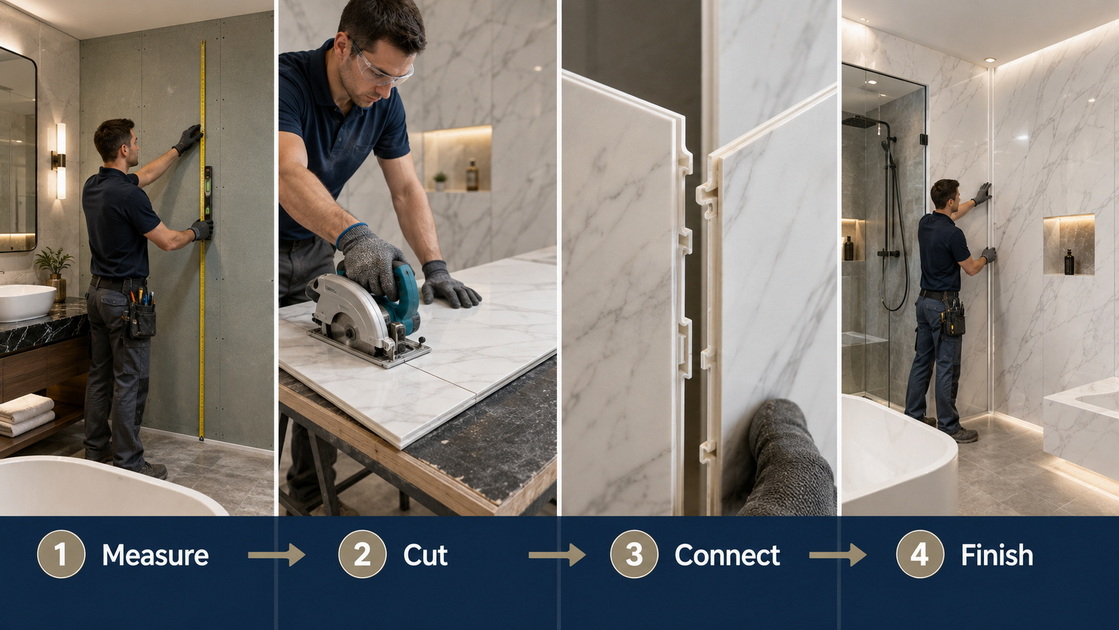
The biggest advantage of PVC is its resistance to routine moisture exposure. In appropriate indoor applications, a well-installed PVC wall system can be a practical alternative to wet trades such as tile installation, particularly for renovations where speed and cleanliness matter.
Key advantages include:
- Waterproof surface performance: Quality PVC wall panels do not absorb water in the way untreated MDF does, making them suitable for bathrooms, kitchens, laundry rooms, changing areas, utility spaces, and humid commercial environments.
- Mold-resistance potential: Because the panel surface is non-porous, it is easier to clean and less likely to support mold growth. However, the wall behind the panel must remain dry and properly ventilated.
- Fast installation: Tongue-and-groove systems, clips, adhesive installation, or battens can reduce renovation time compared with tile, plaster, or conventional wet-wall finishing.
- Lightweight logistics: Hollow PVC structures can lower handling effort, reduce shipping weight, and simplify on-site installation.
- Easy maintenance: Daily dust, splashes, and common surface dirt can usually be removed with a soft cloth and mild cleaning method.
- Wide decorative options: Modern UV printing, film lamination, embossing, and surface texturing allow PVC panels to imitate marble, wood grain, stone, textile, or solid-color finishes.
PVC is practical, but it should be specified intelligently rather than marketed as suitable for every condition.
- Heat exposure: PVC can soften, distort, or expand when installed too close to strong heat sources. Do not use standard PVC panels directly behind high-heat cooking equipment, fireplaces, or heat-generating appliances unless the exact product system has been approved for that application.
- Impact and scratch risk: Surface hardness varies by formulation and coating. High-traffic projects should request abrasion, impact, and scratch-performance information.
- Thermal movement: PVC expands and contracts more noticeably than wood-based panels. Correct installation gaps, profiles, clips, and accessories are essential.
- Fire testing must be product-specific: PVC is not automatically "fireproof." Fire performance depends on formulation, thickness, backing, adhesive, substrate, and installation assembly.
- Environmental transparency: PVC's lifecycle and end-of-life management remain important procurement considerations. Buyers should ask about recycled content, material disclosure, restricted substances, and recycling pathways where these matter to the project.
ASTM E84 measures the surface-burning characteristics of building materials, including flame-spread and smoke-developed behavior. It is useful documentation for many U.S. interior-finish applications, but it is not equivalent to a full fire-resistance rating for an entire wall assembly.
| Selection Factor | MDF Wall Panels | PVC Wall Panels | Best Choice |
|---|---|---|---|
| Core material | Engineered wood fiber and resin | Polyvinyl chloride resin with additives | Depends on design and environment |
| Moisture resistance | Low to moderate; standard MDF needs strict protection from water | High for normal indoor wet-area use | PVC |
| Surface appearance | Excellent for paint, real wood veneer, deep routing, and custom millwork | Broad printed, embossed, laminated, and UV decorative options | MDF for premium natural wood effect |
| Customization | High; supports carving, grooves, CNC patterns, and special profiles | Good; mainly through color, texture, width, profile, and film selection | MDF |
| Installation speed | Moderate; requires accurate cutting and secure fixing | Often faster, especially with lightweight interlocking profiles | PVC |
| Weight | Usually heavier | Usually lighter, particularly hollow structures | PVC |
| Cleaning | Depends on surface finish; avoid excessive moisture | Easy to wipe and maintain | PVC |
| Wet-area suitability | Not recommended for direct wet exposure unless engineered and fully protected | Suitable for bathrooms, laundry rooms, and humid interiors when properly installed | PVC |
| Fire-performance documentation | Must be confirmed by the exact substrate, surface, and assembly | Must be confirmed by the exact panel formulation and assembly | Documentation required for both |
| Indoor-air documentation | Request E0/E1, CARB, or TSCA Title VI evidence as applicable | Request VOC and material documentation where relevant | Depends on project requirements |
| Typical applications | Hotel lobbies, bedrooms, villas, offices, retail features, dry corridors | Bathrooms, kitchens, renovation projects, utility areas, wet commercial spaces | Environment-dependent |
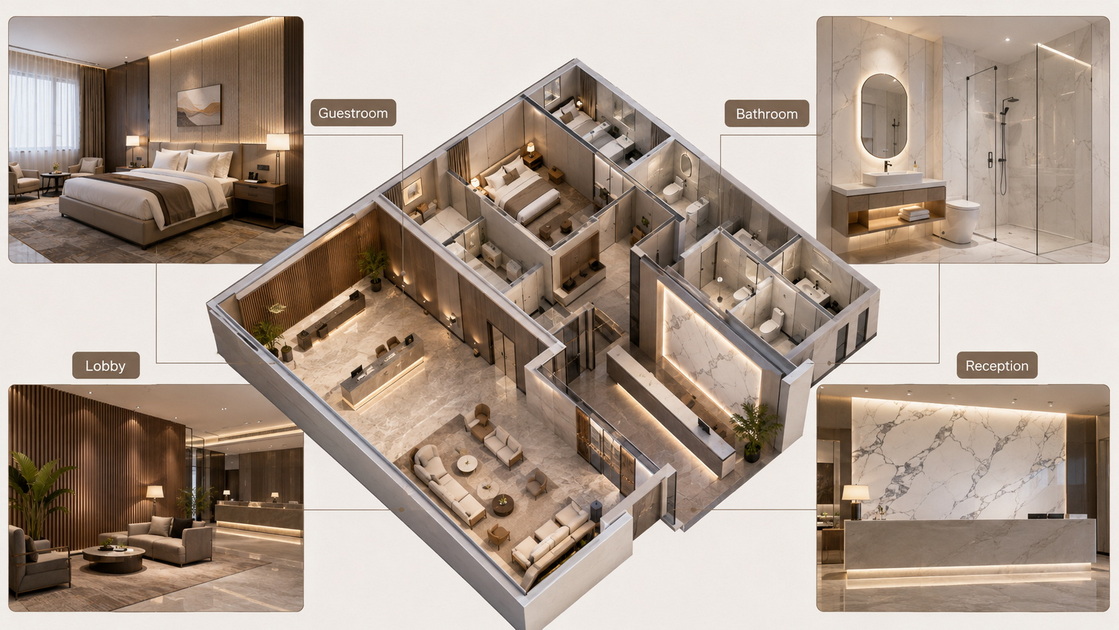
Hotels need wall panels that balance aesthetics, cleaning efficiency, fire documentation, acoustic comfort, and installation speed.
For hotel guestrooms, corridors, lobbies, reception zones, and executive lounges, veneered MDF decorative panels can create a warmer and more premium appearance. Walnut, oak, ash, smoked wood, and matte painted finishes work especially well for feature walls, headboards, TV backgrounds, and reception cladding.
For hotel bathrooms, service corridors, housekeeping zones, changing rooms, and utility areas, PVC or waterproof composite wall panels are usually more practical because they reduce concerns related to moisture, grout lines, and cleaning time.
For meeting rooms, private dining rooms, and guestroom walls, consider acoustic-backed wall panels. The right combination of perforated or slatted face materials, acoustic felt, mineral wool, and installation cavity can improve comfort, but acoustic claims should be supported by the tested configuration—not a generic material statement.
Villas typically place more value on visual refinement, customized dimensions, and seamless integration with doors, cabinetry, lighting, and furniture.
Choose MDF-based panels when the project needs:
- Natural wood veneer or a high-end painted finish
- Curved, fluted, grooved, or CNC-cut decorative patterns
- Custom wall-to-ceiling continuity
- Integrated hidden doors, skirting, light channels, or cabinetry
- A warm and architectural interior character
Choose PVC or WPC wall panels when the project needs:
- Waterproof finishes in bathrooms or laundry rooms
- Faster renovation with less demolition
- Easy-clean walls for rental properties or family spaces
- Lightweight panels that reduce installation complexity
- Decorative marble, stone, or wood-look surfaces at a more controlled budget
Retail stores, restaurants, clinics, offices, salons, and showrooms must consider foot traffic, maintenance cycles, brand identity, and downtime during installation.
PVC panels are effective when speed, washability, and moisture resistance are the key drivers. MDF panels are more suitable when the wall is a major brand-expression element, such as a retail feature wall, restaurant entrance, display backdrop, or office reception area.
A hybrid specification often provides the best commercial value:
1. Use MDF or wood-veneer panels in front-of-house visual areas.
2. Use PVC or WPC waterproof panels in wet zones and service rooms.
3. Use UV marble boards or high-gloss decorative boards where a stone-like appearance is required without the weight or installation complexity of natural stone.
4. Use acoustic-backed systems in conference rooms, restaurants, studios, and other spaces where speech clarity matters.
The original MDF-versus-PVC discussion is useful as a starting point, but it often leaves out the questions that determine whether panels succeed on a real project. Professional buyers should not choose from appearance photos alone.
Before approving a wall-panel order, request the following:
1. Exact product construction: Confirm the panel core, surface material, backing, thickness, width, length, density, and edge profile.
2. Application limits: Ask where the panel should not be installed, including high-heat areas, exterior exposure, direct water exposure, or uneven substrates.
3. Fire-test report: Request a report for the exact product or relevant system—not a general statement that the material is "fireproof."
4. Emission and indoor-air records: For MDF, ask for E0/E1 documentation and market-specific compliance evidence. For U.S.-bound composite wood products, verify TSCA Title VI labeling and certification as applicable.
5. Waterproofing details: Ask whether "100% waterproof" refers to the decorative face, the panel core, the joint system, or the finished installed wall. The answer matters.
6. Installation method: Confirm whether the panel uses adhesive, clips, battens, screws, or a combination. Request drawings for trims, corners, expansion gaps, and termination details.
7. Cleaning instructions: Make sure cleaners will not damage UV coatings, decorative films, veneers, or sealants.
8. Sample approval process: Approve physical samples under the project's actual lighting. Wood grain, gloss, texture, and color can look different from online images.
9. Packing and logistics: Confirm carton protection, palletizing, container loading, spare-panel percentages, and trim quantities before production.
10. Technical support: Choose a supplier able to provide installation guidance, cutting recommendations, drawings, and issue-response support after shipment.
Three words are commonly misused in wall-panel marketing: waterproof, fireproof, and eco-friendly.
A credible specification approach uses measurable language.
- "Waterproof" should identify what was tested or guaranteed: surface water resistance, water absorption, joint sealing, or entire wall-system performance.
- "Fireproof" should be replaced by the actual test standard and classification. For example, ASTM E84 evaluates surface-burning characteristics, while EN 13501-1 provides a reaction-to-fire classification framework for construction products.
- "Eco-friendly" should be supported by verifiable documentation, such as formaldehyde-emission compliance, restricted-substance declarations, recycled-content evidence, responsible sourcing, or product-specific environmental disclosure.
For MDF, there is no substitute for formal documentation. The U.S. EPA states that composite wood products, including MDF, must be labeled as TSCA Title VI compliant after March 22, 2019. For buyers serving California, CARB compliance is also highly relevant because the regulation specifically covers MDF and requires applicable products and finished goods to meet formaldehyde-emission standards and labeling requirements.
At Binmao Decor, we do not treat every project as a one-material sale. With 14 years of manufacturing experience in PVC wall panels, UV boards, waterproof and fire-performance-focused composite wall systems, we help customers match materials to the actual use environment.
Our fast-install wall-panel solutions can be customized by:
- Width, thickness, length, and profile
- PVC, WPC, PU, MDF, veneer, UV board, or composite construction
- Oak, walnut, wood grain, stone, fabric, matte, gloss, and customized decorative finishes
- E1/E0 MDF options and requested product documentation
- Waterproof, mold-resistant, flame-retardant, and acoustic-backed requirements
- Hotel, villa, residential, retail, office, and commercial-project specifications
- Installation accessories, drawings, and technical support
The right approach is simple: specify the wall panel around the project—not around a single product label.
If you are sourcing wall panels for a hotel, villa, distribution business, or commercial renovation, send us your drawings, target finish, application conditions, destination market, and required test standards. Our team can recommend a suitable MDF, PVC, WPC, UV board, PU, veneer, or acoustic composite solution and prepare samples for evaluation.
Neither material is universally better. MDF is usually better for premium dry-area decoration, real wood veneer, custom grooving, and architectural detailing. PVC is usually better for humid spaces, easy maintenance, and rapid installation.
Standard MDF should not be used in areas with direct water exposure or persistent humidity. Even moisture-resistant MDF needs carefully sealed edges, appropriate finishing, good ventilation, and a suitable installation design. For bathrooms, PVC or other waterproof composite panels are generally the safer option.
The PVC panel surface and body can be water-resistant, but the final wall system also depends on joints, trims, sealant, wall condition, installation method, and ventilation. Ask the supplier whether the waterproof claim covers the panel only or the full installed system.
PVC wall panels should not be described as automatically fireproof. Fire behavior depends on the specific formulation, thickness, coating, backing, adhesive, substrate, and installation assembly. Request an applicable test report, such as ASTM E84 or EN 13501-1 documentation, based on the project's market and code requirement.
E1 and E0 are commonly used terms associated with lower-formaldehyde-emission MDF categories, but buyers should not rely on the label alone. Request the applicable standard, test method, laboratory report, certificate date, and market-specific compliance information. For U.S. projects, also verify TSCA Title VI requirements where applicable.
Hotels often need a mixed solution. MDF veneer or decorative MDF works well in guestrooms, lobbies, and dry corridors. PVC or waterproof composite panels work well in bathrooms and service areas. Acoustic-backed panels can add value in meeting rooms, restaurants, and guestroom walls.
In many renovation projects, PVC panels can be installed over existing surfaces, but the substrate must be assessed first. Loose tiles, active dampness, major unevenness, mold, and structural defects should be corrected before installation. The correct adhesive, battens, clips, or mechanical fixing method depends on the wall condition.
1. U.S. Environmental Protection Agency. "Formaldehyde Emission Standards for Composite Wood Products." Explains TSCA Title VI labeling requirements for composite wood products, including medium-density fiberboard. [EPA source](https://www.epa.gov/formaldehyde/formaldehyde-emission-standards-composite-wood-products). [epa](https://www.epa.gov/formaldehyde/formaldehyde-emission-standards-composite-wood-products)
2. California Air Resources Board. "Frequently Asked Questions: Regulated Community." Explains California requirements for formaldehyde emissions from composite wood products, including MDF. [CARB source](https://ww2.arb.ca.gov/resources/documents/frequently-asked-questions-regulated-community). [ww2.arb.ca](https://ww2.arb.ca.gov/resources/documents/frequently-asked-questions-regulated-community)
3. California Air Resources Board. "Consumer FAQ." Provides consumer-facing information on CARB labeling and formaldehyde-emission requirements for MDF and other composite wood products. [CARB consumer guidance](https://ww2.arb.ca.gov/resources/documents/consumer-faq). [ww2.arb.ca](https://ww2.arb.ca.gov/resources/documents/consumer-faq)
4. Intertek. "ASTM E84: Standard Test Method for Surface Burning Characteristics of Building Materials." Summarizes the purpose of ASTM E84 surface-burning testing. [Intertek source](https://www.intertek.com/building/standards/astm-e84/). [intertek](https://www.intertek.com/building/standards/astm-e84/)
5. CEN / iTeh Standards. "EN 13501-1: Fire Classification of Construction Products and Building Elements." Describes the European reaction-to-fire classification procedure for construction products. [EN 13501-1 source](https://standards.iteh.ai/catalog/standards/cen/90bbbdc1-c23c-4579-b891-da92600aa4d0/en-13501-1-2007). [standards.iteh](https://standards.iteh.ai/catalog/standards/cen/90bbbdc1-c23c-4579-b891-da92600aa4d0/en-13501-1-2007)
6. Composite Panel Association. "EPA Formaldehyde Guide." Provides MDF-related formaldehyde emission information and compliance guidance. [Composite Panel Association guide](https://www.compositepanel.org/wp-content/uploads/CPA_EPA-Guide_032018.pdf). [compositepanel](https://www.compositepanel.org/wp-content/uploads/CPA_EPA-Guide_032018.pdf)
7. George Panel. "MDF vs PVC Wall Panels: Comparison of the Differences." Original article reviewed for this reconstructed and expanded topic coverage. [Original article](https://www.georgepanel.com/mdf-vs-pvc-wall-panels-comparison-of-the-differences/). [georgepanel](https://www.georgepanel.com/mdf-vs-pvc-wall-panels-comparison-of-the-differences/)


