
Views: 269 Author: Sunny Publish Time: 2026-08-31 Origin: Site


Content Menu
● Wall Panel Cost Per Square Foot
● Why Wall Panel Prices Vary So Much
>> 1. Core Material and Construction
>> 2. Finish Quality and Decorative Technology
>> 3. Fire Performance and Test Documentation
>> 4. Moisture Resistance Is Not the Same as Waterproofing
● How to Calculate Your Wall Panel Budget
>> 1: Measure the Net Wall Area
>> 3: Include Accessories and Installation
● Material Selection by Project Type
>> Select by Risk, Not Only by Appearance
● MDF, E1/E0 and Low-Emission Requirements
● Why the Cheapest Wall Panel Is Often Not the Lowest-Cost Option
● Request a Project-Specific Wall Panel Quote
>> 1. How much do PVC wall panels cost?
>> 2. Are WPC wall panels more expensive than PVC wall panels?
>> 3. Are waterproof wall panels suitable for bathrooms?
>> 4. What is the difference between E0 and E1 MDF wall panels?
>> 5. How can I verify a wall panel's fire rating?
>> 6. Do acoustic wood slat panels actually reduce noise?
>> 7. What information should I send for an accurate wall panel quotation?
Waterproof wall panel cost in 2026 typically ranges from about $2 to $20+ per square foot for materials, depending on whether you choose entry-level PVC, decorative WPC, low-emission MDF, acoustic wood-slat panels, PU stone panels, or real-wood veneer systems. For hotels, villas, apartments, retail interiors, and commercial projects, the right comparison is not simply the initial panel price—it is the total installed cost, durability, compliance documentation, and long-term maintenance requirement.
At Binmao Decor, we have spent 14 years manufacturing fast-installation interior wall systems for global residential, hospitality, and commercial clients. From 100% waterproof PVC wall panels and UV boards to fire-retardant WPC cladding, E1/E0 MDF panels, oak or walnut veneer finishes, PU stone, and acoustic-backed decorative panels, we see one recurring challenge: buyers often receive incomplete quotations that do not account for accessories, wastage, installation complexity, freight, or project-specific performance requirements.
This guide explains what wall panels really cost, what drives the final price, and how to select the right quick-install wall panel system for your project.
The following ranges are planning estimates for material-only and installed wall panel costs. Actual pricing varies by panel thickness, core material, finish, order quantity, country of installation, project complexity, testing requirements, and customization level.
| Wall Panel Type | Typical Material Cost | Typical Installed Cost | Best Applications |
|---|---|---|---|
| PVC wall panels | $2–$10/sq. ft. | $7–$25/sq. ft. | Bathrooms, kitchens, wet areas, rental properties |
| WPC wall panels | $5–$20/sq. ft. | $10–$30/sq. ft. | Hotels, villas, living rooms, corridors, commercial interiors |
| MDF wall panels | $3.50–$12/sq. ft. | $8–$22/sq. ft. | Painted feature walls, wainscoting, dry residential interiors |
| Acoustic wood slat panels | $7.50–$20+/sq. ft. | $13–$35+/sq. ft. | Offices, meeting rooms, bedrooms, hospitality spaces |
| UV marble / decorative boards | $4–$15/sq. ft. | $9–$25/sq. ft. | TV walls, lobbies, retail displays, bathrooms |
| PU stone panels | $6–$18/sq. ft. | $12–$30/sq. ft. | Feature walls, commercial displays, lightweight stone-look interiors |
| Natural wood veneer panels | $12–$35+/sq. ft. | $20–$55+/sq. ft. | Luxury villas, executive interiors, high-end hotels |
PVC panel pricing is often the lowest among waterproof options, while WPC, acoustic, veneer, and fire-rated systems generally carry a higher upfront cost because they involve thicker substrates, more complex finishes, better structural performance, or specialized backings. Market guides commonly place standard PVC material costs around $2–$10 per square foot and standard interior WPC products around $5–$10 per square foot, although premium finishes and imported project specifications can push costs higher.
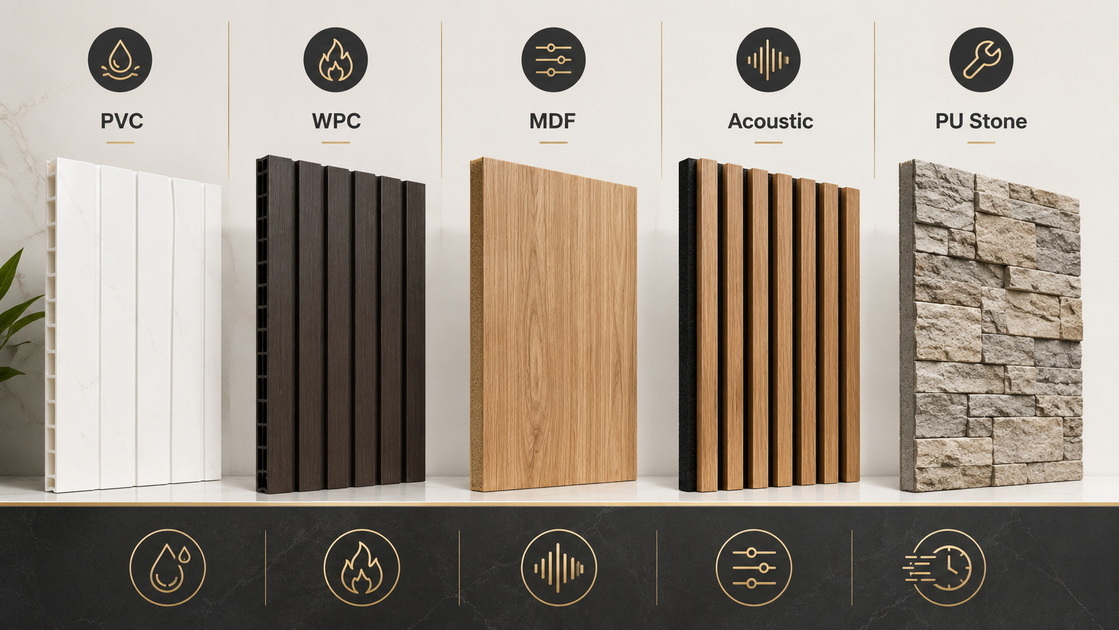
A supplier's advertised "price per panel" can be misleading. One panel may cover 5 square feet, while another covers 20 square feet. Some prices include trim profiles and accessories; others cover only the board itself. The most useful way to compare products is to request a quotation in cost per square meter or cost per square foot, including accessories and recommended installation materials.
The panel core has a major impact on water resistance, dimensional stability, weight, fire performance, surface durability, and cost.
- PVC panels are lightweight, moisture-resistant, and practical for bathrooms, kitchens, utility rooms, and cost-sensitive projects.
- WPC wall panels combine polymer and wood-based components to create a more substantial decorative panel with a wood-like appearance. They are popular for modern fluted walls, hotel rooms, apartment living spaces, and commercial corridors.
- MDF panels offer a smooth and stable surface for paint, routed patterns, and decorative millwork. However, standard MDF is not the right choice for constantly wet environments unless the panel construction and installation system are specifically designed for moisture exposure.
- Acoustic panels usually combine veneer or decorative slats with an acoustic felt backing. The price reflects both visual finish and sound-management construction.
- PU stone panels deliver a lightweight alternative to natural stone, often reducing structural load and installation effort compared with real masonry or stone cladding.
For a hotel bathroom or spa area, a 100% waterproof PVC or properly specified WPC-based system may offer better long-term value than a lower-cost MDF wall panel that may swell or fail after repeated humidity exposure.
The visible surface is not just a design decision—it is a cost driver. Wood grain film, high-gloss UV coating, marble print, synchronized texture, metallic finish, embossed leather grain, real wood veneer, and custom digital printing all affect price.
For example, an economical white PVC panel may be appropriate for a utility room, but a luxury hotel lobby may require:
- Oak, walnut, teak, or smoked-wood veneer visuals.
- Fluted, ribbed, or wave-profile decorative surfaces.
- Scratch-resistant and stain-resistant surface treatment.
- Color matching across multiple production batches.
- Seamless transition profiles around doors, corners, ceilings, and lighting channels.
- Custom width, depth, or panel length for the project layout.
At Binmao Decor, customization can include panel width, depth, profile, substrate, color, decorative finish, acoustic backing, and packaging requirements. This flexibility helps designers maintain a consistent visual language across guest rooms, hallways, reception areas, villas, and branded retail environments.
"Fireproof" is often used loosely in marketing, but professional buyers should request the exact test standard, test report, sample specification, and applicable classification for the intended market. A panel may be described as flame-retardant or fire-resistant, but its actual suitability depends on the complete installed system and local building-code requirements.
In North America, ASTM E84 evaluates the surface-burning characteristics of interior wall and ceiling finishes, including flame spread and smoke development. Common classifications are Class A, B, and C; Class A generally requires a Flame Spread Index of 0–25 and a Smoke Developed Index of 0–450.
Before approving a wall panel supplier, request:
1. The current product test report—not a generic report for a different panel.
2. The report's issuing laboratory and test standard.
3. The product model, thickness, finish, and backing shown on the report.
4. Whether the report applies to the final installed assembly.
5. Documentation required by your destination market, consultant, architect, or local authority.
This step is especially important for hotels, schools, offices, retail chains, public corridors, and large commercial projects where fire, smoke, and material compliance affect project approval.
A decorative board can be "moisture resistant" without being fully waterproof. This distinction matters.
- 100% waterproof panels are designed to resist water exposure and are usually the safer option for bathrooms, shower-adjacent walls, kitchens, washrooms, basements, and humid hospitality environments.
- Moisture-resistant MDF may perform well in controlled interior conditions but still requires careful sealing, proper edge treatment, and avoidance of sustained water exposure.
- Wood veneer systems can create a premium aesthetic, but they need the correct substrate, coating, ventilation, and environmental conditions to prevent movement, warping, or surface deterioration.
For projects with high humidity, cleaning chemicals, or frequent turnover—such as serviced apartments, hotels, clinics, and restaurants—buyers should evaluate the entire system: panel body, joints, trim, adhesive, edge sealing, substrate condition, and cleaning method.
A clear budget should include more than the panel surface area. Use the following process to avoid under-ordering or comparing incomplete quotations.
Measure each wall's width and height:
Wall Area=Width×Height
Then subtract large openings such as doors and windows if the panel layout will not cover them.
For example, a 12-foot-wide wall with an 8-foot ceiling equals:
12×8=96 sq. ft.
Most projects need extra material for cutting, fitting, damaged pieces, future repairs, and alignment around windows, sockets, doors, or irregular corners.
A practical allowance is:
- 5%–8% for simple rectangular walls with standard panels.
- 10%–15% for fluted profiles, complex layouts, multiple cutouts, angled walls, or carefully matched wood grains.
- 15%+ for high-end veneer, book-matched patterns, custom layouts, or projects with many returns and columns.
For the 96-square-foot wall above, adding 10% wastage means ordering approximately 106 square feet of material.
Do not compare panels only by their board price. Ask whether the quotation includes:
- Start and end trims.
- Internal and external corner profiles.
- Ceiling and skirting accessories.
- Adhesive, screws, clips, or battens.
- LED channels or decorative metal strips.
- Packaging and export palletization.
- Samples, inspection, and test documentation.
- Sea freight, inland delivery, duty, and local installation labor.
A lower-priced panel may become more expensive if it requires extensive site cutting, framing, finishing, or replacement after installation.
Installation labor can be as important as product price. A flat, square, accessible wall is relatively simple. A hotel corridor with fire doors, electrical panels, HVAC grilles, curved corners, elevators, high ceilings, and lighting details is not.
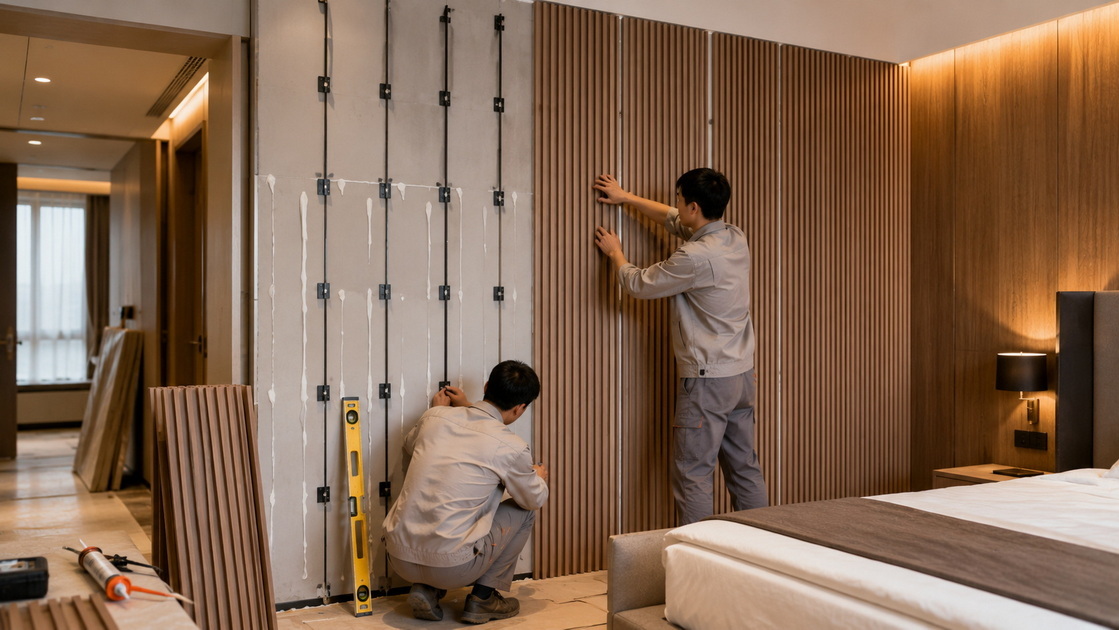
Labor costs rise when installers must handle:
- Uneven or damaged substrates.
- Multiple electrical outlets and switches.
- Door frames, windows, vents, sprinklers, and access panels.
- Tall ceilings or stairwell walls.
- Pattern matching and directional wood grain.
- Complex fluted-panel alignment.
- On-site painting, sanding, filling, or sealing.
- Difficult access and restricted working hours in active hotels or retail sites.
This is why fast-installation wall panels can offer a meaningful commercial advantage. Factory-finished, precisely sized panels reduce site work, shorten installation time, and help minimize dust, wet trades, and disruption. For hospitality renovations, where room downtime affects revenue, a faster and cleaner installation method can be worth more than the lowest material quotation.
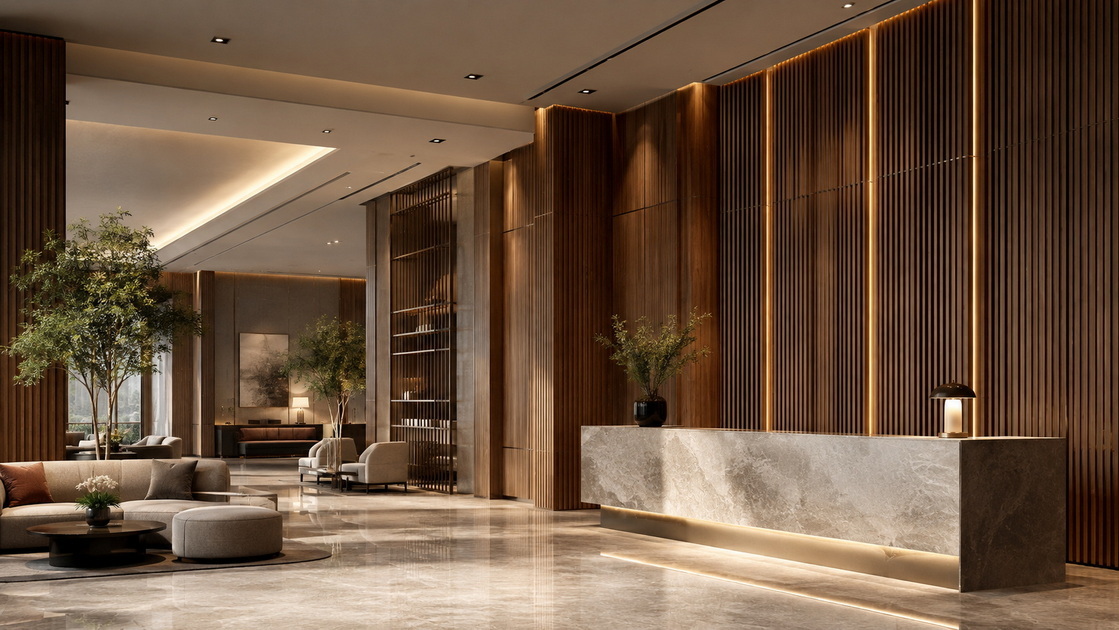
| Project Type | Recommended Panel System | Why It Works |
|---|---|---|
| Hotel guest room | WPC, acoustic slat panel, UV board, veneer-finish panel | Durable, decorative, fast to install, customizable |
| Hotel bathroom | Waterproof PVC or specified waterproof composite panel | Better suited to humidity and routine cleaning |
| Luxury villa | Wood veneer, fluted WPC, PU stone, custom MDF in dry areas | High design flexibility and premium appearance |
| Office meeting room | Acoustic-backed wood slat panels | Improves visual warmth while supporting sound control |
| Retail store | UV board, PU stone, WPC profiles, custom branding panels | Fast visual transformation and brand-specific finishes |
| Rental apartment | PVC wall panel or economical WPC system | Low maintenance and practical replacement value |
| Restaurant or café | WPC, PU stone, acoustic panel, UV marble board | Supports atmosphere, durability, and faster refurbishment |
A visually attractive panel is not automatically appropriate for every room. The right procurement question is: What is most likely to make this wall fail over the next five years?
- In bathrooms, it is usually water and poor edge sealing.
- In hotel corridors, it may be impact damage and cleaning frequency.
- In meeting rooms, it may be acoustic comfort.
- In luxury villas, it may be finish consistency and long-term visual quality.
- In export projects, it may be compliance documents, packing strength, lead time, and after-sales technical support.
Selecting by failure risk helps project teams choose the correct panel construction before comparing colors and patterns.
For MDF-based decorative panels, buyers should carefully distinguish between regional classifications, supplier declarations, and mandatory destination-market regulations. E0 and E1 are commonly used specifications in international sourcing discussions, but a project should not assume that those labels automatically prove compliance in every market.
For the United States, the EPA regulates formaldehyde emissions from composite wood products under TSCA Title VI. Regulated products include hardwood plywood, MDF, thin MDF, and particleboard. The EPA lists an emission limit of 0.11 ppm for MDF and 0.13 ppm for thin MDF. Products manufactured or imported for the U.S. market must meet applicable compliance and labeling requirements.
For any MDF, veneer-MDF, or acoustic slat product, ask your supplier for:
- Substrate specification and density.
- Formaldehyde-emission documentation.
- Applicable E0/E1 declaration or certification.
- TSCA Title VI or CARB-related documentation when required for U.S. projects.
- Finish and adhesive information.
- Batch-level quality-control process.
- Test reports relevant to the exact ordered product.
Binmao Decor can manufacture panels with E1/E0-grade MDF options, as well as PVC, WPC, PU, wood veneer, and acoustic-backed structures. For project buyers, the key is to confirm the required performance and documentation before mass production—not after containers have shipped.
The cheapest wall panel can create expensive problems if it fails during installation or early use. Low-cost products may have inconsistent thickness, weak locking edges, poor lamination, low-density core materials, insufficient packaging, or color variation between batches.
The real cost of a panel includes:
- Material purchase price.
- Freight and import handling.
- On-site labor.
- Wastage and breakage.
- Rework caused by poor fit or damaged surfaces.
- Cleaning and maintenance.
- Replacement cost.
- Room downtime for hotels or businesses.
- Reputation risk for contractors, designers, and developers.
For a commercial project, a durable factory-finished panel that installs quickly and requires less maintenance can offer a lower total cost of ownership than a cheaper alternative that needs more labor, more repairs, or premature replacement.
There is no single "correct" price for wall panels because every project has different design, performance, compliance, and installation requirements. The best quotation should clearly state the product composition, thickness, dimensions, finish, quantity, accessories, packaging, test documents, production lead time, and trade terms.
Binmao Decor supplies fast-installation decorative wall panel solutions for modern hotels, villas, apartments, offices, restaurants, and commercial interiors. With 14 years of manufacturing experience, we support customized PVC wall panels, WPC wall panels, UV boards, waterproof and fire-retardant composite panels, MDF and wood veneer systems, PU stone panels, and acoustic-backed wall solutions.
Send us your wall dimensions, drawings, reference photos, required material, target market, and performance requirements. Our team can recommend an appropriate panel structure, provide technical installation support, and prepare a customized quotation for your project.
PVC wall panels typically cost around $2–$10 per square foot for materials, depending on thickness, surface finish, panel size, and supplier. Professional installation can increase the total cost to roughly $7–$25 per square foot, particularly when wall preparation, trim details, electrical cutouts, or waterproof edge sealing are required.
Usually, yes. WPC wall panels generally cost more than standard PVC panels because they often have a thicker, more decorative, wood-like construction. However, WPC may provide better perceived quality and design flexibility for hotel rooms, living rooms, retail spaces, and feature walls. Standard indoor WPC products are commonly cited in the $5–$10 per-square-foot range, with premium products costing more.
Yes, properly specified waterproof wall panels can be suitable for bathrooms, washrooms, kitchens, and humid spaces. However, the complete installation system matters: use compatible trims, adhesive or mechanical fixing, sealed edges, and proper detailing around wet zones. Confirm whether the selected panel is designed for direct water exposure or only general humidity resistance.
E0 and E1 are commonly used low-formaldehyde emission classifications in global material sourcing. Their precise meaning depends on the applicable standard and test method. If you are importing MDF products into the United States, ask for TSCA Title VI compliance documentation because U.S. requirements apply specific emission limits to composite wood products, including MDF.
Ask for the test report for the exact panel model, thickness, finish, and backing you plan to purchase. For North American projects, ASTM E84 is commonly used to assess flame spread and smoke development for interior wall and ceiling finishes. Do not rely only on a supplier's "fireproof" marketing claim.
Acoustic wood slat panels can improve sound absorption and reduce reflected sound when they use an appropriate acoustic backing and are installed as part of a well-designed room system. Their performance depends on the felt backing, panel geometry, cavity depth, substrate, room size, and other hard or soft surfaces in the space. For projects with specific acoustic targets, request laboratory data and consult an acoustic professional.
Send the wall dimensions, project drawings, installation location, panel style, preferred color or finish, required thickness, estimated quantity, target market, fire and emission requirements, delivery location, and any reference images. This allows the manufacturer to recommend the right substrate, surface, accessories, packing method, and installation system.
1. U.S. Environmental Protection Agency. "[Frequent Questions for Regulated Stakeholders About Implementing the Formaldehyde Standards for Composite Wood Products Act](https://www.epa.gov/formaldehyde/frequent-questions-regulated-stakeholders-about-implementing-formaldehyde-standards)." Details regulated composite wood products and federal emission limits, including MDF requirements. [epa](https://www.epa.gov/formaldehyde/frequent-questions-regulated-stakeholders-about-implementing-formaldehyde-standards)
2. U.S. Environmental Protection Agency. "[Formaldehyde Emission Standards for Composite Wood Products](https://www.epa.gov/formaldehyde/formaldehyde-emission-standards-composite-wood-products)." Explains TSCA Title VI compliance and labeling requirements for applicable composite wood products. [epa](https://www.epa.gov/formaldehyde/formaldehyde-emission-standards-composite-wood-products)
3. US Made Supply. "[ASTM E84 – Steiner Tunnel Surface Burning Test](https://usmadesupply.com/resources/building-codes-standards/fire-inspection-compliance/astm-e84)." Overview of ASTM E84 flame-spread and smoke-developed classifications for interior finish materials. [usmadesupply](https://usmadesupply.com/resources/building-codes-standards/fire-inspection-compliance/astm-e84)
4. WPC Kojo. "[What Is the Price Range of WPC Wall Panels in 2026](https://www.wpckojo.com/blogs/wpc-wall-panel-price-2026-global-range-indoor-outdoor-cost.html)." Industry pricing overview for WPC wall panels and installation considerations. [wpckojo](https://www.wpckojo.com/blogs/wpc-wall-panel-price-2026-global-range-indoor-outdoor-cost.html)
5. Mumu-ing. "[How Much Do PVC Wall Panels Typically Cost?](https://www.mumu-ing.com/info/how-much-do-pvc-wall-panels-typically-cost-103267799.html)." Overview of material and installation cost ranges for PVC wall panels. [mumu-ing](https://www.mumu-ing.com/info/how-much-do-pvc-wall-panels-typically-cost-103267799.html)
6. USA Builders Depot. "[How Much Do WPC Wall Panels Cost? A Price Breakdown](https://usabuildersdepot.com/blogs/news/wpc-wall-panel-price)." Provides a practical cost framework for standard and premium WPC wall panel applications. [usabuildersdepot](https://usabuildersdepot.com/blogs/news/wpc-wall-panel-price)
7. George Panel. "[How Much Does the Wall Panel Cost in 2026?](https://www.georgepanel.com/how-much-does-the-wall-panel-cost/)." Competitor reference reviewed for common market pricing structures, project budgeting steps, and buyer concerns. [georgepanel](https://www.georgepanel.com/how-much-does-the-wall-panel-cost/)


