
Views: 266 Author: Sunny Publish Time: 2026-10-24 Origin: Site


Content Menu
● Bamboo Wood Fiber Wall Panels vs. WPC Wall Panels
● What Are Bamboo Wood Fiber Wall Panels?
>> Bamboo Composite Panels Are Not Solid Bamboo
>> Why Two WPC Panels Can Perform Differently
● Appearance: Which Material Creates a Better Feature Wall?
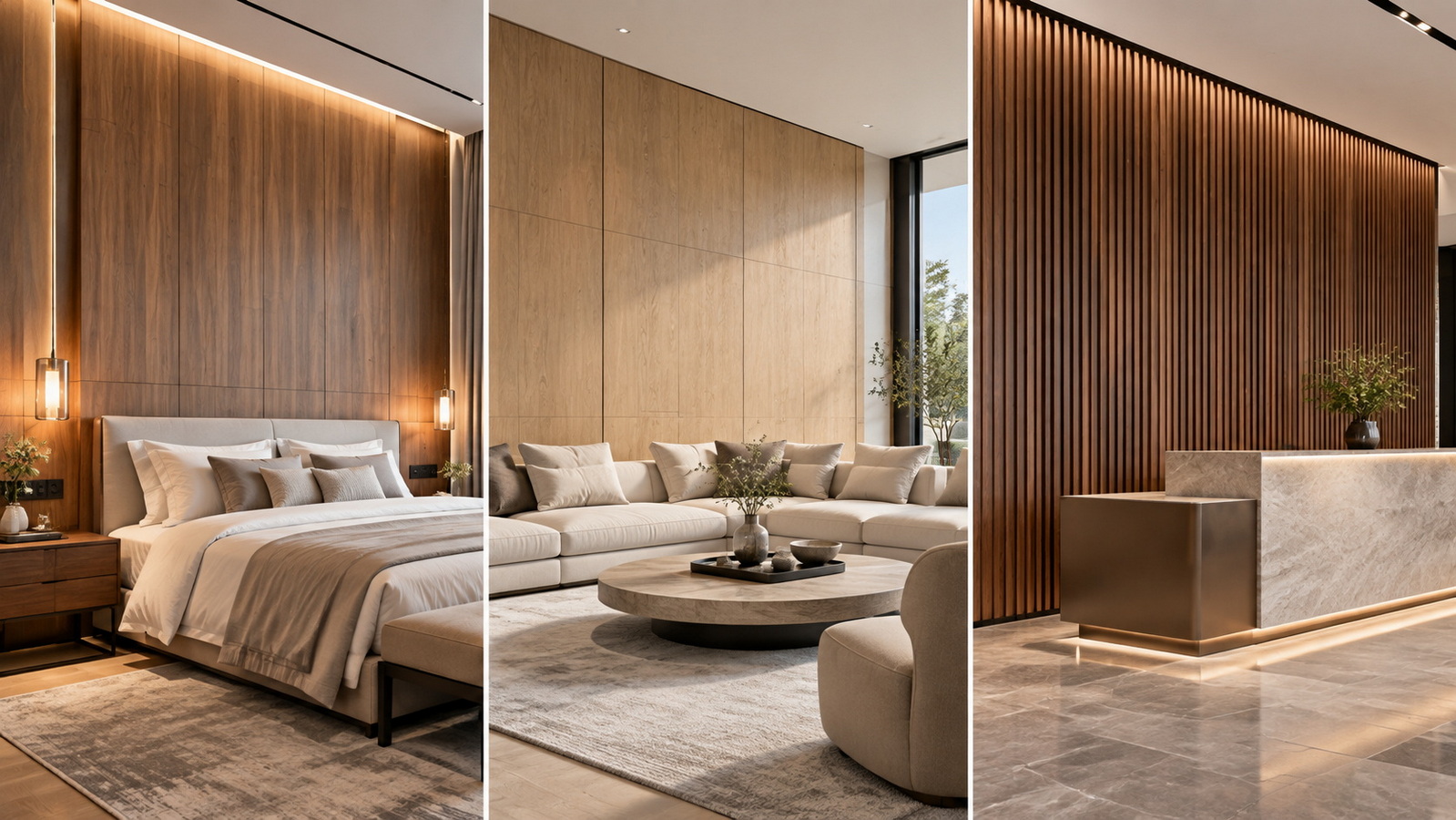
>> Hotel Headboards and Villa Living Rooms
>> Reception Areas and Commercial Interiors
● Moisture Resistance: Look Beyond "Waterproof" Claims
>> Waterproof Panels Do Not Automatically Create Waterproof Walls
>> Mold Prevention Still Requires Moisture Control
● Fire Performance: Compare Reports, Not Advertising
>> Flame Retardancy Is Not Fire Resistance
● Indoor Air Quality and Environmental Claims
>> Check the Complete Panel Construction
● Acoustic Performance: Decorative Texture Is Not Proof
● Installation and Maintenance: Compare the Complete System
>> Practical Questions for Hospitality Projects
● Cost Comparison: Use Installed Cost, Not Panel Price
>> Normalize Supplier Quotations
● A Practical Sample-Approval Process
>> 1: Review Documents Before Choosing Colors
>> 2: Build a Representative Mock-Up
>> 3: Assess Project-Specific Cleaning
>> 4: Approve a Reference Sample
● Which Wall Panel Should You Choose?
● Plan Your Feature Wall with Binmao Decor
>> Are bamboo wood fiber wall panels the same as WPC wall panels?
>> Which wall panel is better for humid interiors?
>> Are bamboo wood fiber wall panels fireproof?
>> Do WPC wall panels improve soundproofing?
>> Which option is less expensive?
>> Can Binmao Decor customize interior feature wall panels?
Choosing between bamboo wood fiber wall panels and WPC wall panels for interior feature walls requires more than comparing colors and prices. For hotel headboards, villa living rooms, reception areas, and commercial interiors, the better choice depends on the panel's composition, surface finish, installation system, and documented performance.
The most important starting point is often overlooked: these product categories can overlap. Some bamboo wood fiber wall panels contain bamboo powder, wood fibers, and polymers, placing them within the broader wood-plastic composite family. A different product name does not necessarily mean a fundamentally different material.

Neither material is universally better. Use this comparison to identify what needs checking before approving a product.
| Comparison factor | Bamboo wood fiber wall panels | WPC wall panels |
|---|---|---|
| Material identity | May combine bamboo powder, wood fibers, polymers, and additives | Combine wood-based material with a polymer matrix |
| Relationship between categories | Some products are effectively a bamboo-containing WPC | A broader composite category with varying formulations |
| Appearance | Depends on decorative film, veneer, coating, and profile | Also depends on finish and profile rather than the category alone |
| Moisture performance | Requires evidence for the specific formulation | Also varies with formulation and manufacturing quality |
| Fire performance | Must be verified for the supplied product | Must be verified for the supplied product |
| Best purchasing approach | Confirm composition, construction, and test documentation | Apply the same checks |
The material distinction above reflects manufacturer descriptions and wood-polymer research; it should not be interpreted as a standardized classification covering every supplier.
Bamboo wood fiber wall panels are decorative interior panels marketed around their bamboo- and wood-derived ingredients. One manufacturer describes a blend of bamboo powder, wood powder, and polymer materials formed through extrusion. However, buyers should not assume that every supplier uses the same recipe.
A bamboo-containing composite panel is not automatically equivalent to solid bamboo, bamboo veneer, or laminated bamboo board.
For purchasing purposes, request:
- The declared core composition and polymer type.
- A cross-section showing solid, hollow, or foamed construction.
- The decorative surface material.
- Panel dimensions, tolerances, and weight.
- Installation instructions and relevant test reports.
My first question would be: "What exactly is inside the panel?" That answer establishes whether two competing quotations actually describe comparable products.
WPC stands for wood-plastic composite. These materials combine wood-derived components with polymers. Their performance depends on the interaction between those ingredients, not simply the presence of plastic. USDA Forest Service research explains that polymers can provide moisture barriers, while wood components can absorb moisture and change dimensions if insufficiently protected.
For an interior feature wall, examine the complete construction:
1. Core formulation.
2. Solid, hollow, or foamed profile.
3. Decorative film, veneer, or coating.
4. Edge and joint design.
5. Fixing method and supporting substrate.
Do not treat an exterior decking specification as proof of suitability for an interior wall. Request documentation addressing the actual product and intended installation.
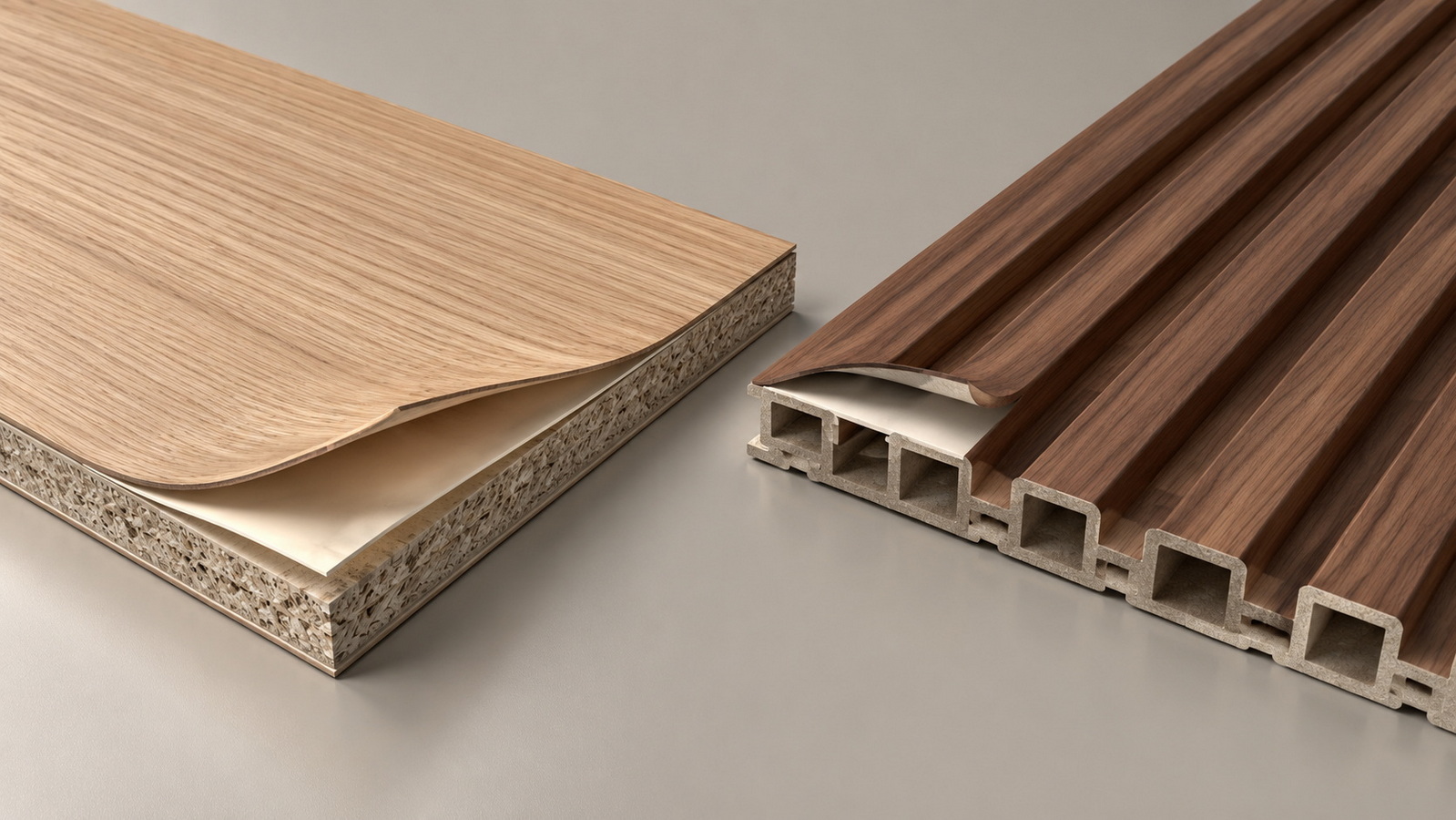
For design selection, I would begin with the desired visual result rather than the core's marketing name.
Compare physical samples for:
- Grain realism and pattern repetition.
- Matte, satin, or gloss consistency.
- Color variation between panels.
- Visible joints and corner transitions.
- Finish quality around cut edges.
- Compatibility with lighting and adjacent materials.
For a broad, calm backdrop, compare wide-format panels and restrained joint layouts. For a more textured composition, compare fluted profiles and their shadow lines.
Neither approach belongs exclusively to bamboo wood fiber or WPC. Ask the supplier which construction can deliver the approved appearance with practical installation details.
Review a sample under the actual lighting direction. A finish that looks convincing in a small photograph may reveal repetition or uneven reflections across a large wall.
My preferred approval method is a physical mock-up containing several adjoining panels, an external corner, and the intended trim.
Both product categories may be promoted for moisture resistance. However, wood-plastic composites are not automatically immune to moisture-related deterioration. Research identifies moisture, temperature, biological exposure, and formulation as relevant factors in composite durability.
Separate three questions:
- Does the panel resist water absorption?
- Does the decorative finish remain bonded after exposure?
- Does the installed wall prevent water from reaching vulnerable layers?
A product-level claim does not answer all three.
For bathroom-adjacent feature walls, request written confirmation of permitted exposure conditions and joint detailing. Do not assume decorative cladding can replace a specified waterproofing system.
"Bamboo," "WPC," and "waterproof" are not substitutes for controlling moisture behind the installation. The U.S. Environmental Protection Agency identifies moisture control as the key to preventing indoor mold growth.
Before covering a wall, investigate leaks, condensation, and existing dampness. A decorative upgrade should not conceal an unresolved building problem.
For hotels and commercial projects, fire documentation should be reviewed before selecting the final finish.
ASTM E84 measures surface-burning characteristics, including flame spread and smoke development. Under the commonly used classification framework, Class A corresponds to a flame-spread index of 0–25 and a smoke-developed index no greater than 450.
A Class A surface-burning classification does not mean that a decorative panel is noncombustible or that the wall has a one-hour fire-resistance rating. Surface-burning behavior and assembly fire resistance are different assessments.
Ask the supplier to identify:
- The exact tested product.
- Thickness and surface finish.
- Substrate and mounting arrangement.
- Laboratory and report number.
- Applicable classification.
- Any installation limitations.
Then have the project's responsible professional check whether that evidence supports the proposed application. Avoid treating classifications from different testing systems as interchangeable.
Neither bamboo content nor a WPC label proves low emissions.
Where a product falls within regulated composite-wood categories, U.S. formaldehyde requirements can apply. EPA guidance identifies hardwood plywood, MDF, and particleboard as regulated categories and explains that certain bamboo-based products are covered when they meet the relevant definitions.
For sourcing, request documentation addressing the supplied construction, including the core, decorative layers, and relevant adhesives.
Binmao Decor's available material options include E1/E0-grade MDF. However, a grade designation should be accompanied by its test method and supporting documentation; it should not be treated as a substitute for checking destination-market requirements.
Likewise, "bamboo-based" is not enough to establish overall environmental superiority. Ask for declared recycled content, sourcing information, product-specific environmental documentation where available, and realistic end-of-life guidance.
A fluted appearance does not establish sound absorption.
ASTM C423 measures sound-absorptive properties and can produce an NRC, or Noise Reduction Coefficient. That evidence addresses absorption within a room. It is different from STC, which describes how effectively a building element reduces airborne sound transmission.
For hotel lounges, restaurants, or meeting rooms, request a test report matching the proposed acoustic backing, panel arrangement, mounting depth, and installation configuration.
If the goal is privacy between guest rooms, evaluate the complete partition rather than relying on decorative wall cladding alone.
A quick-install panel still requires a workable installation plan.
Before ordering either bamboo wood fiber wall panels or WPC wall panels, confirm:
1. Substrate condition and flatness requirements.
2. Approved adhesive, clips, or mechanical fixings.
3. Panel orientation and joint layout.
4. Movement allowances specified by the manufacturer.
5. Corner, skirting, outlet, and access details.
6. Cleaning instructions and replacement procedures.
I would also ask the installer to demonstrate how one damaged panel can be replaced.
A system that looks efficient during initial installation may be less convenient if replacement requires dismantling a large section. Request spare-panel recommendations and retain approved samples for future color matching.
For maintenance, obtain written cleaning guidance rather than assuming all films, coatings, and veneers tolerate the same chemicals.
There is no defensible universal price winner without comparable quotations.
A useful budgeting framework is:
Installed project cost = panels + freight + duties + trims + substrate preparation + installation labor + waste allowance.
Keep future maintenance and replacement costs visible as separate decision factors.
Ask both suppliers to quote against the same:
- Net wall area and panel layout.
- Core construction and dimensions.
- Finish specification.
- Packaging and shipping terms.
- Accessories and fixing system.
- Documentation requirements.
A lower square-meter price is not necessarily better value if it excludes essential trims or describes a different product construction.
This process is a procurement recommendation, not a substitute for laboratory testing.
Check that the product identity, drawings, reports, and installation instructions refer to the proposed construction.
Include adjoining panels, a corner, a joint, the actual substrate, and intended lighting. Review appearance and installation practicality together.

Using supplier-approved methods, assess whether routine cleaning leaves visible changes. Record the method and observations rather than describing the exercise as certification.
Retain a signed sample, finish reference, profile drawing, and agreed tolerances. Use these as the purchasing reference for production approval.
This approach turns a subjective material preference into a traceable approval decision.
Shortlist bamboo wood fiber wall panels when their documented construction, finish, and installation details meet the brief.
Shortlist WPC wall panels on exactly the same basis.
For a hotel headboard, prioritize the approved appearance, cleaning requirements, and fire documentation. For a villa living room, consider finish realism, joint planning, and lighting. For a commercial reception wall, also examine replacement access and maintenance demands.
The strongest choice is the product whose evidence and installation details match the project—not the category with the most ambitious claims.
Drawing on 14 years of manufacturing experience, Binmao Decor supplies quick-install wall-panel solutions for hotels, villas, and commercial interiors. Available material options include PVC/WPC, UV-finished panels, PU, E1/E0-grade MDF, oak and walnut veneers, and acoustic-backed constructions.
Send Binmao Decor your wall dimensions, project location, preferred finish, exposure conditions, and required performance criteria.
Request a project-specific proposal covering panel dimensions, profile depth, finish samples, installation details, and available product test reports. Confirm waterproofing, flame-retardancy, and acoustic claims against the selected construction before placing an order.
Sometimes they overlap. A bamboo wood fiber panel containing plant fibers and a polymer matrix may fall within the broader composite category. Confirm the supplier's formulation rather than relying on its product name.
Choose using product-specific evidence, permitted exposure conditions, and installation requirements. Neither label guarantees superior moisture performance, and indoor mold prevention still requires moisture control.
Do not assume so. Request the exact product's test report. Surface-burning classifications describe particular fire behavior; they do not establish that a panel is noncombustible or that an entire wall is fire-resistant.
Not automatically. Sound absorption and sound transmission are different properties. Ask for absorption evidence for acoustic comfort and relevant assembly-level transmission evidence where privacy is the objective.
Compare equivalent quotations and installed costs. Panel price alone cannot account for differences in construction, freight, trims, substrate work, labor, or waste.
Yes. Based on its stated capabilities, Binmao Decor can customize dimensions and finishes and provide installation technical support. Confirm the available construction, supporting reports, and project-specific limitations during quotation.


