
Views: 269 Author: Sunny Publish Time: 2026-10-29 Origin: Site


Content Menu
● Bamboo Wood Fiber Wall Panels vs. Natural Wood: Comparison at a Glance
● What Are Bamboo Wood Fiber Wall Panels?
>> Natural wood exchanges moisture with surrounding air
>> Use humidity data to understand the risk
>> Composite performance needs product-specific evidence
● Waterproof Panels vs. Waterproof Wall Systems
● Address Moisture Behind the Finish
● Appearance, Comfort, and Long-Term Maintenance
>> Natural wood offers individual character
>> Composite panels prioritize consistency
● Fire Safety and Indoor Air Quality
>> Flame retardancy is not a fire-resistance rating
>> Emissions claims need a defined standard
● Compare More Than Panel Prices
● A Practical Room-by-Room Selection Framework
>> Hotels and serviced apartments
>> Villas and residential interiors
● A Five-Step Approval Process Before Bulk Purchasing
● Specify a Project-Matched Wall System With Binmao Decor
>> Are bamboo wood fiber wall panels waterproof?
>> Can natural wood wall panels be used in bathrooms?
>> Do bamboo wood fiber wall panels prevent mold?
>> Which material is easier to maintain?
>> Are bamboo wood fiber panels more sustainable than natural wood?
>> What documents should buyers request?
Choosing between bamboo wood fiber wall panels and natural wood for humidity-prone interiors requires more than comparing colors and textures. In hotels, villas, bathrooms, and commercial spaces, moisture performance depends on the panel core, exposed edges, installation system, and conditions behind the finished wall.
My specification priority is straightforward: choose the material whose documented performance matches the actual exposure. A properly specified polymer-based bamboo fiber composite can be a practical option for moisture-prone decorative walls. Natural wood remains compelling where authentic grain, repairability, and material character justify more careful humidity management.
The deciding factor is verification—not a "waterproof" label or a wood-look finish.

| Selection factor | Bamboo wood fiber wall panels | Natural wood wall panels |
|---|---|---|
| Material identity | Commercial category; composition must be confirmed | Solid timber; distinguish from veneer over engineered cores |
| Humidity response | Depends on fiber content, polymer matrix, construction, and finish | Absorbs and releases moisture, causing dimensional movement |
| Water exposure | Require evidence for the specific panel, edges, and joints | Generally better protected from repeated direct wetting |
| Appearance | Consistent decorative patterns; embossed textures may be available | Unique grain, color variation, and natural aging |
| Installation | Profiles may support clips, interlocking joints, or adhesive | Requires moisture-aware detailing and suitable fixing |
| Maintenance | Follow finish-specific cleaning instructions | May require finish maintenance or refinishing |
| Repairability | Individual-panel replacement may be preferable | Solid wood can often be repaired or refinished |
| Fire performance | Product-specific testing required | Product-specific treatment and testing may be required |
| Best-fit approach | Documented composite systems for demanding maintenance conditions | Authentic timber in controlled, appropriately detailed interiors |
Neither category guarantees a successful installation. The complete wall system matters as much as the visible surface.
"Bamboo wood fiber wall panel" is a commercial description, not a universal material specification.
Depending on the supplier, the product may combine bamboo or wood fibers with polymers, fillers, additives, and a decorative surface. Other similarly named products may use different substrates or construction methods.
Before comparing bamboo wood fiber panels with natural wood, request:
- Core composition and panel cross-section.
- Overall thickness and profile dimensions.
- Surface film, coating, or veneer specification.
- Water-exposure limitations.
- Installation instructions and matching test reports.
Do not confuse a bamboo-patterned surface with a bamboo-based core. Likewise, a PVC-based composite, an MDF-backed decorative panel, and a solid bamboo board should not share one performance description.
For this comparison, natural wood means solid timber wall cladding. Real wood veneer over MDF or plywood belongs in a separate specification because the substrate also determines moisture performance.
Wood is hygroscopic: it absorbs and releases moisture as surrounding conditions change.
This changes its dimensions, particularly across the grain. Species, grain orientation, board width, moisture content, and fixing details influence whether that movement becomes visible as gaps, cupping, or distortion.
Protective coatings slow moisture exchange but do not eliminate it. Consequently, "sealed natural wood" should not be interpreted as dimensionally inert.
For a villa bedroom with stable conditioning, this movement may be manageable. A hotel bathroom with repeated steam exposure presents a different specification challenge.
Oregon State University's guidance illustrates the relationship between relative humidity and wood's equilibrium moisture content:
| Relative humidity | Approximate equilibrium moisture content |
|---|---|
| 40% | 7–8% |
| 60% | 10–11% |
| 80% | 15–16% |
These are guidance values, not installation targets for every climate. They show why timber acclimatized in dry storage can behave differently after installation in a persistently humid room.
The practical lesson: specify wood for its expected service environment, rather than assuming one delivery moisture content suits every project.
A polymer-based bamboo fiber panel may offer useful moisture resistance, but its name alone does not establish water absorption or dimensional stability.
Ask how the tested product behaved after moisture exposure. Check whether testing covered the finished surface only, or also cut edges and the core.
Avoid comparing a documented composite panel with an unspecified timber species—or a verified timber installation with an undocumented composite.
Humidity, splashing, condensation, and continuous wetting are different exposures.
A bathroom vanity wall may experience occasional splashes. A shower enclosure faces repeated direct water exposure. A coastal hotel corridor may experience humid air without regular surface wetting.
These locations should not automatically receive the same wall specification.
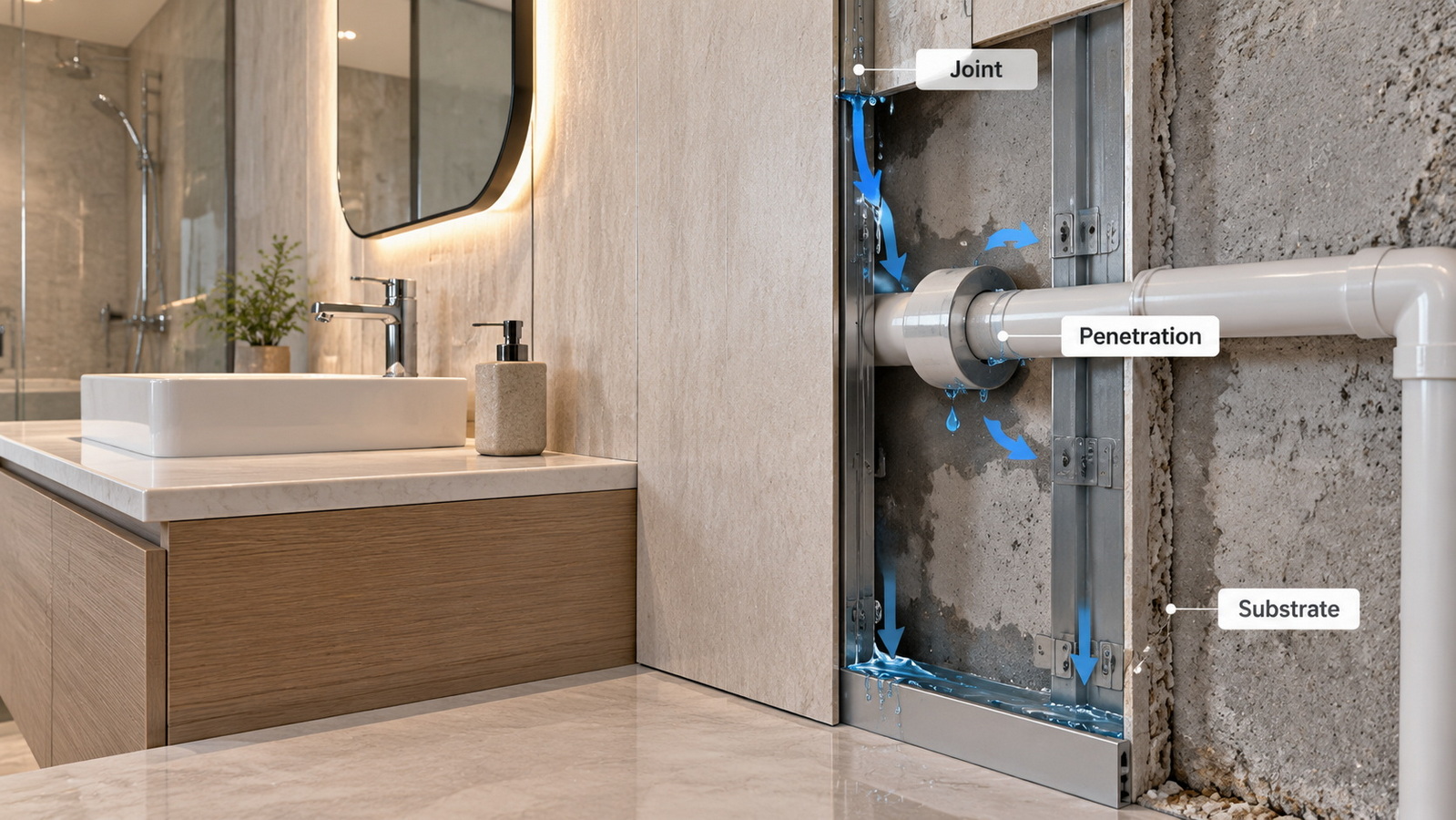
Even when a panel is described as waterproof, water may enter through:
- Open joints and perimeter gaps.
- Unsealed service penetrations.
- Damaged finishes or exposed edges.
- Junctions with floors, fixtures, and windows.
- Defects in the surrounding construction.
My recommendation is to evaluate two separate questions:
1. Can the panel tolerate the intended exposure?
2. Does the installed wall prevent moisture from reaching vulnerable layers?
Do not substitute decorative cladding for a required waterproofing system. For showers, steam rooms, or similarly demanding locations, obtain explicit approval for the complete assembly and intended use.
No decorative panel can compensate for an active leak or persistent condensation.
The U.S. Environmental Protection Agency recommends keeping indoor relative humidity below 60%, ideally between 30% and 50%, where possible. It also advises drying water-damaged materials within 24–48 hours.
These are moisture-management guidelines, not guarantees that a particular panel will remain mold-free.
A clean-looking surface can conceal damp adhesive, backing, framing, or wallboard. Therefore, a "mold-resistant" product claim should not replace substrate inspection.
Before installation:
1. Identify and repair leaks.
2. Assess dampness using methods appropriate to the substrate.
3. Investigate condensation risks.
4. Confirm ventilation and conditioning arrangements.
5. Obtain approval before covering affected construction.
For hotel renovations, this inspection can be more valuable than choosing a premium surface finish over an unresolved moisture problem.
Natural timber suits interiors where unique grain, tactile depth, and aging are central to the design.
Oak and walnut can create distinctive feature walls, although species selection should consider movement, finish compatibility, availability, and the room environment—not appearance alone.
Solid wood also offers repair potential. Whether it can be sanded or refinished depends on its thickness, profile, finish, and fixing method.
Do not extend that expectation automatically to thin veneer products.
Decorative composite systems can suit projects that need repeatable finishes across multiple rooms.
However, review physical samples under the project's actual lighting. Large walls may reveal pattern repetition, joint lines, gloss variation, or differences between flat and embossed surfaces.
For maintenance, request a written cleaning guide. Confirm compatibility with the hotel's detergents and cleaning methods rather than assuming every decorative film tolerates aggressive disinfectants.
If a damaged finish cannot be repaired locally, accessible panel replacement becomes an important design advantage.
Neither bamboo wood fiber panels nor natural wood should receive an assumed fire classification.
ASTM E84 measures surface-burning characteristics, including flame spread and smoke development. Its results do not establish a one-hour or two-hour wall assembly rating.
For commercial interiors, request a report identifying the tested:
- Product and manufacturer.
- Thickness and construction.
- Surface finish.
- Mounting arrangement.
- Relevant backing or substrate.
Confirm acceptance with the project's responsible designer or local authority. A report for a different panel construction may not support the proposed installation.
Natural wood, decorative laminates, coatings, adhesives, and engineered substrates should be assessed as a complete interior specification.
For applicable products entering the United States, EPA's TSCA Title VI requirements cover regulated composite wood categories, including MDF, particleboard, and hardwood plywood.
An E0 or E1 description alone does not demonstrate compliance with every destination market's requirements. Ask which standard was used, what was tested, and whether certification applies to the supplied product.
There is no reliable universal price advantage without a project quotation.
Compare total installed and maintained cost:
- Material + freight + preparation + accessories + labor + maintenance + repair disruption.
A low panel price may exclude trims, corner pieces, adhesives, wastage, or substrate correction. Conversely, a higher-priced system may simplify installation—but that benefit should be confirmed through an actual installation plan.
For hotels, include access and downtime. Replacing one damaged panel in an occupied corridor may be easier than repairing a permanently bonded feature wall.
Ask both suppliers to quote the same wall area, finish expectations, preparation scope, and accessory package.
Consider documented composite systems where repetitive cleaning, consistent appearance, and replacement access are priorities.
Use natural wood selectively where authentic material character contributes strongly to the guest experience and humidity can be controlled.
Neither choice removes the need for ventilation or moisture-safe detailing.
Natural wood can suit conditioned bedrooms, lounges, and feature walls.
For moisture-prone utility areas or walls near bathrooms, compare the actual composite specification with the proposed timber assembly. Keep splash exposure and concealed dampness separate from general room humidity.
Prioritize fire documentation, cleaning compatibility, repair access, and finish continuity.
For an entrance wall, inspect impact resistance and replacement arrangements. For a restroom-adjacent wall, investigate moisture pathways before selecting the decorative material.
This room-based approach is more useful than declaring one material suitable for every interior.
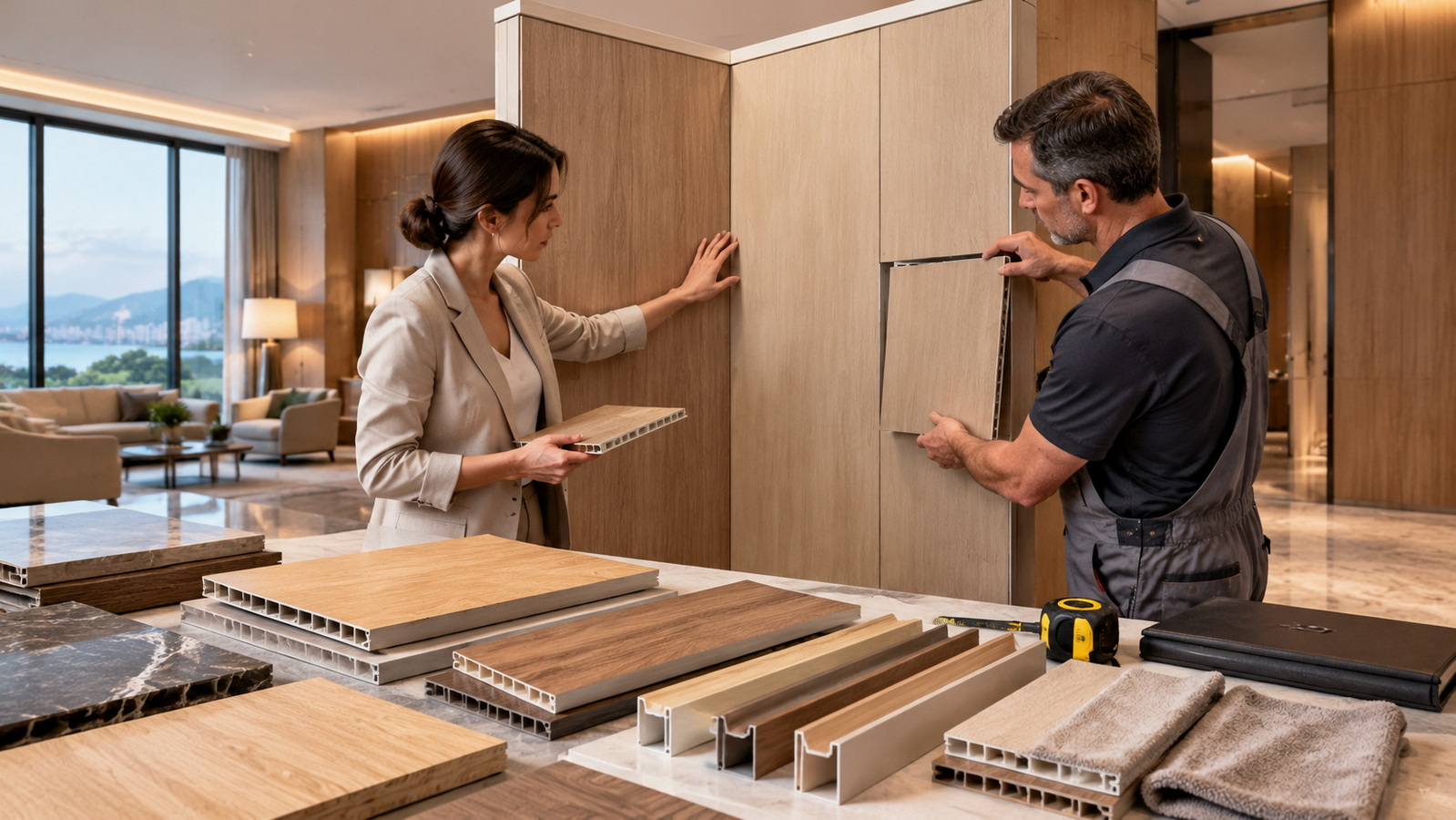
A small procurement trial can expose specification gaps before they become installation problems.
1. Define the exposure. Record whether the wall faces humid air, splashes, condensation, or direct wetting.
2. Verify the construction. Match the sample, technical sheet, quotation, and reports.
3. Build a representative mock-up. Include corners, joints, penetrations, and perimeter details.
4. Trial approved cleaning methods. Check appearance, residue, and finish compatibility.
5. Confirm repair and warranty terms. Establish replacement access, spare stock, and exclusions.
A site trial supports product selection; it does not replace laboratory testing or regulatory approval.
Binmao Decor is a Chinese integrated wall panel manufacturer with 14 years of experience, according to its supplied company profile. Its stated offering includes PVC wall panels, UV boards, and composite wall solutions for hotels, villas, and commercial interiors.
Available project options include customized dimensions and finishes, wood veneers, MDF-based constructions, PVC/WPC, PU, and acoustic backing structures.
These options should be specified individually rather than treated as having identical waterproofing, fire, or emissions performance.
Send Binmao Decor your room types, destination market, dimensions, finish preferences, and expected moisture exposure. Request a matched sample set, relevant product reports, installation guidance, and a quotation covering accessories.
For bamboo wood fiber wall panels specifically, confirm the available core formulation and application limits before approval.
Some formulations are marketed for moisture-resistant or waterproof applications. Confirm the specific product's evidence, edge details, joints, and installation limitations. The category name alone is insufficient.
They may be suitable in appropriately designed locations with controlled humidity and limited direct wetting. Species, finish, acclimatization, ventilation, and installation details all matter.
They do not eliminate building moisture problems. Leaks, condensation, and damp backing materials still require investigation, even when the visible panel resists moisture.
That depends on the finish and installation. Compare approved cleaning methods, repair options, replacement access, and maintenance intervals rather than relying on broad material claims.
Not automatically. Compare sourcing, material composition, manufacturing evidence, service life, repairability, transport, and realistic end-of-life options. A bamboo-related name does not establish a lower environmental impact.
Request composition details, dimensional specifications, relevant moisture and fire reports, applicable emissions documentation, installation instructions, cleaning guidance, and warranty terms matching the supplied product.
1. USDA Forest Products Laboratory. ["Drying and Control of Moisture Content and Dimensional Changes."] Technical guidance on moisture equilibrium, drying, dimensional movement, and moisture control during handling and installation. [research.fs.usda]
2. Oregon State University Extension Service. ["Wood and Moisture Relationships."] Source for the equilibrium moisture content ranges and explanations of wood movement and coating limitations. [extension.oregonstate]
3. U.S. Environmental Protection Agency. ["A Brief Guide to Mold, Moisture and Your Home."] Source for indoor humidity guidance and the recommendation to dry water-damaged materials within 24–48 hours. [epa]
4. U.S. Environmental Protection Agency. ["Moisture Control Guidance for Building Design, Construction and Maintenance."] Building-level guidance supporting the distinction between decorative materials and overall moisture management. [epa]
5. Intertek. ["ASTM E84: Standard Test Method for Surface Burning Characteristics of Building Materials."] Explains flame spread, smoke development, and the test's surface-burning scope. [intertek]
6. U.S. Environmental Protection Agency. ["Formaldehyde Emission Standards for Composite Wood Products."] Explains covered composite wood categories and third-party certification requirements. [epa]


