
Views: 246 Author: Sunny Publish Time: 2026-11-09 Origin: Site


Content Menu
● Bamboo Wood Fiber Wall Panels vs. Fluted Wall Panels
● What Are Bamboo Wood Fiber Wall Panels?
>> Where Smooth Composite Panels Fit Hotel Interiors
● What Are Fluted Wall Panels?
>> How Core Materials Change Fluted Panel Performance
● Appearance: Continuous Surfaces or Architectural Texture?
>> Smooth Panels for Quiet, Cohesive Interiors
>> Fluted Panels for Depth and Focal Points
● Moisture Resistance: Evaluate the Entire Wall Assembly
>> Waterproof Panels Do Not Automatically Create Waterproof Walls
>> Mold Prevention Requires Moisture Control
● Fire Performance: Compare Reports, Not Marketing Labels
>> Understand What the Classification Covers
>> Match Documentation to the Proposed Construction
● Acoustics: Decorative Grooves Are Not a Performance Rating
● Maintenance, Impact Exposure, and Replacement
>> Practical Maintenance Checks
● Indoor Air Quality and Environmental Claims
● A Hotel-Zoning Strategy: Use Both Panel Types Selectively
● Compare Installed Cost, Not Just Panel Price
>> Three Questions That Improve Cost Comparisons
● Specify a Coordinated Solution With Binmao Decor
● A Five-Step Hotel Wall Panel Approval Process
>> 1. Define Requirements by Zone
>> 2. Obtain a Product-Specific Submittal
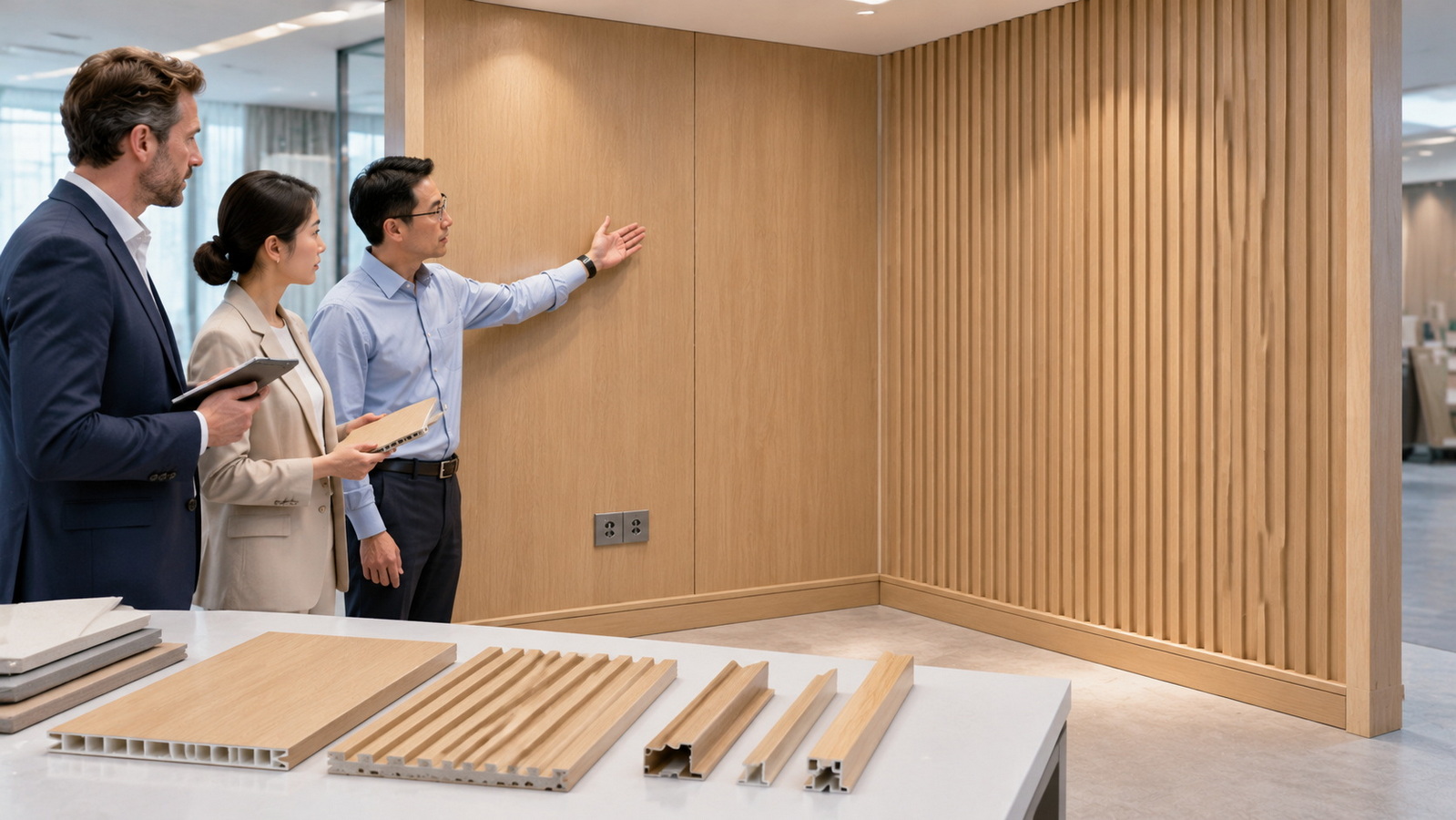
>> 3. Build a Representative Mock-Up
>> 4. Involve Operations Before Approval
>> 5. Establish Production Controls
>> Are bamboo wood fiber wall panels better than fluted wall panels?
>> Can bamboo wood fiber panels have a fluted surface?
>> Which wall panels are suitable for hotel bathrooms?
>> Do fluted wall panels reduce hotel noise?
>> Are bamboo wall panels automatically environmentally preferable?
>> Can smooth and fluted panels be combined?
Choosing between bamboo wood fiber wall panels and fluted wall panels for hotel design starts with an important distinction: one describes a material category, while the other describes a surface profile. They are not necessarily competing products. A bamboo wood fiber composite panel can also have a fluted face.
For hotel owners, architects, and procurement teams, the real decision involves appearance, moisture exposure, fire performance, maintenance, and installed cost. My recommendation is to compare the complete wall system—not simply two product names.
This guide focuses on smooth-faced bamboo wood fiber composite panels versus fluted decorative panels, while explaining where their specifications overlap.

The most useful comparison separates the panel's core material from its visible design.
| Selection factor | Smooth bamboo wood fiber composite panels | Fluted wall panels |
|---|---|---|
| Product identity | A composite material, often combining plant fibers, polymers, fillers, and additives | A ribbed or grooved profile available in different materials |
| Typical appearance | Broad woodgrain, stone-effect, or solid-color surfaces | Repeated vertical or horizontal lines with pronounced shadows |
| Material options | Formulation varies by manufacturer | MDF, wood veneer, PVC, WPC, PU, and other constructions |
| Visual role | Continuous backgrounds and coordinated wall coverage | Feature walls, reception backdrops, and decorative accents |
| Cleaning considerations | Flat surfaces generally simplify wiping | Recesses require additional attention |
| Moisture suitability | Depends on the complete formulation and installation | Depends primarily on the core, finish, and detailing |
| Acoustic potential | Requires a specifically engineered construction | Requires an appropriate backing and tested assembly |
| Cost comparison | Assess usable coverage and installed system cost | Include profile depth, trims, cutting, and detailing |
The central takeaway is specification: neither a bamboo label nor a fluted appearance proves waterproofing, fire compliance, acoustic performance, or environmental superiority.
In this article, bamboo wood fiber wall panels refer to decorative composites, not solid bamboo boards.
Products sold under this name may combine bamboo or wood fibers with PVC or another polymer, mineral fillers, additives, and a decorative surface. Recipes vary, so buyers should request a construction breakdown rather than assume every supplier offers the same material.
Smooth-faced panels are worth considering when the design calls for:
- Continuous woodgrain backgrounds.
- Large marble-effect feature surfaces.
- Coordinated guestroom wall finishes.
- Simplified cleaning access.
- Repetitive installation across multiple rooms.
From a specification perspective, their value lies in repeatability. A hotel needs consistent color, joint alignment, and replacement availability across an entire project—not just an attractive sample.
However, the material name alone does not establish durability. Core density, decorative film, surface coating, edge construction, and fixing method all deserve review.
Fluted wall panels feature repeated grooves or ribs that create depth and directional rhythm. They can be manufactured from several different substrates, with substantially different performance characteristics.
Common options include:
- MDF with a decorative film, paint, or wood veneer.
- PVC or WPC profiles.
- Real-wood components.
- PU decorative elements.
- Slatted constructions with an acoustic backing.
An oak-veneered MDF panel and a wood-effect PVC profile may look similar in photographs. Nevertheless, their exposed edges, moisture limitations, fastening requirements, and emissions documentation can differ.
For that reason, "fluted wall panel" should never be treated as a complete technical specification.
Smooth bamboo wood fiber composite panels can support a restrained hotel palette. Broad surfaces allow furniture, lighting, artwork, and signage to remain the main visual elements.
For guestrooms, this can be particularly useful around headboards and television walls, where several competing textures may make a compact room feel visually crowded.
My design recommendation is to assess the panel alongside the actual flooring, upholstery, and lighting temperature. A convincing standalone woodgrain sample can look very different within the finished palette.
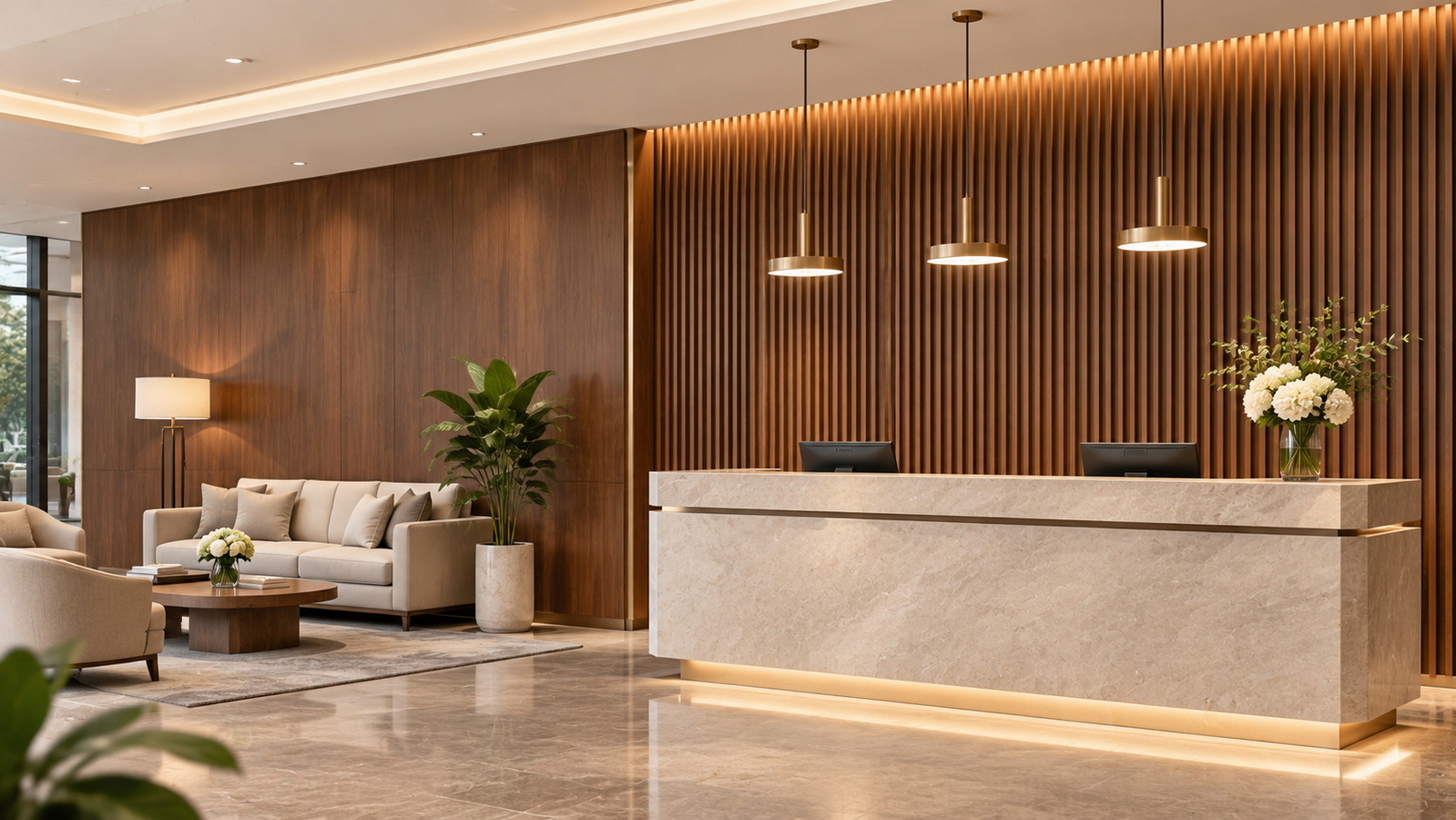
Fluted profiles suit locations where the wall should attract attention, such as a reception backdrop or lounge feature.
Their effect depends heavily on lighting direction, groove spacing, and profile depth. Grazing light can emphasize texture, but it can also reveal alignment errors and uneven substrates.
Approve a full-height sample section under the intended lighting. Include an internal corner, an outlet, and a termination detail—not just an uninterrupted panel face.
Hotels contain very different moisture environments. A conditioned guestroom, bathroom vanity area, and spa corridor should not automatically receive identical specifications.
PVC-based products may be suitable candidates for moisture-prone locations, but performance must be confirmed for the selected construction.
Even where the panel body is waterproof, water can potentially enter through:
- Unsealed joints.
- Cut edges and penetrations.
- Poorly detailed corners.
- Connections with floors or fixtures.
- Defective substrates behind the cladding.
Decorative panels should not replace a required waterproofing system unless the proposed assembly is specifically approved for that purpose.
A mold-resistant surface does not eliminate the risk of concealed moisture behind a wall.
Hotel specifications should address leaks, condensation, ventilation, and substrate condition. Avoid installing decorative cladding over unresolved dampness.
For MDF-based fluted panels, confirm the manufacturer's exposure limitations and edge-sealing requirements. For PVC/WPC alternatives, request water-exposure data and installation details rather than relying on a general "100% waterproof" description.
Fire safety deserves early review, particularly for corridors, public areas, and escape routes.
Under the International Building Code framework, interior wall finishes can be classified using ASTM E84 or UL 723, subject to applicable provisions.
Class A under that framework means a flame-spread index of 0–25 and a smoke-developed index of 0–450. It does not mean that a panel is noncombustible or that the wall provides a particular duration of fire resistance.
The classification required for a hotel depends on the applicable code, location, occupancy conditions, and other project factors.
Before approval, verify:
1. The exact product identification.
2. Core composition and thickness.
3. Decorative surface and backing.
4. Test method and classification.
5. Specimen mounting and substrate.
6. Whether the proposed installation falls within the report's scope.
Neither smooth bamboo composites nor fluted panels win this comparison automatically. The defensible choice is the documented product accepted for the intended application.
A fluted appearance alone does not demonstrate useful sound absorption.
If quieter lounges, restaurants, or meeting areas are a priority, request acoustic results for the complete proposed construction, including backing, cavity, and mounting arrangement.
Similarly, a smooth composite panel should not be presented as an acoustic solution without supporting evidence.
Also distinguish absorption from sound isolation. Managing reflections inside a lounge is different from reducing sound transmission between guestrooms. The latter requires assessment of the partition, doors, penetrations, and adjoining construction—not merely the decorative finish.
Hotel walls must remain presentable under repeated cleaning and daily use.
Smooth surfaces generally offer more straightforward wiping access. Fluted surfaces introduce recesses that housekeeping teams must reach, especially around low-level walls and furniture.
Rather than assuming one material is more durable, test representative samples against the hotel's actual operating conditions.
Ask housekeeping and engineering teams to evaluate:
- Approved cleaners and disinfectants.
- Surface marking and stain removal.
- Scratch visibility under room lighting.
- Exposed corners near luggage routes.
- Access for replacing individual sections.
- Availability of matching spare material.
For busy corridors, consider whether protective detailing is needed at trolley height. Decorative texture should not substitute for an impact-management strategy.
"Bamboo," "natural," and "low-emission" describe different things. One does not automatically prove another.
For regulated composite wood products supplied to the United States, EPA's TSCA Title VI framework covers hardwood plywood, MDF, and particleboard, including applicable products incorporated into finished goods.
Where relevant, request compliant panel documentation and supply-chain records. An E0 or E1 designation alone should not be treated as proof of compliance with a different jurisdiction's requirements.
For either panel category, environmental evaluation should consider:
- Verified material composition.
- Relevant emissions testing.
- Adhesives and surface treatments.
- Documented recycled content.
- Expected replacement requirements.
- Realistic local end-of-life options.
My recommendation is to favor specific, verifiable statements over broad claims such as "completely eco-friendly."
The following is a planning example, not a completed project case study.
| Hotel zone | Suggested design approach | Priority check |
|---|---|---|
| Reception backdrop | Fluted feature section | Lighting, alignment, and fire documentation |
| Guestroom headboard | Smooth composite, optionally framed with fluted accents | Cleanability and outlet coordination |
| Guest corridor | Durable, replaceable wall system | Required fire classification and impact exposure |
| Bathroom vanity area | Documented moisture-suitable construction | Joints, edges, substrate, and splash exposure |
| Restaurant or lounge | Decorative panels coordinated with acoustic treatment | Tested acoustic construction where needed |
| Meeting room | Finish selected around the acoustic design | Absorption requirements and service access |
This approach avoids forcing one product into every location. It also lets the design team reserve more intricate detailing for areas where guests will notice it most.
A fair quotation compares equivalent finished coverage.
A narrow fluted profile quoted per linear meter cannot be directly compared with a broad panel quoted per square meter. Confirm effective coverage after joints and overlaps before calculating quantities.
Use this framework:
Installed cost = panels + trims + substrate preparation + fixing materials + labor + wastage + logistics.
Also evaluate replacement access and the potential operational disruption of future repairs.
1. Does the quotation include corners, end caps, and matching profiles?
2. How much usable coverage remains after cutting around doors and services?
3. Can damaged sections be replaced without dismantling adjacent finishes?
Without matched specifications and installation assumptions, a universal claim that one category is cheaper would be misleading.
Based on the supplied company background, Binmao Decor brings 14 years of manufacturing experience to integrated decorative wall panels for hotels, villas, and commercial interiors.
Its stated capabilities include PVC and UV panels, composite constructions, E1/E0-grade MDF options, oak and walnut veneers, PVC/WPC, PU, and acoustic-backed configurations.
These options allow buyers to coordinate smooth backgrounds and fluted features within one design package. However, waterproofing, mold resistance, flame retardancy, and other performance claims should always be checked against the selected product's documentation.
Send Binmao Decor your wall elevations, project location, application zones, target finishes, and performance requirements. Request a coordinated sample package, proposed installation details, relevant test reports, and an itemized quotation before placing the production order.
Record moisture exposure, cleaning frequency, fire requirements, visual intent, and acoustic objectives.
Request construction details, dimensions, tolerances, relevant reports, installation instructions, and warranty terms.
Include a corner, socket, joint, trim, and connection with the skirting or floor finish.
Ask housekeeping to clean the sample and engineering staff to inspect fixing access and replacement procedures.
Agree on an approved reference sample, acceptable appearance variation, packaging, batch identification, and spare-material requirements.
Neither is inherently better. Bamboo wood fiber describes a material category; fluted describes a profile. Compare the actual core, finish, construction, and intended hotel application.
Yes. Bamboo or wood fiber composites can be manufactured with fluted profiles. The categories overlap rather than forming a strict either-or choice.
Select products explicitly documented for the intended exposure. Check joints, penetrations, substrates, and installation instructions. A waterproof panel body alone does not establish a waterproof bathroom assembly.
Not necessarily. Request acoustic evidence for the complete assembly. Decorative grooves alone do not establish absorption performance or sound isolation between rooms.
No. Assess composition, emissions documentation, service requirements, and end-of-life options. Bamboo content alone does not establish the environmental performance of a composite product.
Yes. Smooth panels can provide continuous backgrounds, while fluted sections create focal points. Coordinate color, thickness, trims, and transitions through a representative mock-up.
1- International Code Council. "2024 International Building Code, Chapter 8: Interior Finishes." Basis for the discussion of interior-finish fire-performance requirements and alternative testing provisions. [codes.iccsafe]
2- International Code Council. "Interior Wall and Ceiling Finishes—Section 803.1.2." Classification criteria supporting the Class A flame-spread and smoke-developed figures. [codes.iccsafe]
3- U.S. Environmental Protection Agency. "Formaldehyde Emission Standards for Composite Wood Products." Regulatory scope, certification, and labeling background. [epa]
4- U.S. Environmental Protection Agency. "Frequent Questions for Regulated Stakeholders About Implementing the Formaldehyde Standards for Composite Wood Products." Clarifications concerning MDF, bamboo-containing regulated products, and finished goods. [epa]
5- International Code Council. "ICC Performance Code, Chapter 8: Moisture." Background on moisture penetration, mold risks, and damage to building materials. [codes.iccsafe]
6- QMB Materials. "Bamboo Fiber WPC Wall Panels." Commercial terminology illustrating bamboo-fiber composite wall-panel categories; not independent evidence of performance. [qmbmaterials]


